Why is it essential?
- It gives the doctor a chance to see the child directly in unstructured situations. After some time to settle in, children show their usual play behaviour (or lack of play) and other worrying behaviours.
- It clarifies points raised in the parent interview - whether a behaviour is really present, and whether it is normal.
- Situations can be set up if needed. For example, when the parent / doctor says "look" and directs attention to an interesting toy, we learn whether the child understands that gesture.
- It adds to the parents' report. Parents know the child better than anyone and are well used to the child's behaviour. But they unknowingly make up for the child's subtle deficits - for example, standing right in front of and close to the child when calling his name so that he looks into their eyes.
- The child's way of interacting with family members and with unfamiliar adults can be seen (this is not compulsory, but should be done if possible).
Direct observation assessment checklist (ASD)
The checklist records the child's name, the date of assessment, who did the interview / observation, and who gave the information. Each behaviour has 4 columns: Observed, Reported, Not Observed, Don't Know.
| Area | Behaviours observed (examples) |
|---|---|
| Social competence | Clear deficit in non-verbal cues / gestures; little joint attention and sharing of interests; rarely starts social action; appropriate imitation is rare; weak social reciprocity; does not enjoy social games such as peek-a-boo; few appropriate relationships with peers; little interest in other children; difficulty making / keeping eye contact; does not look at an object pointed at |
| Communication | Echolalia (repetitive / non-functional speech); delayed or absent speech; does not point to show interest or wants; little response to language / seems deaf; little intention to communicate; cannot start / keep up a conversation; no varied pretend / social imitative play; odd pitch, rhythm and tone of voice; cannot generalise word meanings; pronoun reversal; rarely asks "what, where, why" questions |
| Behaviour patterns | Interest in parts of objects (for example, wheels); improper use of objects; rigid about routines / rituals / social rules; negative reaction to change / transitions; absorbed in topics / details / patterns; stereotyped movements; unusual interest in, or unusual avoidance of, sensory stimuli |
| Environment (home / school / clinic) | Demands too high; overwhelming stimuli; no direct teaching of social interactions; need for more positive teaching interactions; needs help to identify extra reinforcers; inconsistency across people / places; weak cooperation |
| Cognitive / developmental | Unusual rate or order of development; weak abstract thinking / over-selectivity; delayed intellectual development; difficulty seeing from another person's point of view |
| Physical / motor | Gross motor clumsiness; fine motor clumsiness; toe walking |
| Play / leisure | Weak imaginative / symbolic / pretend play; does not play properly with toys |
| Academic skills | Cannot apply facts properly; cannot work independently; difficulty following tasks in sequence |
| Self-help | Difficulty dressing, eating and using the toilet; unusual / difficult sleep pattern; dangerous / unsafe behaviours |
| General / vocational | Difficulty following instructions; difficulty working independently; tantrums; physical aggression; difficulty following general rules; self-injurious behaviour |
Play environment
- Because the functioning levels of these children vary a great deal, toys should suit different developmental levels (sensory, functional, symbolic).
- Materials should be suited to the child's age and gender.
- Information received before the assessment guides the choice of materials - the child should not be overwhelmed, nor should the challenge be too low.
- The closer the toys are to the child's level of functioning and interest, the greater the chance of seeing his real behaviours and usual play.
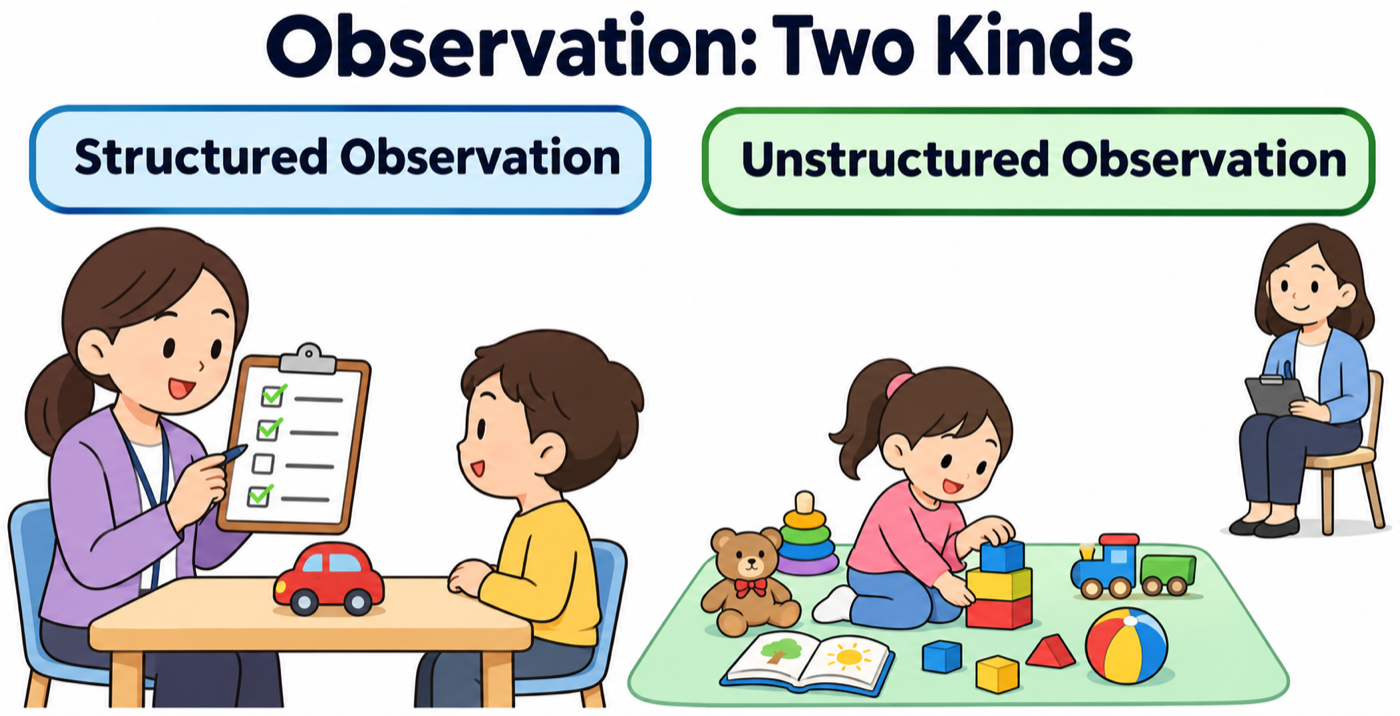
Degree of structure: structured and unstructured observation
| Point | Structured observation | Unstructured observation |
|---|---|---|
| What it does | The doctor can press to bring out specific behaviours common in children with ASD | The child's usual behaviours and use of play materials are seen without adult demands or interference |
| Advantage | Symptoms can be recorded in a more standard way; if psychometric data exist, the child can be compared with similar children; response to future intervention can be seen easily | A more representative sample of the child's usual behaviour; behaviour seen naturally, not in response to special pressure, for judging the level of functioning |
| Drawback | Usual behaviour may be suppressed by non-cooperation, new materials, or difficulty changing activities and partners | Specific behaviours may not appear |
- Observations should include both.
Observation domains
A naturalistic setting should be arranged so that the child can mix with the surroundings and with others as comfortably as possible. The specific behaviours observed are 9:
- Turn-taking
- Shared attention
- Social reciprocity
- Pretend play
- Sustained interaction
- Giving / showing on his own
- Imitating new actions
- Shifting attention to where the examiner directs
- Use of toys and objects
Exam focus: Direct observation adds to the parents' report; parents unknowingly make up for the child's deficits. The checklist has 4 columns: Observed, Reported, Not Observed, Don't Know. Structured = specific behaviours, standard recording; unstructured = natural, representative behaviour. Both are needed.
Memory code: "ORND" - the checklist columns: Observed, Reported, Not observed, Don't know. "Structured = Specific, Unstructured = Usual".