Differential assessment means using tests to decide whether the child's features are really due to ASD or to another condition that looks like autism, and to check whether another condition is present along with ASD. (The differences between the features of autism and intellectual disability were covered in the chapter "Nature, Types and Characteristics"; here we see how to test for them and tell them apart.)
Why differential assessment?
- Autism has no specific medical test, and its features also appear in other conditions. For example, not responding to one's name is also seen in hearing loss.
- A wrong diagnosis leads to the wrong intervention. Knowing the correct cause makes genetic counselling, treatment and prediction of the future possible.
- For this, the interdisciplinary team, the history, the physical-neurological examination, laboratory tests and cognitive-adaptive assessment are all used together. Tools such as the ADI-R are especially useful for separating autism from other developmental disorders.
Which condition is separated by which test?
| Condition that resembles / occurs with autism | Assessment / test that separates it | Key sign to look for |
|---|---|---|
| Hearing loss | Hearing screening, audiologist's assessment; ABR / BERA under sedation if needed | Whether the lack of response to language is due to hearing loss; newborn screening is not enough |
| Visual impairment | Functional vision screening, eye examination | Squint, long-sightedness, short-sightedness |
| Intellectual disability / global developmental delay | Cognitive + adaptive behaviour assessment | If the social and communication deficits match the overall cognitive level, it is not ASD (see the example of a 4-year-old functioning at a 12-month level) |
| Rett's disorder | MECP2 genetic test | If the features resemble Rett's |
| Fragile X syndrome | Fragile X DNA probe (FMR1); physical examination | Prominent ears, long face, high palate; appears in many different ways in the family |
| Tuberous sclerosis | Skin examination, physical examination | Ash-leaf spots, facial lesions, seizures |
| Foetal alcohol syndrome | History + physical examination | Mother's history of alcohol use, facial features, growth deficiency |
| Congenital infections (cytomegalovirus) | Prenatal history, physical examination | Small head, hearing loss appearing later, enlarged liver |
| Chromosomal disorders | High-resolution karyotype, FISH | Major chromosomal changes |
| Landau-Kleffner syndrome | Sleep EEG / video EEG | Gradual loss of receptive and expressive language that was present until then |
| Seizure disorder | EEG | History of seizures, regression |
| Degenerative neurological disorders | Urine organic acids test | Gradual loss of skills |
| Metabolic disorders | Metabolic screening, amino acid chromatography | Cyclic vomiting, protein intolerance |
| Lead poisoning | Lead screening | Pica |
| Thyroid problem | Thyroid test | Growth deficiency |
| Language disorder / Social (Pragmatic) Communication Disorder | Language assessment, observation | If restricted, repetitive behaviours are absent, it is not ASD |
Steps of differential assessment
- History: health, developmental and family history - regression, seizures, genetic conditions in the family.
- Physical and neurological examination: physical signs of syndromes, neurological abnormalities.
- Sensory testing: ruling out vision and hearing problems early.
- Laboratory and genetic tests: only those the history points to.
- Direct observation + standard tools: such as ADI-R, ADOS, CARS, ISAA.
- Cognitive and adaptive assessment: whether the deficits match the overall level or not.
- Team synthesis: the interdisciplinary team together gives the diagnosis and intervention recommendations.
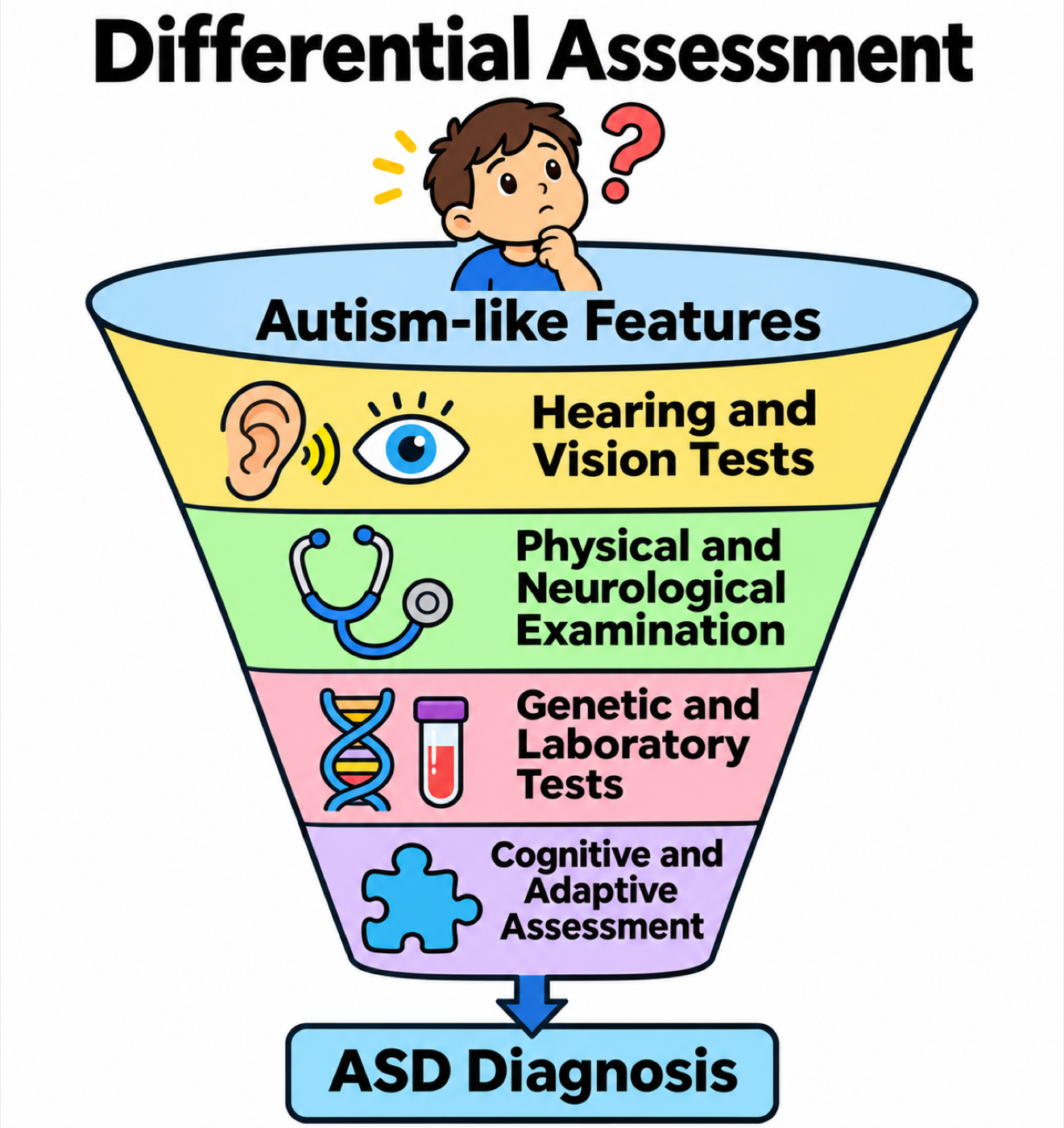
Exam focus: Differential assessment = separating ASD from conditions that resemble it. Hearing loss → audiology; intellectual disability → cognitive + adaptive assessment; Rett's → MECP2; Fragile X → FMR1 DNA probe; Landau-Kleffner → sleep EEG. It is ASD only if the deficits do not match the cognitive level.
Memory code: "HIRFL" - Hearing loss (audiology), Intellectual disability (cognitive), Rett's (MECP2), Fragile X (FMR1), Landau-Kleffner (sleep EEG) - the five main look-alikes of autism.