What is assessment?
- In special education, assessment is the process of collecting information about a student to identify his disability and special learning needs, and to help decide whether he is eligible for special education services.
- According to Swanson and Watson (1989), assessment, like evaluation, is a problem-solving process.
- Gearheart and Gearheart (1990) and Pierangelo and Giuliani (2006) described the many ways of collecting information about students.
- Referral / intervention decisions, classification and placement decisions (where the child should study) all come out of this problem-solving process called assessment.
- The first step in assessment is deciding its purpose. The purpose depends on the question asked, the person who referred the child (the referral source) and the setting of the assessment (school, clinic, residential centre).
- The American Psychiatric Association (APA) gave the diagnostic criteria for Autistic Disorder, Asperger's Disorder, other Pervasive Developmental Disorders and mental retardation in DSM-IV-TR in 2000. Diagnostic assessment was based on these criteria. (Today the DSM-5 criteria are used.)
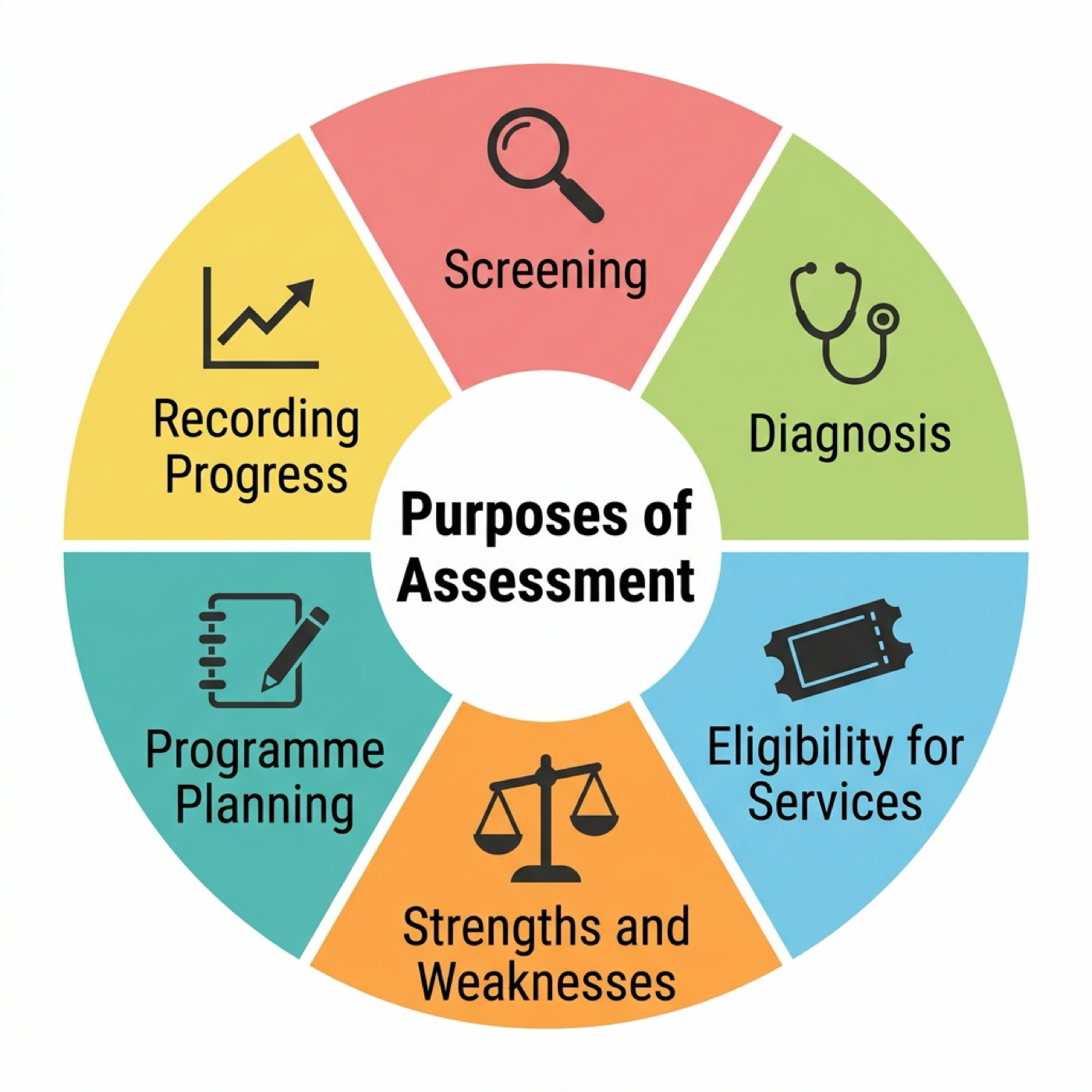
Purposes of assessment
| Purpose | Meaning |
|---|---|
| Screening | Picking up early signs in children who may have a deficit within the ASD range |
| Diagnosis / identification | Deciding which disorder is present |
| Eligibility for services | Deciding whether the child is eligible for special education services |
| Assessing strengths and weaknesses | Finding out strengths, weaknesses and emotional health |
| Intervention / programme planning | Planning what and how to teach; information for good curriculum teaching |
| Recording and reviewing progress | Recording and checking how well the intervention has worked |
Tests: two kinds
- Norm-Referenced Tests (NRT): compare the child's score with the average of other children of the same age.
- Criterion-Referenced Tests (CRT): check against a fixed standard whether the child has learnt a particular skill.
- Which test to choose depends on the purpose of the assessment. Tests are not the only way to find a student's level; informal assessments also exist.
Types of assessment (approaches used with children with autism)
| Type | What is done |
|---|---|
| 1. Clinical Assessment | Measuring with checklists and scales such as CARS, CHAT, ADI-R and ISAA in a medical / clinic setting; hence "clinical" |
| 2. Behavioural Assessment | Understanding complex behaviour in simpler parts using the ABC model (Antecedent - Behaviour - Consequence) |
| 3. Observational Assessment | Systematic observation of behaviour; helps monitor whether teaching methods are working. Two kinds: formal and informal |
| 4. Educational Assessment | Tests are selected according to the purpose: NRT, CRT |
| 5. Functional Assessment | Working out the purpose of a behaviour (what the child is trying to achieve with it) |
Previous papers questions asked in the exam on what you just read
This is not related to clinical assessment of children with Autism Spectrum Disorder
- (1)Clinical assessment
- (2)Observation assessment
- (3)Economic assessment
- (4)Behavioural assessment
Answer & explanation
Correct answer: (3) Economic assessment
The question asks which type of assessment has nothing to do with assessing a child for Autism Spectrum Disorder (ASD).
ASD assessment includes clinical assessment by doctors and psychologists, observation of the child in natural settings such as home and classroom, and behavioural assessment using checklists and rating scales. These look at social interaction, communication and repetitive behaviour. The family's income or economic condition does not decide whether a child has ASD. So the answer is option (3) Economic assessment.
Options (1), (2) and (4) are all regular parts of ASD assessment. Since Autism shows itself through behaviour, observation and behavioural assessment are especially important.
Remember: ASD is assessed through behaviour, not money.
Exam focus: Assessment is a problem-solving process (Swanson and Watson, 1989). First step = deciding the purpose. Autism assessment has 5 types: clinical, behavioural, observational, educational, functional; "financial assessment" is not in this list. Behavioural assessment = ABC model; educational assessment = NRT, CRT; observation = formal, informal.
Memory code: "CBOEF" ("Can Bright Observers Explain Function?") - Clinical, Behavioural, Observational, Educational, Functional. For the six purposes, "SDE-SPR" - Screening, Diagnosis, Eligibility, Strengths, Planning, Recording progress.