The first important area in autism assessment is collecting the child's history. It has three parts: the child's health history, the developmental and behavioural history, and the family medical and mental health history.
Child health history: who collects it, and how?
- It includes the history from before pregnancy to delivery, the child's full health history (including a review of old medical records) and the family health history.
- It may be collected by a doctor or by another suitably trained health professional (a paediatric nurse, a medical social worker), but the information must be reviewed by a doctor.
- A health history questionnaire may be used, but the key points must be clarified in a face-to-face interview.
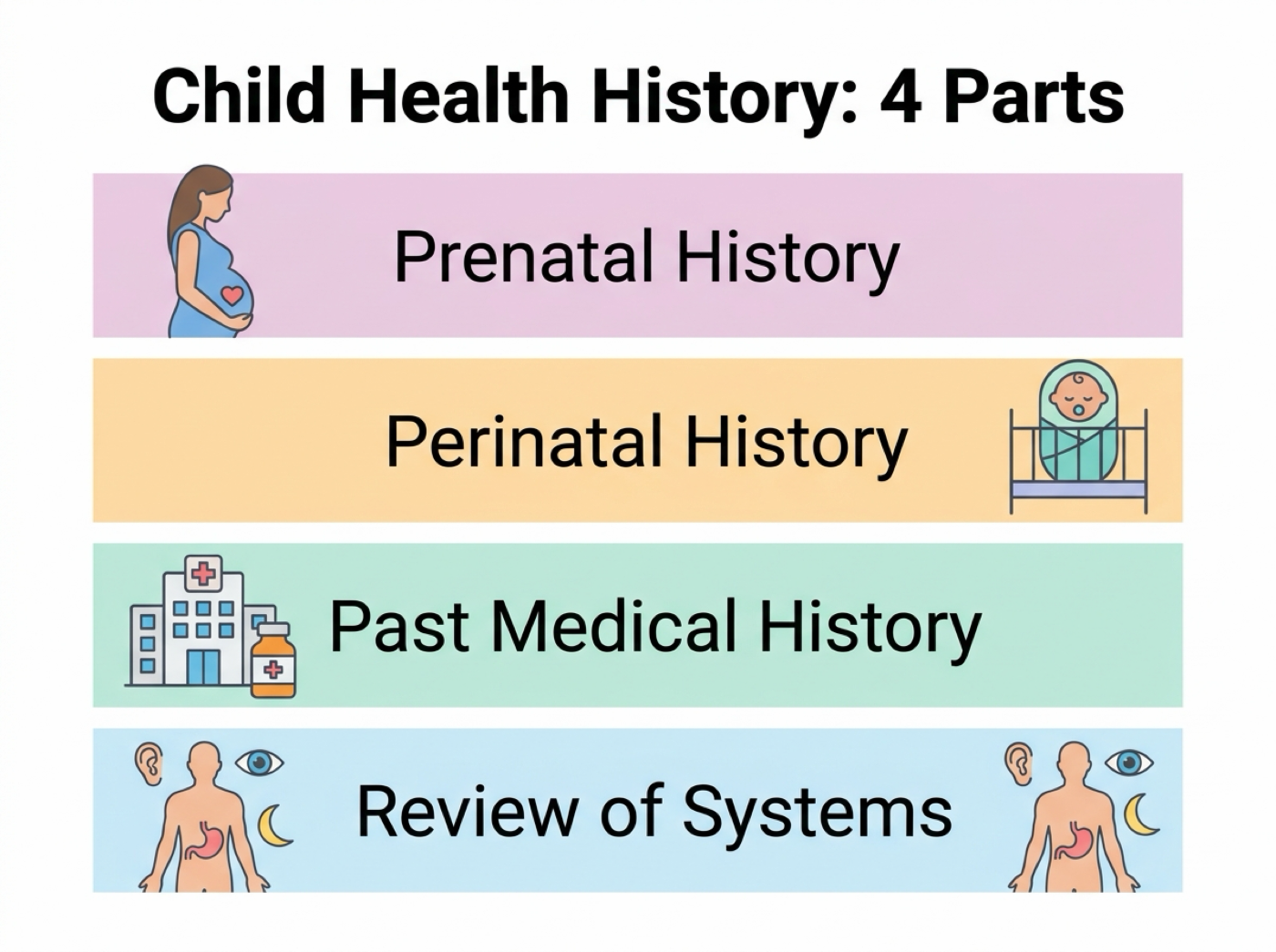
Four parts of the health history
| Part | What is asked | Why |
|---|---|---|
| A. Prenatal history | Earlier pregnancies, miscarriages | Earlier miscarriages may point to genetic disorders |
| Illnesses during pregnancy | Infections such as cytomegalovirus and toxoplasmosis damage the development of the foetus | |
| Medicines taken during pregnancy | Effect on the baby's development; for example, mothers with epilepsy are often given anti-seizure medicines | |
| B. Perinatal history | Length of pregnancy, when labour began, problems during delivery | For example, if a caesarean section was done, check whether it was due to foetal distress and look for signs of oxygen shortage in the baby (foetal hypoxia) |
| Weight, length and head circumference at birth | Show whether there was growth delay in the womb and what the gestational age was | |
| How the newborn period went | Shows when later developmental problems began; for example, early feeding difficulties may be due to a neurological problem in coordinating sucking and swallowing | |
| C. Past medical history | Hospital admissions, surgeries, serious injuries | Especially head injuries with loss of consciousness |
| Earlier illnesses | For example, repeated vomiting and dehydration may be due to a defect in amino acid metabolism | |
| Seizures | A significant share of children with ASD (about 30%) develop seizure disorders over time | |
| Infectious diseases, immunisation status | To check for immune deficiencies | |
| Diet information | Many children with ASD are on a restricted diet, by their own choice or as part of treatment; check whether there is a nutritional risk from too few nutrients and calories | |
| Allergies | How they were identified, how they show in the child, whether more tests / treatment are needed | |
| Medicines used earlier | Prescription and non-prescription medicines; behavioural effects as well as medical effects; whether a paradoxical effect on behaviour was seen | |
| Developmental regression | Many children with ASD seem to develop normally for some time; careful questioning may show that signs were present earlier. Record which skills were present earlier and at what age, and compare them with present functioning | |
| D. Review of systems | Signs of disease in all body systems | Whether there are underlying medical disorders |
| Sleep | Many children with ASD have sleep disorders, such as difficulty falling asleep and waking at night; these disturb the child's and the family's functioning | |
| Hearing, vision | Many children with developmental disorders have hearing and vision problems; find out the parents' concerns, earlier tests (method, child's cooperation, results) and sensory over-sensitivity | |
| Diarrhoea, constipation | Some children with ASD have gastrointestinal problems |
Developmental and behavioural history (parent interview)
- The parent interview should cover the child's developmental history, behavioural history and present functioning.
- Information is collected by a questionnaire or a direct interview; in practice, using both together is best.
- Information that is easy to identify and verify goes in the questionnaire: developmental milestones, motor skills, eating and sleeping patterns, earlier tests and treatments. When these are known beforehand, more interview time is left for present concerns and details of the diagnostic criteria.
Areas recorded in the interview:
- First concerns about the child's development - not only the parents' but also those raised earlier by relatives or the primary doctor; and how the parents understood events at that time (moving house, illness, day-care experience).
- The infant's temperament.
- Social-emotional milestones - baby games (pat-a-cake, "peek-a-boo"), eye contact during feeding and play, shared attention, greetings. Giving a reference point such as "the first birthday" helps parents remember.
- Sensory abnormalities - the doctor should give examples so that parents can tell normal patterns from unusual ones. (For example, hand-flapping and jumping are common in many children who cannot yet talk; children react this way to exciting stimuli such as children's TV characters.)
- Eating and sleeping problems or patterns.
- Fine and gross motor development and milestones.
- Unusual interests and activities.
- Interest in other children / siblings.
- The pattern of attachment to caregivers.
- The ability to use non-verbal means of communication such as gestures and facial expressions.
- The intention to communicate, both with and without words.
- Favourite activities and games.
- Other important features, such as loss of skills or worsening behaviour.
Family medical and mental health history
- The aim is to find out whether medical, developmental or mental disorders that relate to the present concerns, or that help in differential diagnosis, exist in the family.
- Many genetic conditions show up differently in members of the same family. For example, tuberous sclerosis often arises from a new genetic change (mutation); Fragile X syndrome may appear in many different ways in family members.
- Special attention should be paid to family members with developmental disabilities or metabolic disorders, or who died at a young age.
Exam focus: The 4 parts of the health history: prenatal, perinatal, past medical history, review of systems. About 30% of children with ASD develop seizures over time. Prenatal infections: cytomegalovirus, toxoplasmosis. For the developmental history, a questionnaire + interview together is best. Even if a health professional collects it, a doctor must review it.
Memory code: "Pre - Peri - Past - Review" - Prenatal, Perinatal, Past medical history, Review of systems. "Seizures = 30" - about 30% of children with ASD develop seizures.