The TEACCH programme
- TEACCH stands for Treatment and Education of Autistic and related Communication-handicapped Children.
- It was developed at the University of North Carolina at Chapel Hill, USA.
- It serves children with autism and related disorders from preschool age onwards. It creates a highly structured learning environment in school and teaches skills individually, matched to the child's developmental level.
- The general skill areas it develops: communication, socialisation, and practical (everyday) skills for independence.
What is structured teaching?
- It is a method that designs teaching strategies and changes the environment to make the world more meaningful for children with special needs.
- It can be used at every developmental level. It does not limit the curriculum; it is only one part of the curriculum.
- It rests on an understanding of the nature of autism and its particular features. It reduces the child's stress, anxiety and frustration, and corrects behaviour problems by providing a meaningful environment.
Why use structured teaching?
- It uses the child's visual strength and helps him focus on the important information in the environment.
- It makes the environment orderly and predictable.
- It builds in routines and makes things familiar.
- It stresses and teaches the idea of "finished".
- It focuses on developing independent skills.
Four parts of structured teaching
| Part | What it includes |
|---|---|
| Physical structure | Clear physical and visual boundaries; few visual and auditory distractions; separate areas for snacks, play, transition and work |
| Daily schedule | Shows visually, in a way the child understands, which activity happens and in what order; there must be a way to show that each activity is "finished" |
| Individual work system | An organised way of receiving and understanding information; a routine that answers four questions |
| Visual structure | Teaching the child to look at the visual cues that give a task its meaning; showing what to do with materials; both visual instructions and visual organisation |
The 4 questions an individual work system answers:
- What work?
- How much work?
- When will it be finished?
- What happens next?
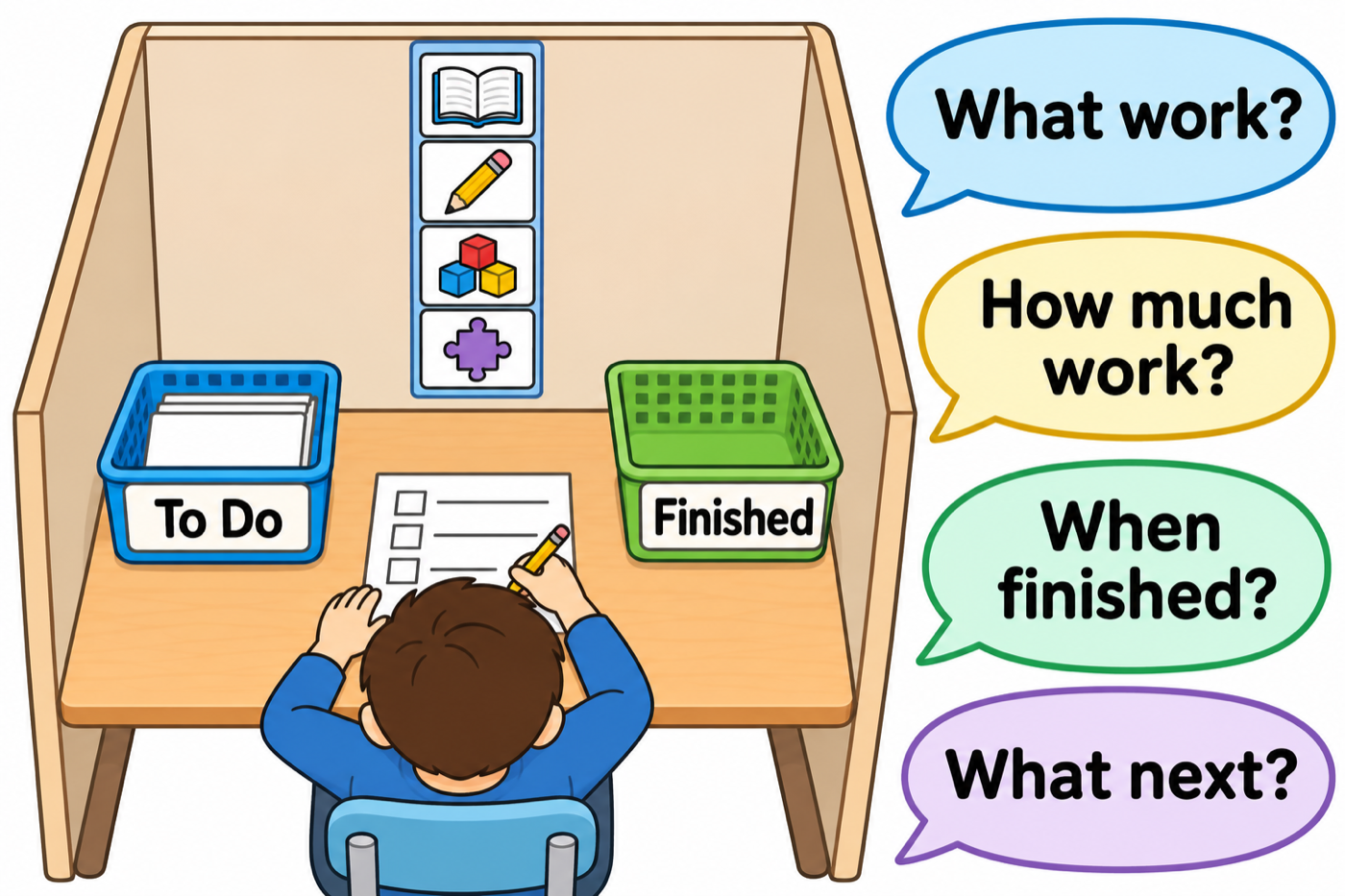
Physical structure: how to arrange the classroom
- A student with ASD sees the world differently and has particular sensory difficulties. So school and the classroom may feel confusing and overwhelming to him.
- Boundaries such as rugs, bookshelves, dividers and study carrels (small work booths) mark each area visually. The student then knows which work happens where and where things are kept.
- Give a separate place for quiet activities and individual work.
- Signs, labels, schedules and choice boards show the rules of each area visually.
- Reduce distractions: bright lights, bells ringing, children's loud voices, chairs scraping on the floor, projectors and the humming of computers.
Routines
- When information is given in a highly predictable way, as a routine, students with ASD respond more socially and focus more on learning.
- They are easily upset by even a small change in the daily schedule. Having no routine at all also leads to distress.
- Example: a routine for independent work - "first work, then break". A routine for large-group teaching - first the teacher gives the lesson, then group practice questions, then independent work, and finally a break.
- Routines also help in teaching functional, leisure and vocational skills.
- A routine becomes a problem when the student's insistence on sameness becomes excessive and negative behaviour starts when something changes. To reduce this stress, prepare the student before the change with transition strategies, role play and visual supports.
Visual supports and activity schedules
- Students with ASD have strong visual skills. Organising teaching and materials visually makes use of this strength.
- Examples: activity schedules, calendars, rules posted on the wall, choice boards.
- Activity schedule = a set of pictures or words that cues the student to take part in an activity. Depending on the student's age and ability, it may be a three-ring binder with one activity on each page, a picture schedule for half the day or the whole day, or something as complex as a day planner or a personal digital assistant (PDA).
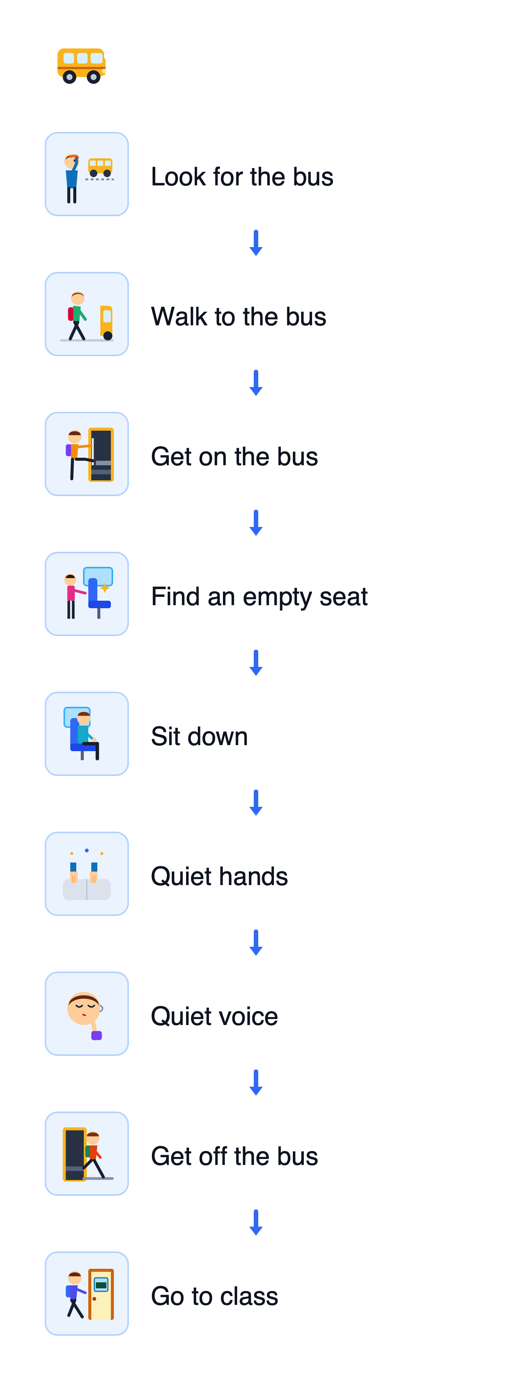
- Mini schedule = pictures or words that show the separate steps of a complex task.
- Example: a "bus to school" mini schedule - look for the bus → walk to the bus → get on the bus → find an empty seat → sit down → quiet hands → quiet voice → get off the bus → go to class.
- Researchers such as Quill (1995) and Hodgdon (1995) suggested that visual methods suit children with autism well. Children with autism have strengths in concrete thinking, rote memory and understanding spatial relationships.
Exam focus: TEACCH = University of North Carolina (Chapel Hill); structured teaching; from preschool age. 4 parts of structured teaching: physical structure, daily schedule, individual work system, visual structure. 4 questions of the work system: what work, how much work, when finished, what next. Children with ASD have a strong visual sense.
Memory code: Structured teaching "Please Do It Visually" - Physical structure, Daily schedule, Individual work system, Visual structure. Work system questions "What - How much - When - What next".