Autism must be told apart from other conditions that look close to it. (Detailed differential assessment is in the chapter "ASD: Identification and Assessment".)
Autism and Intellectual Disability
- Autism and Intellectual Disability are two separate conditions. Some people have intellectual disability along with autism.
- Autism affects a person's learning style, not the level of intelligence.
- Population studies by Lorna Wing and her colleagues at the Medical Research Council - Social Psychiatry Unit in London brought out the "core" features of autism (the triad); they showed that the social deficits of autism are seen more in children with low IQ.
| Aspect | Autism (ASD) | Intellectual Disability |
|---|---|---|
| Main deficit | Social interaction, communication, rigidity in behaviour | Intellectual functioning (reasoning, learning, problem solving), adaptive behaviour |
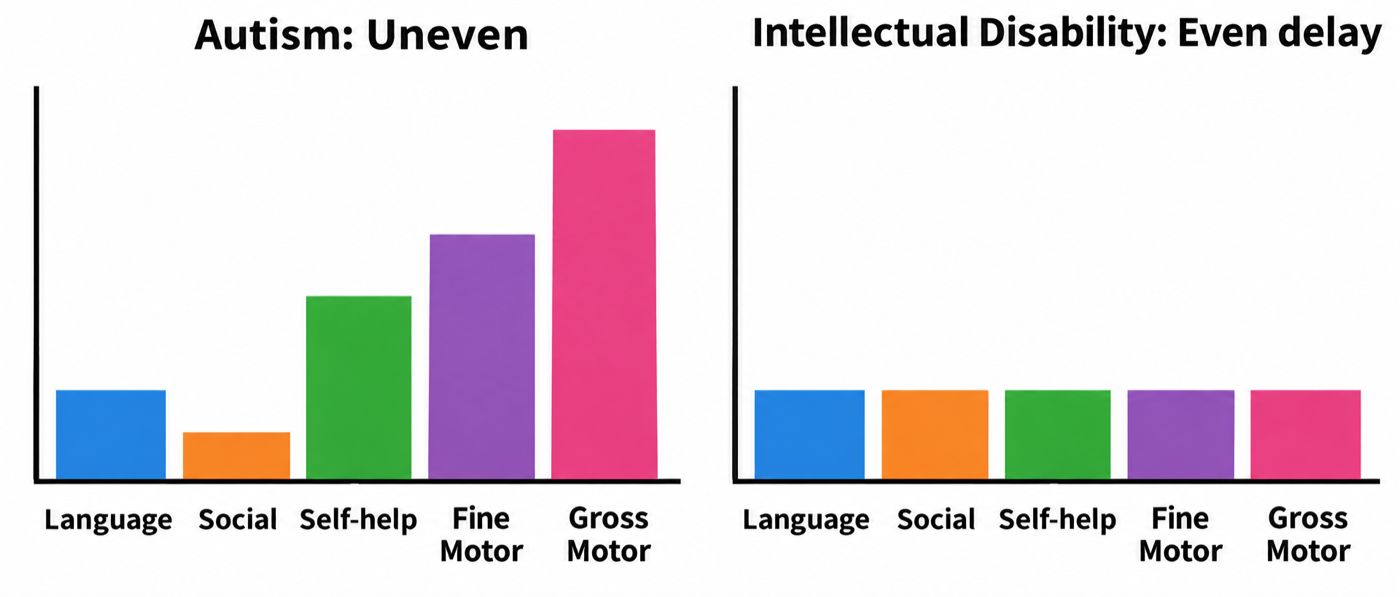
| Pattern of development | Uneven - some skills ahead of age, some far behind; there may be special talents (splinter skills) | Delay almost equal in all areas |
| Social and communication skills | Well below the intellectual level | In line with the intellectual level; usually better social skills than in autism |
| Motor skills | Gross motor skills are often good | Usually delayed like everything else |
| Repetitive / stereotyped behaviour | A main feature | May be present but not a main feature |
| RPwD Act 2016 | Sub-category (b) under the Intellectual Disability heading | The Intellectual Disability heading |
A new related disorder added in DSM-5
- Social (Pragmatic) Communication Disorder - people with clear deficits in social communication but without restricted-repetitive behaviours (the B criteria) are considered for this disorder. That means it is not ASD.
Other conditions that look like autism or occur with it
| Condition | Link with autism |
|---|---|
| Hearing Impairment | Because they do not respond when their name is called, children with autism are at first thought to be deaf |
| Language delay / Speech-Language Disorder | Speech is delayed, but social interest and gestures are usually normal |
| Schizophrenia | Autism was once called "childhood schizophrenia"; Kanner separated it |
| ADHD | Often occurs with autism; attention deficit, hyperactivity |
| Epilepsy | Seen more often in people with autism |
| Anxiety, Depression | Often occur in people with autism |
| Rett Syndrome | Autism-like features, but a separate genetic cause (MECP2) |
Exam focus: Autism ≠ intellectual disability; but the two may occur together. In autism development is uneven; in ID the delay is equal. In the RPwD Act 2016, ASD is under the Intellectual Disability heading. Social (Pragmatic) Communication Disorder = only a social communication deficit, no repetitive behaviours.
Memory code: A-U, I-E: Autism = Uneven (uneven development), Intellectual Disability = Even (equal delay in all areas).
A word on treatment
Approaches such as early intensive behavioural interventions, Sensory Integration and diet control (gluten-casein free diet) are covered in detail in the chapter "ASD: Teaching Approaches, Strategies and Vocational Training".