Hearing is the ability to perceive sound. About 90% of the information we receive about the world around us comes through sight and hearing. In the words of the philosopher Immanuel Kant: "Blindness separates people from things; deafness separates people from people." No line sums up the value of hearing better.
- Hearing means communication. Talking with others, laughing together, having a close conversation - all of this is possible because of hearing.
- Even a baby in the womb perceives sounds, voices and music.
- Hearing keeps working day and night, 24 hours a day.
- The ear is the most efficient and, at the same time, the most delicate sense organ of the human body. Yet today's visually driven world does not give it the value it deserves.
- Among the special senses, the receptors for hearing are the hair cells; for sight, rods and cones; for taste, taste buds; for smell, olfactory nerve cells.
Why is hearing important?
- Hearing helps us mix socially, work, talk with others and even relax.
- It warns us of approaching danger and tells us when someone else is in trouble - in other words, it keeps us safe.
- Hearing is a vast source of information for us; that information is the bridge between us and the world.
- Hearing problems can also lead to loneliness and depression.
- Because the number of elderly people is rising and noise pollution is increasing, the number of people with hearing loss keeps growing. Even so, the value of good hearing and the consequences of hearing loss are still underestimated.
- For soldiers, hearing is the most important "survival sense". Sound gives the first information about the enemy, even before the enemy is seen. Training, teamwork and receiving commands all depend on hearing. Noise-induced hearing loss reduces their readiness and effectiveness.
Hearing in daily life
| Situation | Tasks that need hearing |
|---|---|
| At work | Taking part in team meetings, talking on the telephone, following a conversation in a busy office |
| In social situations | Chatting with friends, dinner conversation in a restaurant, talking with grandchildren, watching TV with everyone |
| For our safety | Walking near busy roads, hearing sirens and traffic signals, noticing a cry for help |
| While learning | Keeping high concentration with less effort, talking with teachers, noting information accurately |
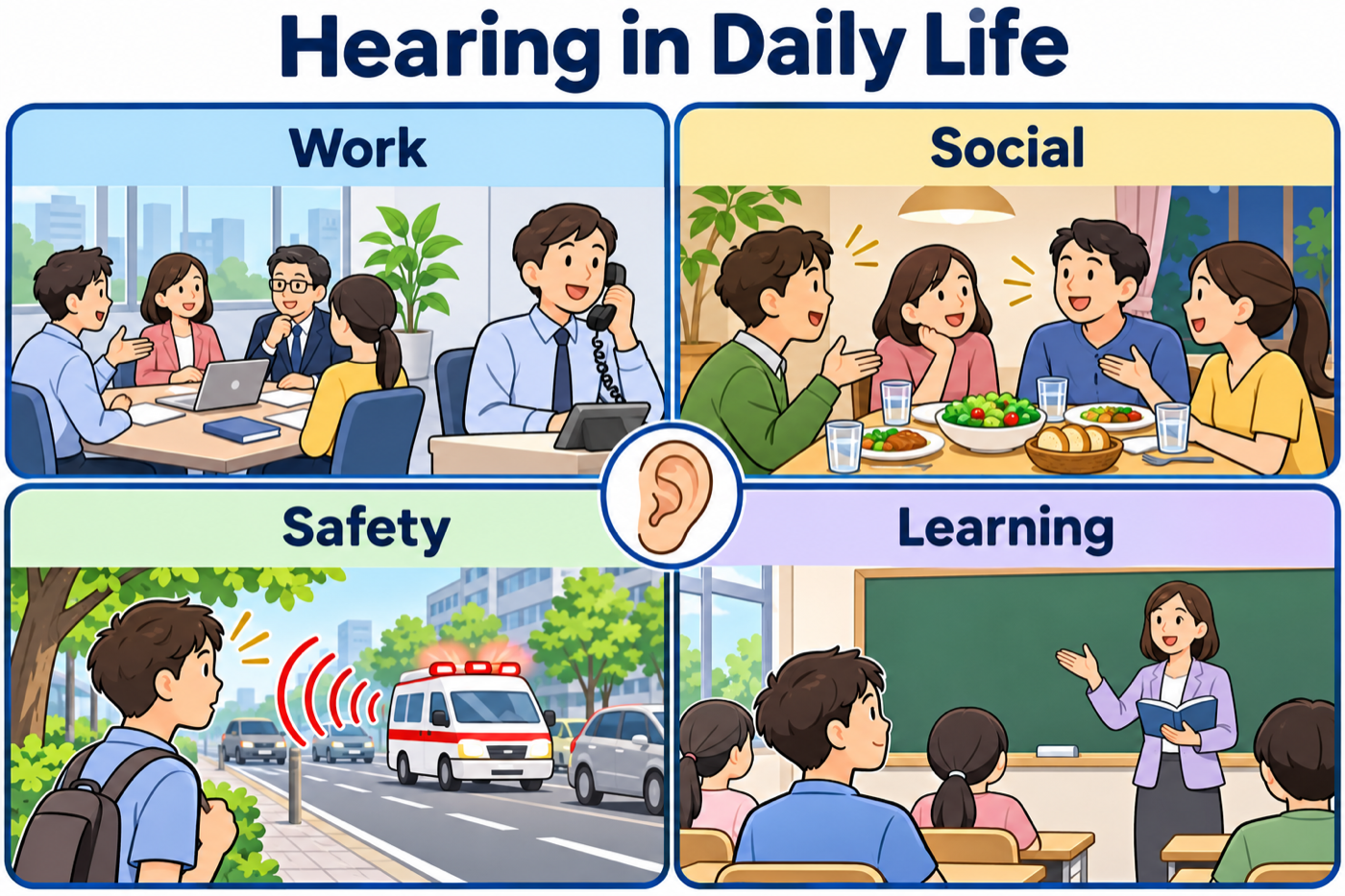
Two main benefits of hearing in life
- Better quality of life: good hearing = good communication. Relationships with the spouse, friends and family stay strong. The good effect reaches the family members too.
- An active, healthy life: stress goes down, concentration goes up, relaxing becomes easier, and overall health and well-being improve.
Hearing also affects the quality of sleep. Some sounds soothe us, while others raise our stress.
Consequences of untreated hearing loss
Hearing loss harms not only the body but also emotional and social health. Without treatment, the following problems appear:
- A negative attitude, anger and irritability
- Stress, fatigue and tension
- Depression and loneliness
- A wish to stay away from social situations
- Reduced alertness, leading to dangerous situations
- Lower efficiency at work
- Difficulty in remembering things and following instructions
Many people put these signs down to "old age". In fact, hearing loss can occur at any age. In children, speech and language development depend entirely on hearing, so catching it early in children is even more important.
Hearing loss damages health (loneliness, depression, chronic diseases), safety (missing warnings and commands), quality of life (not hearing the voices of loved ones, birdsong or the sound of waves) and getting work done (misunderstanding commands). There is economic loss too, such as lower productivity and the loss of trained employees.
Hearing - language, development, education and personality
- Hearing comes first, speech comes after. For most children, learning begins with listening. The first link a baby makes is between "what is heard and what is seen".
- The vocabulary we speak depends on the vocabulary we hear and understand. That is why we know more than we can say.
- Deafness is not just the absence of sound; it is also the absence of language. Hearing loss affects every area of a child's development.
- Even occasional hearing losses in the first three years of life can lead to a gap that cannot be made up in the long run.
- Good hearing is a strong foundation for language and educational development. Even a mild, persistent hearing loss is a significant reason for falling behind at school. If the classroom is busy and noisy, even a child with a small loss cannot hear the lesson properly.
- Several studies (Jenkins and others 1978; Bergner and Mo 1982) reported that middle ear inflammation (otitis media) leads to delayed language, poorer listening skills and lower achievement.
- According to Michael Best (1964), people with severe hearing loss experience the world differently from hearing people. Abstract thinking is harder for them than concrete thinking. Children with severe loss may show impulsiveness and social immaturity; they depend more on adults and lag behind in making friends.
Challenges caused by hearing loss
| Challenge | What happens |
|---|---|
| Social handicap | Difficulty fitting into society; communication difficulty because others' words are not understood; withdrawal and a submissive nature |
| Problems in personal-social development | Language is the main barrier; growing dependence on others leads to a feeling of inferiority |
| Personality problems | Children with partial hearing loss feel more frustrated than totally deaf children - because they keep trying to reach the level of typical children |
| Psychological problems | Helplessness in situations that run on speech; low self-esteem from comparing themselves with peers |
| Language problems | Language is a "hearing-speaking" process, so it develops slowly; limited vocabulary; multiple meanings of one word and complex sentence structure are not understood |
| Unusual emotional behaviour | Throwing objects to get attention; irritation and stubbornness when not understood |
- Economically: in developing countries, children with hearing loss rarely go to school; unemployment is high among adults; even those in jobs are mostly in low-level posts. This can change with education, vocational rehabilitation and more awareness among employers.
- Given the chance - through speech, writing or sign language - people with hearing loss can take part on an equal footing with everyone.
- (Details of language, speech, educational assessment, early intervention and hearing devices are in the next chapter, "Impact of Hearing Impairment: Language, Communication and Education".)
Exam focus: "Blindness separates people from things, deafness separates people from people" - Immanuel Kant. About 90% of information about the world comes through sight + hearing. Receptors for hearing = hair cells. Hearing first, speech after. The first 3 years are critical for language. Children with partial loss feel more frustrated than totally deaf children.
Memory code: "Kant: Blind-Things, Deaf-People" (BT-DP): blindness cuts us off from Things, deafness from People. The 4 areas that need hearing: "WSSL" - "We Still Seek Listening": Work, Social, Safety, Learning.