Audiological assessment is the set of tests done by an audiologist (hearing specialist) to find out whether there is a hearing loss and, if so, of what type, what degree, in which ear and at which frequencies. Suitable hearing devices and rehabilitation services are provided on the basis of these results.
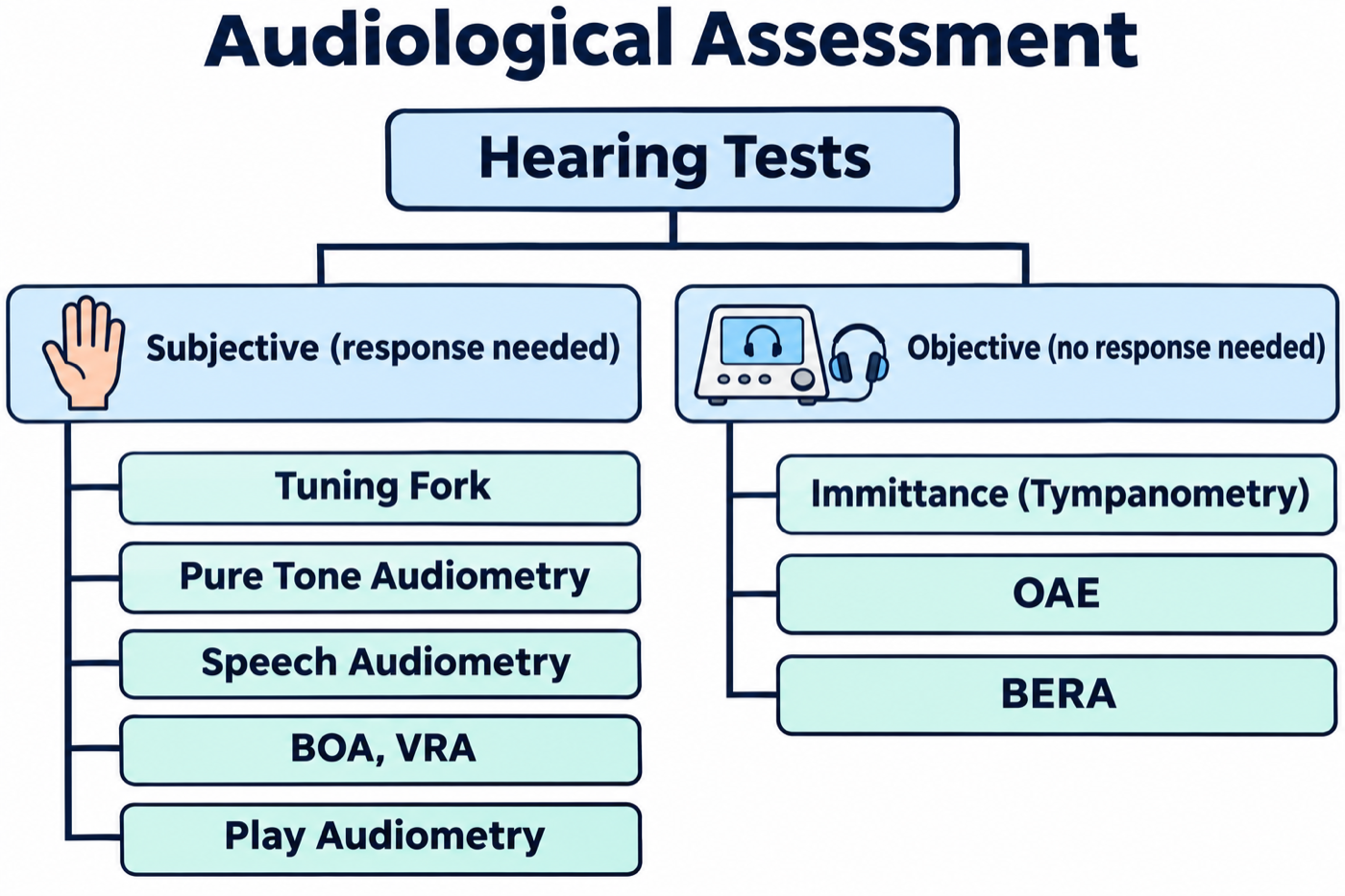
Hearing tests are of two kinds:
| Kind | Meaning | Examples |
|---|---|---|
| Subjective / behavioural tests | The person must respond - raising a hand to show "I heard it", pressing a button, repeating a word, turning the head | Tuning fork tests, pure tone audiometry, speech audiometry, BOA, VRA, play audiometry |
| Objective tests | No response is needed from the person; the machine itself measures the result; also suitable for infants, people who cannot respond and people who pretend | Immittance audiometry (tympanometry), OAE, BERA |
Tuning fork tests
- Simple, informal tests done with a vibrating tuning fork (usually 512 Hz). They roughly show whether a loss is conductive or sensorineural.
- Rinne test: compares air conduction (AC) and bone conduction (BC) in the same ear. The fork is placed on the bone behind the ear, and when the sound stops it is held in front of the ear canal.
- In normal hearing and in sensorineural loss: AC > BC (Rinne positive).
- In conductive loss: BC > AC (Rinne negative).
- Weber test: the fork is placed on the middle of the forehead / head.
- In normal hearing: the sound is heard in the middle, equally in both ears.
- In conductive loss: the sound is heard more on the affected ear side.
- In sensorineural loss: the sound is heard more on the better ear side.
Pure tone audiometry and the audiogram
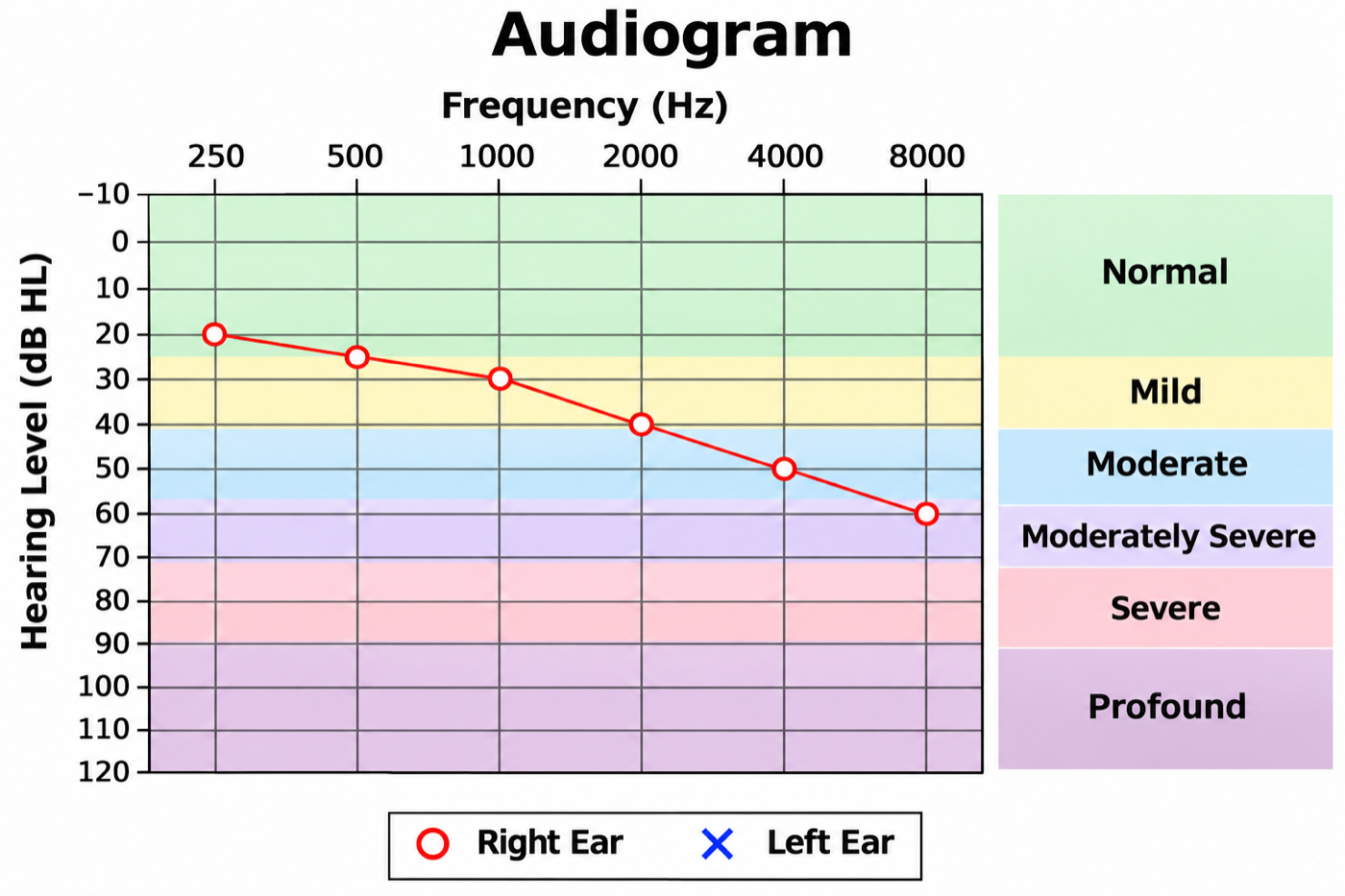
- The audiometer produces pure tones at different frequencies (usually 250 to 8000 Hz) and at different intensities. The lowest intensity the person can hear at each frequency (the hearing threshold) is found. It is a formal test, but since it depends on the person's response it is subjective.
- Air conduction test: through headphones - tests the whole ear pathway.
- Bone conduction test: through a vibrating device (bone vibrator) placed on the bone behind the ear - bypasses the outer and middle ear and tests the inner ear directly.
- Audiogram: the chart on which the results are plotted. The horizontal axis shows frequency (Hz) - low to high pitch from left to right; the vertical axis shows intensity (dB HL) - from -10 at the top to 120 at the bottom. The lower the line, the more severe the loss. Usually the right ear is marked with a red "O" and the left ear with a blue "X".
- Pure tone average: the average of the thresholds at 500, 1000 and 2000 Hz; the degree of loss (mild, moderate...) is decided with it.
This is how the type of loss shows on the audiogram:
| Type of loss | Air conduction | Bone conduction | Sign |
|---|---|---|---|
| Conductive | Reduced | Normal (within the normal range) | A gap between the two (air-bone gap) |
| Sensorineural | Reduced | Reduced by the same amount | Both drop together; no gap |
| Mixed | Reduced | Reduced | Both drop, and there is also a gap between them |
Speech audiometry
- A test done with words instead of pure tones; the person must repeat the words heard - so it is subjective.
- Speech Reception Threshold (SRT): the lowest intensity at which the person can correctly repeat half of the words.
- Speech discrimination score: the percentage of words the person identifies correctly at a comfortable loudness; useful for estimating how much benefit a hearing aid will give.
Immittance (impedance) audiometry
- A probe is placed in the ear canal and, while the air pressure is varied, the machine itself measures how the eardrum and middle ear respond - a formal, objective test.
- Tympanometry: shows how the middle ear is working - it reveals fluid in the middle ear (otitis media), a hole in the eardrum and Eustachian tube problems. Types of result graph (tympanogram): A - normal; B - flat line, fluid in the middle ear or a perforation; C - negative pressure in the middle ear (poor Eustachian tube function).
- Acoustic reflex: contraction of a middle ear muscle in response to a loud sound; this is also measured in this test.
Previous papers questions asked in the exam on what you just read
A formal objective hearing test
- (1)Tuning Fork Test
- (2)Pure Tone Audiometry
- (3)Immittance Audiometry
- (4)Speech Audiometry
Answer & explanation
Correct answer: (3) Immittance Audiometry
The question asks which hearing test is both formal and objective. ‘Objective’ means the machine measures the result without depending on the person's own response.
Hearing tests are subjective or objective. In subjective tests the person must respond, for example by raising a hand on hearing a tone. In objective tests no such response is needed. In immittance audiometry, a probe is placed in the ear canal, the air pressure is varied, and the instrument itself measures how the eardrum and middle ear respond (tympanometry and acoustic reflex). It can be done on infants and on people who cannot respond. So the answer is option (3).
The tuning fork test (1), such as the Rinne and Weber tests, is an informal screening test that depends on the person's response. Pure tone audiometry (2) is formal but subjective, because the person must signal when a tone is heard. Speech audiometry (4) is also subjective, as the person must repeat the words heard. Many choose (2), but the key word is ‘objective’.
Remember: Hearing tests needing no response: immittance (tympanometry), BERA, OAE.
OAE (Otoacoustic Emissions)
- When the outer hair cells of a healthy cochlea hear a sound, they send back a very faint echo. A sensitive microphone in a small probe placed in the ear canal records this echo.
- If the echo is present, the cochlea is working well; if not, more tests are needed.
- A quick, painless objective test that can be done even on a sleeping baby. That is why it is the first test in newborn hearing screening.
BERA (Brainstem Evoked Response Audiometry)
- The full form of BERA is Brainstem Evoked Response Audiometry; it is also called ABR (Auditory Brainstem Response). It is a test related to the ear.
- Electrodes are stuck on the head and click sounds are played into the ear. A computer records the electrical response (waves I to V) of the auditory nerve and the brainstem to the sound.
- An objective test that needs no response from the person; it can be done even while the baby is asleep. So it is known as the best test for accurately assessing the hearing of infants, young children, people who cannot respond and people who pretend (functional deafness).
- Besides estimating the hearing threshold, it also shows problems at the level of the auditory nerve / brainstem. Babies who fail OAE screening get BERA in the second stage.
Previous papers questions asked in the exam on what you just read
BERA stands for
- (1)Brainstem Evoked Response Audiometer
- (2)Bold Embossed Response Activity
- (3)Bone Evoked Response Audiometer
- (4)Brain Evolved Recall Analysis
Answer & explanation
Correct answer: (1) Brainstem Evoked Response Audiometer
The question asks for the full form of BERA.
BERA stands for Brainstem Evoked Response Audiometry (printed here as 'Audiometer'). Click sounds are played into the ear and electrodes on the head record the electrical responses of the brainstem. The child does not have to respond, so it is an objective test, useful for newborns, young children and those who cannot cooperate.
So the answer is option (1) Brainstem Evoked Response Audiometer.
Options (2) Bold Embossed Response Activity and (4) Brain Evolved Recall Analysis are made-up expansions. Option (3) Bone Evoked Response Audiometer looks close, but the B stands for Brainstem, not Bone; bone conduction testing is a separate part of pure tone audiometry.
Remember: B in BERA = Brainstem; it measures hearing without the child's response.
Through which one of the following tests we can identify accurate hearing loss in the ear
- (1)Pure Tone
- (2)BERA
- (3)Infidence
- (4)Early Intervention
Answer & explanation
Correct answer: (2) BERA
The question asks which test identifies hearing loss accurately.
Hearing tests are of two kinds. In subjective tests the person must respond, for example by raising a hand or pressing a button when a sound is heard; pure tone audiometry is one. In objective tests no response is needed and the machine records the brain's own response to sound; BERA (Brainstem Evoked Response Audiometry) is one. Because it does not depend on the person's cooperation, BERA gives an accurate hearing level even in infants and young children.
So, as per the official key, the answer is option (2) BERA.
Pure tone (1) is also a standard test of hearing level, but it depends on the child's responses, which can be unreliable in young children; many candidates pick it, but the key prefers the objective test. 'Infidence' (3) is not a test (possibly a misprint of impedance, a middle-ear test). Early Intervention (4) is a service for young children, not a test.
Remember: BERA = objective; pure tone = subjective.
Accurate hearing loss can be identified by administering this test
- (1)BERA
- (2)Ink blot
- (3)Pure tone
- (4)Early Identification
Answer & explanation
Correct answer: (1) BERA
The question asks which test finds the exact hearing loss without depending on the child's own response.
BERA means Brainstem Evoked Response Audiometry. Sounds are given to the ear and electrodes record the electrical responses of the hearing nerve and brainstem. It is an objective test: the child does not have to raise a hand or answer. So hearing level can be measured accurately even in infants and children who cannot cooperate. Hence the answer is option (1) BERA.
Many students pick (3) Pure tone. Pure Tone Audiometry is also important, but it is a subjective test that depends on the person signalling that they heard the sound, so it can go wrong with young children. The Ink blot (Rorschach) test is a personality test and has nothing to do with hearing. Early Identification is not a test at all; it is the process of finding a problem early.
Remember: BERA = objective (brain response); Pure tone = subjective (person's response).
The organ involved in testing defect in its functioning through BERA Test
- (1)Heart
- (2)Nose
- (3)Ear
- (4)Mouth
Answer & explanation
Correct answer: (3) Ear
The question asks which organ's function is tested by BERA.
BERA stands for Brainstem Evoked Response Audiometry. Electrodes are placed on the head and click sounds are sent into the ear. A computer records the electrical response of the hearing nerve and brainstem to these sounds. The child does not have to respond, so it is very useful for detecting hearing loss in infants and in children who cannot give answers. So the answer is option (3) Ear.
The heart (1) is tested with an ECG. The nose (2) and mouth (4) have nothing to do with BERA. The word "Audiometry" (measurement of hearing) in the name points directly to the ear.
Remember: Audiometry = hearing test = ear.
Behavioural tests for young children
Young children who cannot wear headphones and press a button are given behavioural tests suited to their age:
| Test | Age | How it is done |
|---|---|---|
| Behavioural Observation Audiometry (BOA) | Infants (about 0-6 months) | A sound is played and the baby's natural reactions are watched: blinking, startling, stopping sucking, stopping movement; there is no reward / conditioning |
| Visual Reinforcement Audiometry (VRA) | About 6 months - 2 years | Sound comes from one side; if the child turns his head that way, a toy there lights up and moves (a visual reward); so the child learns to turn towards the sound. It is a modified form of the Conditioned Orientation Response (COR) audiometry developed by Suzuki and Ogiba |
| Play audiometry | About 2-5 years | The child is taught to do a game action, such as dropping a bead into a basket or stacking a block, every time a sound is heard |
- Auropalpebral reflex (APR): the eye closing at once when a loud sound is heard, or eyelids that are already closed tightening. "Auro" = ear, "palpebral" = eyelid. This reflex, present from birth, is watched in behavioural tests of infants.
- Moro (startle) reflex: the baby flinging out its arms and startling at a sudden loud sound; this too is a response watched in infants.
Previous papers questions asked in the exam on what you just read
A quick closing of the eye or tightening of the eyelids which are already closed due to sound is called as
- (1)Auto-Palpebral Reflex
- (2)Auro-Palpebral Reflex
- (3)Acoustic-Palpebral Response
- (4)Auditory-Puretone Reflex
Answer & explanation
Correct answer: (2) Auro-Palpebral Reflex
The question asks for the name of the reflex in which the eyes close quickly, or already closed eyelids tighten, in response to a sudden sound.
This is the auropalpebral reflex (APR): 'auro' refers to the ear and 'palpebral' to the eyelid. It is present from birth, so it is checked during behavioural hearing screening of newborns and infants. So the answer is option (2) Auro-Palpebral Reflex.
In option (1), 'auto' has nothing to do with the ear; it is a look-alike word. Option (3) sounds similar in meaning, but the standard name used in textbooks and hearing screening is the auropalpebral reflex (APR). There is no 'auditory-puretone reflex' (4); pure tone refers to an audiometry test.
Remember: Auro = ear, palpebral = eyelid: blink to sound = APR.
Visual Reinforcement Audiometry (VRA) is modification of a earlier well-known technique ____
- (1)Oto Acoustic Emission
- (2)Behavioural Observation Audiometry
- (3)Conditioned Orientation Response Audiometry
- (4)Brainstem Evoked Response Audiometry
Answer & explanation
Correct answer: (3) Conditioned Orientation Response Audiometry
The question asks which earlier technique was modified to develop Visual Reinforcement Audiometry (VRA).
In VRA, used with children of roughly 6 months to 2 years, a sound is presented from one side. When the child turns the head towards it, a toy on that side lights up or moves. This visual reward teaches the child to keep turning towards sounds. The same idea was used earlier in Conditioned Orientation Response (COR) audiometry developed by Suzuki and Ogiba: the head turn (orientation) towards a sound is conditioned with a light reward. VRA is a modification of COR, so the answer is option (3).
Otoacoustic emissions (1) and brainstem evoked response audiometry (4) are objective tests that do not need any response from the child, so they are separate methods. Behavioural observation audiometry (2) only watches the infant's natural reactions to sound, without any conditioning or reward.
Remember: VRA grew out of COR audiometry: turn to the sound, see the lit toy.
Exam focus: BERA = Brainstem Evoked Response Audiometry (ABR) - an ear test, accurate hearing loss, objective, for infants. OAE = echo from the outer hair cells, the first test in newborn screening. Formal objective test = immittance (tympanometry, middle ear). Pure tone audiometry = 250-8000 Hz, audiogram, subjective. Conductive = air-bone gap, Rinne negative, Weber towards the affected ear. VRA = developed from COR. APR = closing the eyelids at a sound.
Memory code: The three objective tests "I-O-B" (Immittance, OAE, BERA) - "the three that ask for no response"; in order middle ear → cochlea → brainstem. Rinne: "In conductive loss, Bone beats Air" (BC > AC). Weber: "Conductive - the bad ear, Sensorineural - the sound ear". Audiogram colours "Red Right O, Blue Left X".