Screening means quickly sorting out the children at high risk of autism and sending them for a full diagnostic assessment. It is the first step in identifying ASD. Screening tools are designed for children who are at high risk.
Features of a good screening tool
- It should be accurate.
- It should have strong psychometric properties (reliability, validity).
- It should be culturally and linguistically appropriate.
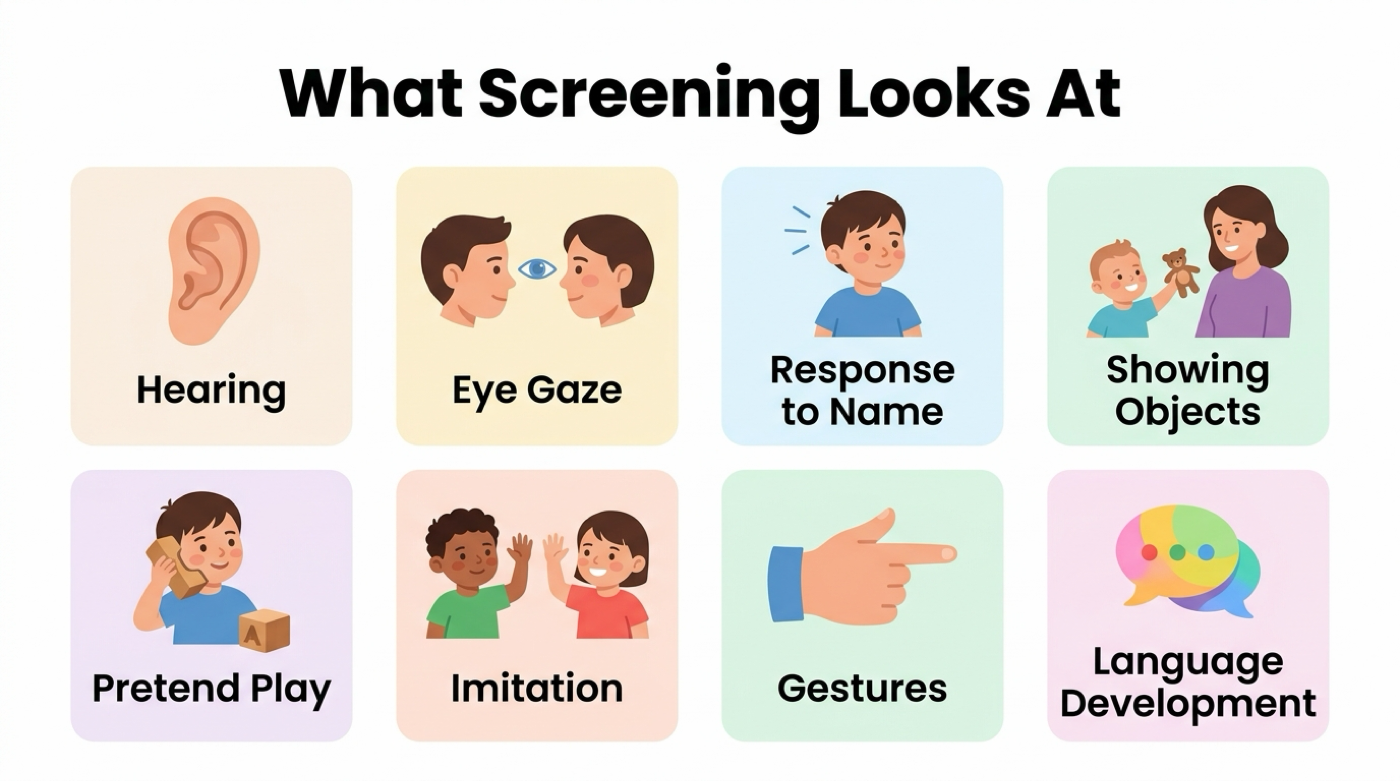
What screening includes / looks at
Report tools filled in by parents and teachers
Tools based on interview and observation
Hearing screening - to see whether hearing loss is the cause of communication and behaviour difficulties, and to separate difficulties caused by hearing loss from ASD
Eye contact (eye gaze)
Turning when one's own name is called
Showing interesting objects to others
Pretend play
Imitation
Non-verbal communication (gestures, facial expressions)
Language development
Children with autism especially lack social communication and language development skills. So the environment in which the child is growing up must also be observed. The teacher should take the parents' help to develop language and social skills.
If a child with ASD is also found to have hearing loss, an audiologist should be consulted. The audiologist tests and confirms the hearing loss, and his role in the child's language development is very important at this stage.
Parents' help in early screening
- A child with ASD should have developmental surveillance at every well-child check-up. Parents should take the child to the paediatrician regularly.
- Photos, videos and tape recordings that show the child's behaviour, and details of developmental milestones, help the specialist a great deal in identification.
Important screening tools
| Tool | Who, when | Age | Key details |
|---|---|---|---|
| CHAT (Checklist for Autism in Toddlers) | Simon Baron-Cohen, early 1990s | 18 months | Made to see whether autism could be detected in children as young as 18 months; a short questionnaire with 2 sections: one filled in by the parents, the other by the family doctor / paediatrician |
| M-CHAT | A modified form of CHAT | Toddlers | A screening checklist filled in by parents |
| SCQ (Social Communication Questionnaire; earlier called the Autism Screening Questionnaire - ASQ) | - | Over 4 years, with a mental age above 2 years | Evaluates communication skills and social functioning; a low-cost way to decide whether to refer for a full diagnostic assessment; 2 forms: Lifetime and Current; each has 40 yes / no questions |
| STAT (Screening Test for Autism in Two-Year-Olds) | Wendy Stone, Vanderbilt | Two-year-old children | Direct observation; 3 skill areas that indicate autism: play, motor imitation, joint attention |
| ABC (Autism Behavior Checklist) | Krug and colleagues, 1980 | From 3 years | 57 items in 5 categories on behaviour; part of the broader tool ASIEP (Autism Screening Instrument for Educational Planning, Krug and colleagues, 1978) |
| ASSQ (Autism Spectrum Screening Questionnaire) | - | School children | A screening questionnaire filled in by parents or teachers |
Previous papers questions asked in the exam on what you just read
Appropriate age group while measuring through diagnostic tool CHAT for ASD
- (1)From 3 years to 22 years
- (2)Before the age of 36 months
- (3)at 18 months of age
- (4)From 3 years to 6 years
Answer & explanation
Correct answer: (3) at 18 months of age
The question asks at what age the autism screening tool CHAT is used.
CHAT stands for Checklist for Autism in Toddlers. It was developed by Simon Baron-Cohen and colleagues to pick up early signs of autism at 18 months of age. Through questions to parents and observation by a health worker, it checks for joint attention, pointing and pretend play. So the answer is option (3) at 18 months of age.
The word 'toddlers' itself shows it is meant for very young children, so 3 to 22 years (1) and 3 to 6 years (4) do not fit. 'Before 36 months' (2) is too broad; the age fixed for CHAT is 18 months.
Remember: CHAT = Checklist for Autism in Toddlers, used at 18 months.
'CHAT' Test will be conducted for
- (1)Children with Intellectual Disability
- (2)Children with Learning Disability
- (3)Children with Autism
- (4)Children with Dwarfism
Answer & explanation
Correct answer: (3) Children with Autism
The question asks which group the CHAT test is meant for.
CHAT stands for Checklist for Autism in Toddlers. It was developed by Simon Baron-Cohen and colleagues in 1992 as an early screening tool for children around 18 months of age. It checks joint attention (looking at the same object with an adult), pointing to show interest and pretend play, which are usually absent or weak in Autism. So the answer is option (3) Children with Autism.
Intellectual Disability (1) is assessed with intelligence and adaptive behaviour tests. Learning Disability (2) is usually identified at school age through reading, writing and maths assessment. Dwarfism (4) is a physical growth condition identified by height measurement and medical tests. None of these uses CHAT.
Remember: The name gives it away: Checklist for Autism in Toddlers.
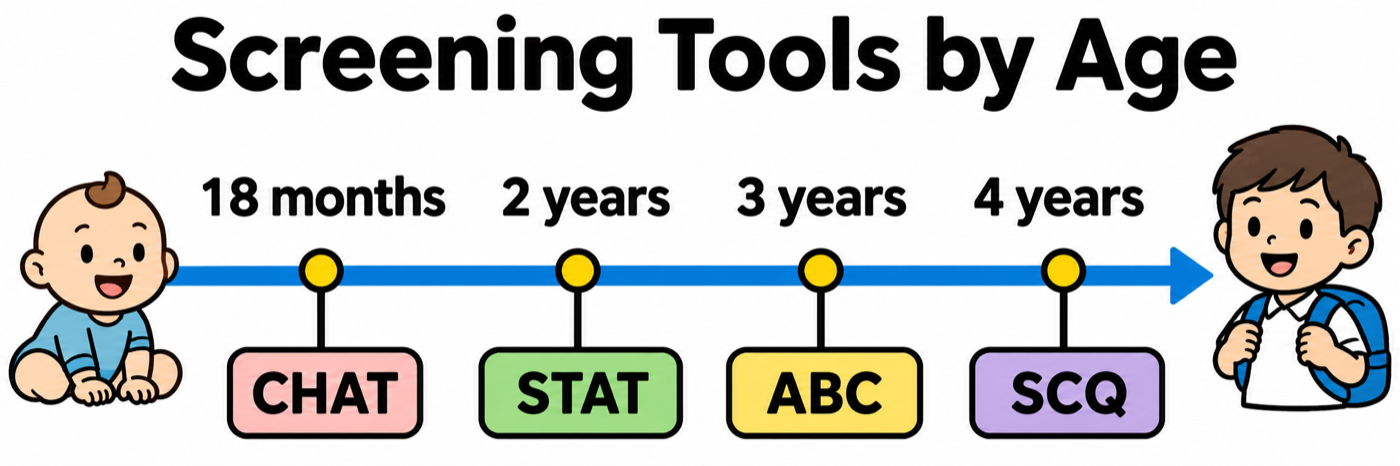
Exam focus: CHAT = for autism, at 18 months; Simon Baron-Cohen; 2 sections (parents + doctor). ABC = 57 items, 5 categories, Krug 1980, part of ASIEP. SCQ = 40 yes/no, 2 forms, for those over 4 years. STAT = play, motor imitation, joint attention.
Memory code: "CHAT at 18, ABC has 57" - CHAT at 18 months; ABC has 57 items (5 categories). STAT's three areas are "PMJ" - Play, Motor imitation, Joint attention.