When screening raises a doubt, trained professionals use standard diagnostic tools. Historically, some doctors preferred informal assessments based on observation. But experts hold that standardised tools, which can be used in a structured and repeatable way with diagnostic criteria, are better. The most widely used tools are CARS, GARS, ADOS and ADI-R.
CARS - Childhood Autism Rating Scale
- Developed by Eric Schopler in the early 1970s. It was built over about 15 years using nearly 1,500 cases.
- It is used to measure the degree of autism in a child. Behaviour, communication skills and social behaviour are observed to see how great the deficit is; it helps to separate autism from other developmental disabilities and to classify children.
- It has 15 items in all; for example: relating to people, body use, adaptation to change, listening response, verbal communication.
- Each item is rated from 1 to 4 (with half points in between, 7 levels in all). Ratings are given by observing the child and using information from parents and records.
- The ratings of the 15 items are added to give a total score (15-60). A score of 30 or more is classified as autistic.
| CARS total score | Meaning |
|---|---|
| Below 30 | Not autism |
| 30 - 36.5 | Mild to moderate autism |
| 37 - 60 | Severe autism |
ADI-R - Autism Diagnostic Interview - Revised
- Developed by Rutter, Le Couteur and colleagues (1994).
- A standardised, structured interview of 93 items; it is put to the people who look after the child (parents / caregivers).
- Based on the ICD-10 definition of autism; it focuses on behaviour before the age of 36 months.
- Uses: diagnosing autism, planning treatment, and distinguishing autism from other developmental disorders.
ADOS - Autism Diagnostic Observation Schedule
- A semi-structured observation tool that diagnoses and assesses autism and Pervasive Developmental Disorders (PDD).
- It can be used to evaluate almost anyone suspected of having autism - from toddlers to adults, from children with no speech at all to verbally fluent adolescents and adults.
GARS - Gilliam Autism Rating Scale
- Introduced by James Gilliam in 1995. It is a rating scale for the severity of autism.
- Made for use by teachers, parents and professionals; based on DSM-IV.
- 42 items in 3 subscales: stereotyped behaviours, communication, social interaction. In addition, there is an optional part (developmental disturbances) in which parents report development during the first 3 years of life.
- It measures the severity and probability of autism in people aged 3 to 22 years.
- Ratings are based on how often (frequency) the target behaviours appear, and an overall level is calculated.
Previous papers questions asked in the exam on what you just read
Expand GARS
- (1)Glenmark Autism Rating Scale
- (2)Grace Autism Rating Scale
- (3)Gait Autism Rating Scale
- (4)Gilliam Autism Rating Scale
Answer & explanation
Correct answer: (4) Gilliam Autism Rating Scale
The question asks for the full form of GARS, a tool used in the assessment of autism.
GARS stands for Gilliam Autism Rating Scale, developed by James E. Gilliam. Parents and teachers rate the child's behaviour on it, and the scores help to judge the likelihood and severity of autism. So the answer is option (4).
Glenmark (1) is the name of a pharmaceutical company. There is no autism rating scale named Grace (2) or Gait (3, which means a way of walking). These options only use words beginning with 'G' to confuse.
Remember: GARS = Gilliam; CARS = Childhood; ISAA = Indian.
BSE - Behavioral Summarized Evaluation
- A rating scale developed in France by Barthélémy and colleagues (1992).
- Used to measure changes in behaviour in children and adolescents with autism.
Diagnostic tools at a glance
| Tool | Developed by, year | Items | Age / special feature |
|---|---|---|---|
| CARS | Eric Schopler, early 1970s | 15 | Rating 1-4; autism from a score of 30 |
| ADI-R | Rutter, Le Couteur, 1994 | 93 | Caregiver interview; ICD-10; behaviour before 36 months |
| ADOS | - | - | Semi-structured observation; toddlers to adults |
| GARS | Gilliam, 1995 | 42 (3 subscales) | 3-22 years; based on DSM-IV |
| BSE | Barthélémy, 1992 | - | France; measures behaviour change |
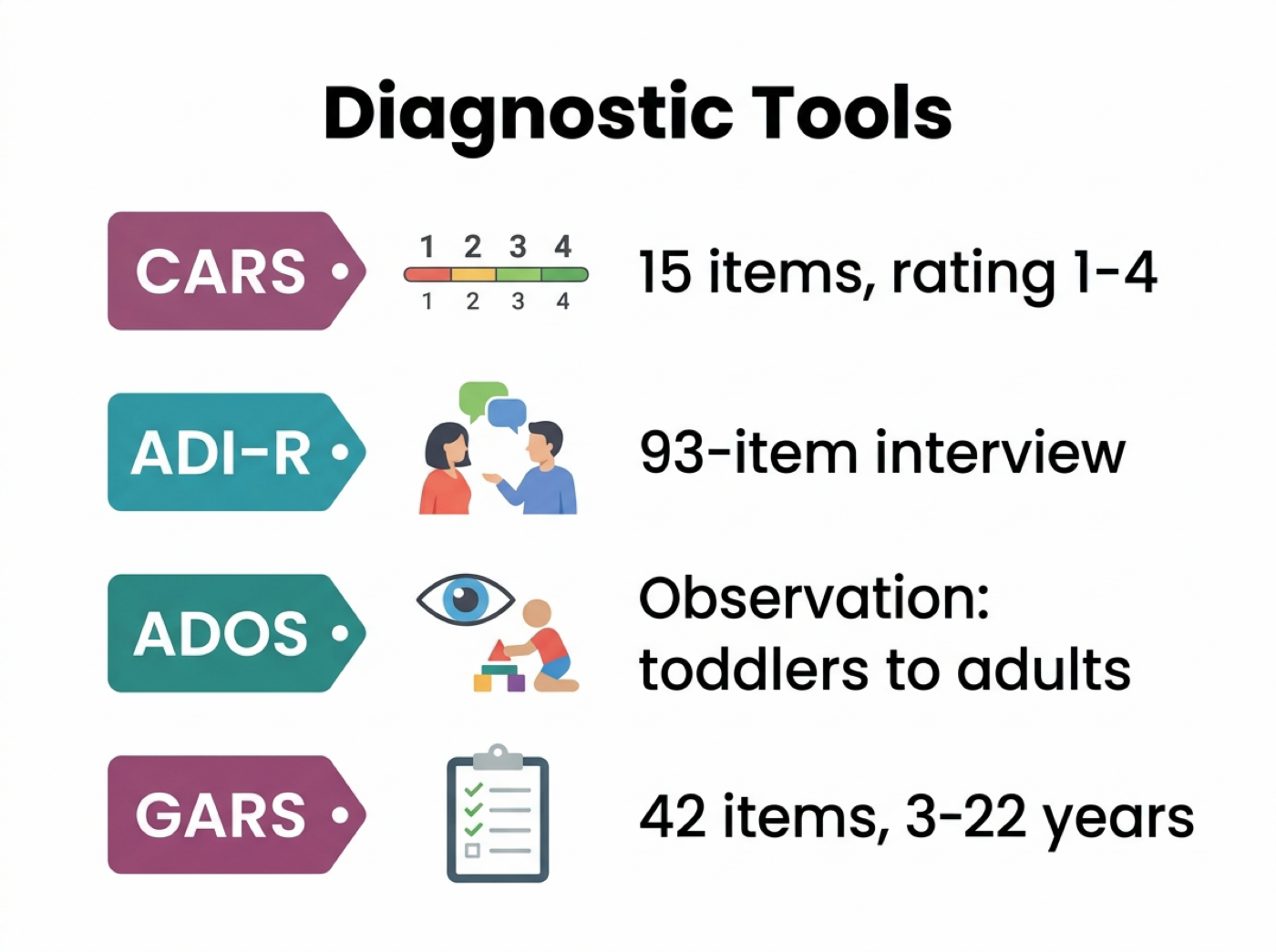
Exam focus: GARS = Gilliam Autism Rating Scale (1995, 42 items, 3-22 years). CARS = Eric Schopler, 15 items, cut-off 30. ADI-R = 93-item caregiver interview, ICD-10, before 36 months. ADOS = semi-structured observation, for all ages. Interview = ADI-R; observation = ADOS.
Memory code: "S-15, R-93, G-42" - Schopler's CARS has 15 items, Rutter's ADI-R has 93, Gilliam's GARS has 42. "I for Interview, O for Observation" - the I in ADI-R stands for Interview, the O in ADOS for Observation.