Because the features and needs of ASD differ from child to child, programmes also differ from child to child. There are some indicators for designing and keeping up a quality educational programme.
Indicators of a quality programme (9)
| No. | Indicator |
|---|---|
| 1 | Comprehensive team approach including the family |
| 2 | Comprehensive assessment of skills and deficits |
| 3 | Clear goals that address the features of ASD |
| 4 | Structuring the environment |
| 5 | Effective teaching strategies |
| 6 | Using FBA for problem behaviour |
| 7 | Assessment of intervention (data collection) |
| 8 | Transition planning |
| 9 | Opportunities with peers |
Areas for comprehensive assessment
Assessment changes with the student's age and ability, but the features of ASD must be kept in mind. (Assessment tools are covered in the chapter "ASD: Identification and Assessment".) Areas looked at for curriculum planning:
- Pre-academic and academic skills
- Pre-vocational and vocational skills
- Self-help and adaptive skills
- Communication and socialisation
- Sensory regulation
- Motivation and reinforcement
- Behaviour
- Fine and gross motor skills
- Leisure activities
- Cognition
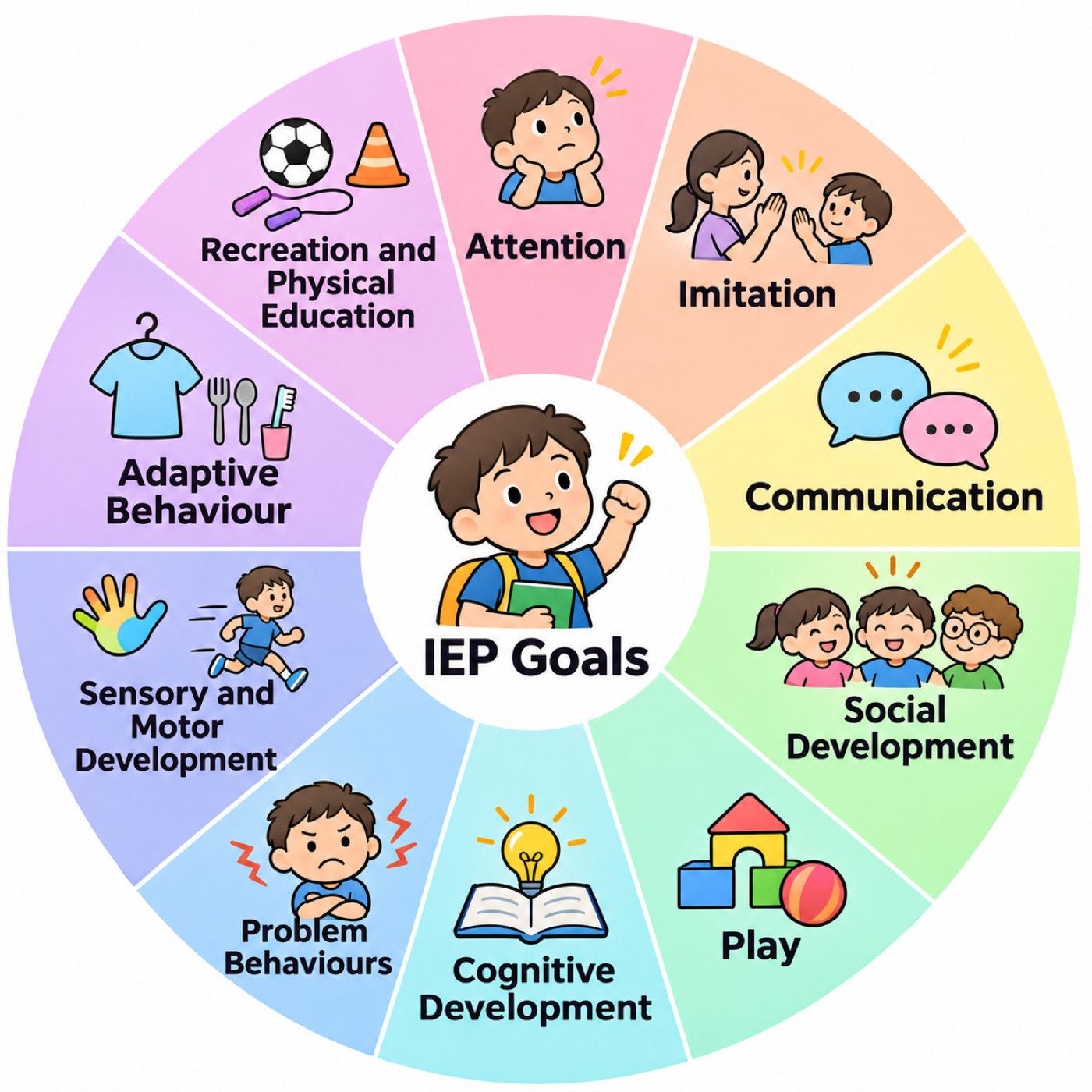
Areas in which IEP goals are written
The key to teaching new skills: clearly defined IEP goals that are developmentally appropriate and functional, and based on the assessment results, the student's strengths and interests, and the features of ASD. Parents play a key role in preparing and carrying out the IEP.
| Area | What the goals include |
|---|---|
| Attention | Sustained attention; joint attention; shifting attention from event to event, object to object, object to person and person to object |
| Imitation | An essential prerequisite skill for learning from others; imitation of objects, motor actions, mouth movements, sounds, words, gestures, academic tasks and social skills |
| Communication | Expressive and receptive language; speech or augmentative communication; functional communication systems as an alternative to problem behaviour |
| Social development | The core area of deficit in ASD; body language, manners, conversation skills, keeping friendships, cooperative play, self-control, empathy, handling conflict |
| Play | Developmentally appropriate, functional play as a way to build social skills with peers |
| Cognitive development | Concept development, problem solving, academic performance, executive functions (flexible, strategic planning to reach a goal) |
| Problem behaviours | Finding the function of the behaviour and teaching an alternative behaviour with positive behaviour supports |
| Sensory and motor development | Identifying individual differences in touch, sight, smell, sound and taste and planning for them; identifying and changing stressors in the environment |
| Adaptive behaviour | Life skills such as hygiene, self-help and safety; taking part in the community in independent living, work and recreation |
| Recreation / leisure / physical education | Builds cognitive, social and motor skills; good use of free time; exercise, health and enjoyment of life |
Questions the team should ask when writing clear IEP goals:
- Have we identified goals that are meaningful for the child?
- Did the family take part in choosing the goals to be reached at home and at school?
- Are the outcomes developmentally important and appropriate? Have the features of ASD been considered?
- Will the goals increase academic progress?
- Can the learnt skills be used in other places (home, community) and with different people?
Curricular adaptation: reading and writing
- Build literacy skills with the help of strategies. Combine word-recognition skills so the student reaches the goal step by step. Teach lessons to suit the classroom atmosphere and surroundings.
- Support with technology (such as computers); give interesting stories that build vocabulary; build comprehension; explain letter order and rules clearly; use literacy to widen social skills.
- Strategies for writing skills: fill-in-the-blank (cloze) exercises, multiple-choice answers to questions, giving examples, focusing on one section at a time, using visual or graphic organisers before writing, and repeated use of frequently used words.
Curricular adaptation: mathematics
- Prepare the student to review regularly.
- Have the student make a personal glossary (dictionary) of maths words; encourage understanding of the calculation process.
- Some children may find it hard to write numbers by hand. These skills can then be developed with technology such as a calculator or computer.
- Teach number concepts with concrete and visual methods and tactile materials.
Exam focus: 9 indicators of a quality programme (from the family team to peer opportunities). IEP goals are developmentally appropriate, functional and assessment-based. Imitation = an essential prerequisite skill for learning from others. Social development = the core area of deficit in ASD. Executive functions = flexible, strategic planning for a goal.
Memory code: IEP goal areas "All Infants Can Share Play; Calm Parents Sing And Relax" - Attention, Imitation, Communication, Social development, Play; Cognitive development, Problem behaviours, Sensory-motor development, Adaptive behaviour, Recreation. 10 areas in all.