There are many teaching methods for children with ASD. The teacher should first assess the problem area and then use the right method for it. Successful programmes use structure, visual supports and routines along with motivation strategies; they teach one-to-one or in a small group, with few distractions, and with consistency, repetition and predictability.
Teaching tips for children with autism
- Use visuals (pictures); avoid long verbal instructions.
- Encourage the child's special talents; use his fixed interests to motivate school work.
- Teach number concepts with concrete, visual methods.
- Let the child use a typewriter (keyboard) instead of writing by hand.
- Protect the child from sounds that hurt his ears.
- Seat the child near a window; do not use fluorescent lights.
- Weighted vests can be used to calm the nervous system.
- You can talk to the child while he is swinging or rolled up in a mat.
- Do not ask him to look and listen at the same time.
- Use materials the child can learn from through touch (for example, sandpaper letters).
- Use words and pictures printed on flash cards.
- Generalise what is taught (so the child uses it in different places and with different people).
Motivation and reinforcement: the token system
| Type of reinforcer | Examples |
|---|---|
| Social activity | Taking a break, playing a game, using the computer, spending time with a favourite person |
| Object / edible | A healthy snack or drink, a small toy, bubbles, playing cards, video games |
- Token economy (token system): the student earns tokens every time he shows the target behaviour. After collecting a set number of tokens fixed in advance, he exchanges them for an item or activity he likes.
- Examples of tokens: points, play money, gold stars, stickers, tickets, coupons, poker chips.
Academic strategies
Most students with ASD need some kind of academic modification. These range from changing how material is presented to changing how the child shows what he has learnt.
| Strategy | What is done |
|---|---|
| Graphic organisers | Organising key ideas visually with semantic maps, Venn diagrams, outlines and charts |
| Handwriting modifications | For those with fine motor difficulty: answering orally, typing on a keyboard, answering in true/false form, recording on tape or digitally, help from a scribe |
| Priming | Preparing the student in advance for an activity that is coming up; for example, showing tomorrow's worksheet beforehand, or outlining the next period's or day's lesson; it can be done close to the activity, at home or at school; it reduces the stress caused by change and the unknown |
| Assignment and test modifications | Extra time, practice in advance, reading the questions aloud, fewer questions, a sample example, multiple-choice questions instead of essays, keyboard instead of handwriting |
Communication strategies
- The communication abilities of students with ASD vary widely: from those who do not speak at all to those with a remarkable vocabulary; from those who understand very little to those who understand complex conversation.
- Students who are non-verbal or at the pre-verbal stage should be taught to communicate through gestures, speech or an augmentative and alternative communication (AAC) system.
- AAC systems: sign language, visual symbol systems, communication boards and voice output devices. They help the student express wants and needs in any setting.
- AAC works best when it is started early. Teach functional communication skills such as requesting, asking for help, refusing and making choices. The first systems should be very functional and concrete.
- A visual symbol system should move from concrete to abstract:
| No. | Stage |
|---|---|
| 1 | Real objects or actual photographs |
| 2 | Colour photographs, line drawings |
| 3 | Printed words |
- Alternative communication method: the Picture Exchange Communication System (PECS), in which the child expresses needs by exchanging pictures, was developed by Andy Bondy and Lori Frost.
- Teach new skills first in a quiet, distraction-free place. Then generalise them to natural situations with natural cues and natural reinforcers.
- Use the student's interests as motivation. Example: if a favourite toy is kept in sight but out of reach, he will use his communication system to ask for it. Praise every attempt to communicate.
- Even students with ASD who can speak have a marked deficit in pragmatic language (the social use of language). They also find complex language hard to understand.
- The teacher should not assume that the student has understood. Speak slowly and clearly. Some need simple one- or two-step instructions; others need extra time to process speech. Pause between statements.
- Say clearly "what to do" rather than "what not to do". Back up speech with closeness, gestures and visual supports.
- Use simple, brief language and repeat it if needed. Work with a speech-language pathologist for a complete communication programme.
- Some children repeat other people's words (echolalia). Rydell and Prizant (1995) said that a child's echolalia can be used as a base for teaching better language skills.
Problem behaviours: Functional Behaviour Assessment (FBA)
- Self-injurious behaviour, stereotypic behaviour, physical aggression, tantrums, defiance and destruction of property are the most difficult and stressful problems for parents and teachers.
- Research supports the use of Functional Behaviour Assessment (FBA) or functional analysis, and Positive Behaviour Supports (PBS), for these.
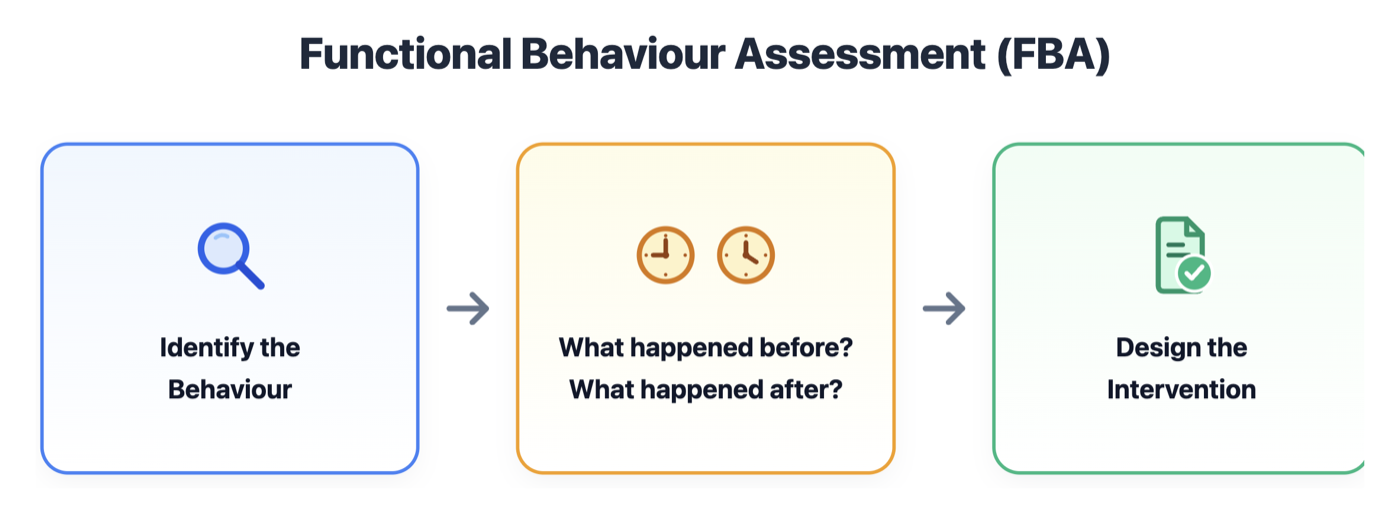
- FBA has at least 3 steps:
| Step | What is done |
|---|---|
| 1 | Identifying the problem behaviour |
| 2 | Identifying the antecedents (what happened before the behaviour), the consequences and the setting events that keep the behaviour going |
| 3 | Designing an intervention based on the assessment results (changing the antecedents, consequences and setting events) |
- Once the function of the behaviour is known, a correct alternative behaviour is taught in its place with positive behaviour supports.
- When a child shows aggressive behaviour in class, corporal punishment or sending the child out of school is not right. The right method is to keep the child apart for a while (time out) and then give counselling.
Previous papers questions asked in the exam on what you just read
Children with special Needs, when expresses aggressive behaviour in classroom shall be controlled through this method.
- (1)Corporal punishment
- (2)Isolation with counselling
- (3)Expel from classroom
- (4)Ignore that activity
Answer & explanation
Correct answer: (2) Isolation with counselling
The question asks how to handle a child with special needs who shows aggressive behaviour in class.
First the child is moved for a short while to a quiet, separate place (time-out). This keeps the child and others safe and lets the child calm down. Then the teacher talks with the child (counselling), finds the cause of the behaviour and teaches the right behaviour. This is an accepted behaviour modification method.
So the answer is option (2), Isolation with counselling.
Corporal punishment (1) is banned by Section 17 of the RTE Act 2009, and punishment usually increases aggression. Expelling the child (3) cuts the child off from learning, and Section 16 of the RTE Act says no child shall be expelled from school. Ignoring (4) can work for minor attention-seeking behaviour, but aggression that can hurt others cannot be left alone.
Remember: Aggression → time-out plus counselling; never punishment or expulsion.
If a student shows aggressive behaviour in classroom then teacher needs to give
- (1)Punishment
- (2)Information to Headmaster
- (3)Expel from School
- (4)Isolation for some time
Answer & explanation
Correct answer: (4) Isolation for some time
The question asks what a teacher should do at once when a student behaves aggressively in class.
Behaviour modification has a technique called time out. The aggressive student is made to sit away from the other children, in a quiet place, for a short time. This gives the child time to calm down, protects the other children and removes the attention that may be feeding the bad behaviour. So the answer is option (4), isolation for some time.
Punishment usually increases aggression, and the RTE Act 2009 bans physical punishment and mental harassment of children, so option (1) is wrong. Informing the headmaster does not control the behaviour in the classroom at that moment, so option (2) is wrong. Expelling the child goes against the child's right to education, so option (3) is wrong.
Remember: Aggression in class: time out, not punishment.
Assessing the outcome of intervention (data collection)
- Collect baseline data about the level of performance in the area of need before the intervention.
- The IEP team decides how often and in what form data should be recorded.
- Fix a criterion in advance for deciding when an intervention has failed.
- Record data to identify progress, problems and lack of progress. This ongoing assessment decides the next goals.
Other teaching methods
- Curriculum-Based Assessment (CBA): assessment based on the skills in the curriculum. It is useful for children with special needs in the regular classroom.
- Montessori method: gives more importance to the child than to the teaching style or the environment (child-centred). Development of the child's senses is central. Didactic apparatus (teaching materials) is used, such as blocks, toys, wooden steps, play items of various shapes and sizes, bells and pictures. With these, children gradually learn to read, write and count. The teacher should show affection towards the children.
Previous papers questions asked in the exam on what you just read
Teaching strategy in Montessori method is
- (1)School centric
- (2)Black board centric
- (3)Teacher centric
- (4)Child centric
Answer & explanation
Correct answer: (4) Child centric
The question asks what the Montessori method of teaching is centred on.
The method was developed by Maria Montessori of Italy. The child is at the centre. In a prepared environment, children choose activities, work at their own pace and learn by themselves through sensory materials. The teacher (called the directress) only observes and guides.
So the answer is option (4), Child centric.
Teacher centric (3) teaching means the teacher talks and children listen, which is the opposite of Montessori. Black board centric (2) is traditional chalk-and-talk teaching. School centric (1) puts school rules and routine first, not the needs of the child.
Remember: Montessori = child at the centre, teacher as guide.
Other precautions
- Parents and school staff should choose the right intervention methods together.
- Intervention methods should be the same in every setting: home, school and community.
- Methods, tools and materials should be backed by research, address the student's strengths and needs, and show progress towards the IEP goals.
- New skills should suit the child's development. Once learnt, they should be practised in all natural settings (home, school, community).
Exam focus: Token system = tokens for the target behaviour, later exchanged for a reward. Priming = introducing an upcoming activity in advance. AAC order: objects / photos → colour photos, line drawings → printed words. PECS = Bondy and Frost. FBA = 3 steps. Montessori = child-centred. Never ask the child to "look and listen at the same time".
Memory code: AAC picture ladder "O-P-L-W" ("Objects Pave the way to Literate Words") - real Objects (or actual photos) → colour Photos and Line drawings → printed Words (concrete → abstract). FBA "I-C-I" - Identify the behaviour, find the Causes (before and after), Intervene.