Autism Spectrum Disorder (ASD) is not a single disease. It is a heterogeneous group of neuro-behavioural syndromes, that is, a group of different sets of symptoms linked to the nervous system and behaviour. It is a neurological / neurodevelopmental disorder that affects how the brain works. It causes difficulty in thinking, feelings, language and relationships with others.
Triad of Impairments
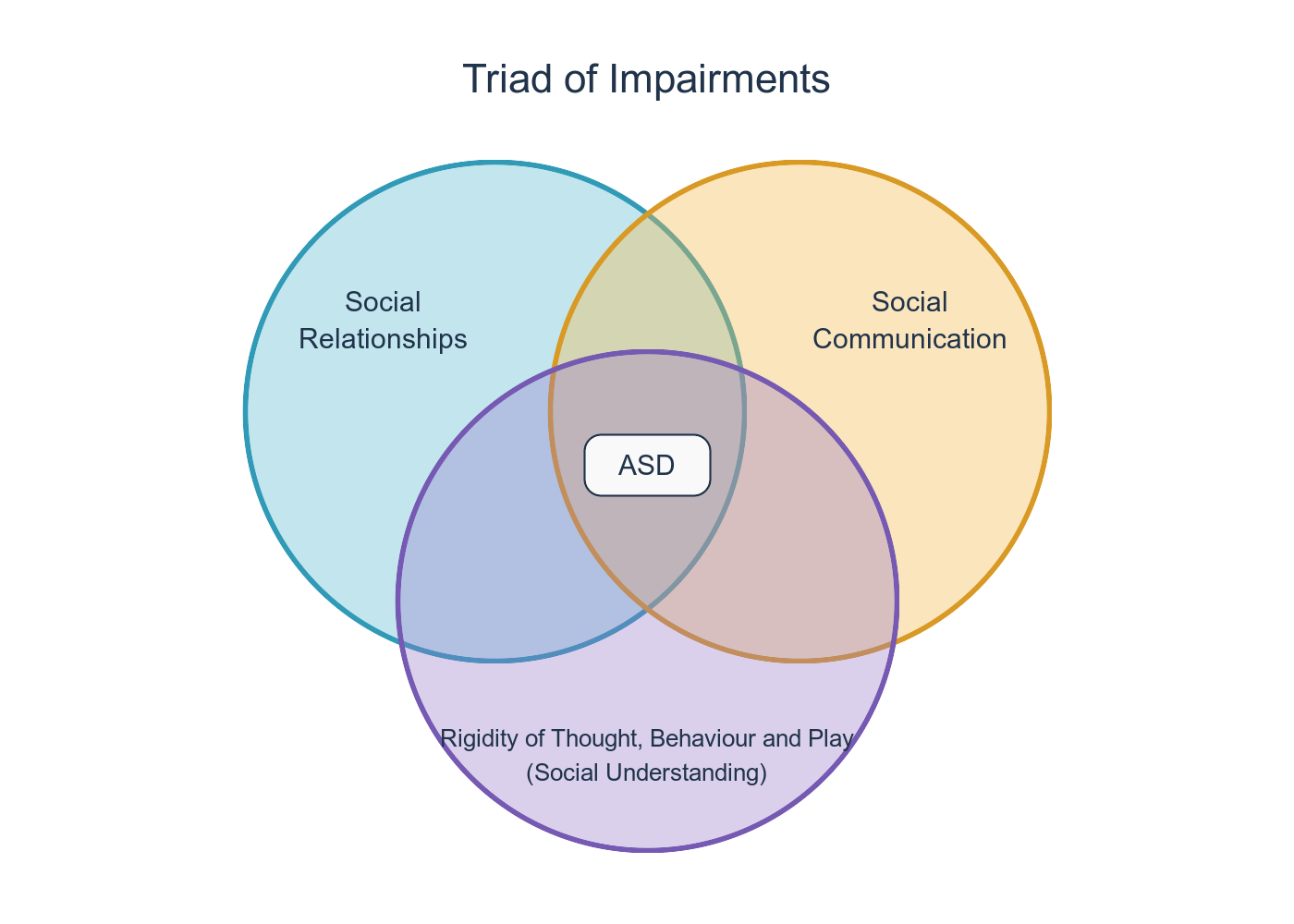
In autism, developmental differences show up mainly in three areas. Together, these three are called the Triad of Impairments.
| Area | What we see |
|---|---|
| Social Interaction / Relationships | Cannot mix with others, cannot make friends |
| Social Communication (Verbal & Non-verbal Communication) | Cannot use speech, gestures and facial expressions properly |
| Imagination / Rigidity of thought, behaviour and play | Repetitive and restricted play and interests |
- Lorna Wing and Judith Gould put forward the idea of this triad through a study they did in 1979 in the Camberwell area of London. Lorna Wing argued that autism is not one separate condition but a spectrum.
Memory code: SCI (as in "science") - Social relationships, Communication, Imagination. Wing + Gould = 79 ("WG 79").
- Diagnosis must be made in these three areas. But in daily life the triad does not always show clearly, so it is hard to identify.
Other problems that can occur with autism
Autism can occur alone, or together with these:
- Sensory Processing Difficulties
- Intellectual Disability (old name: Mental Retardation)
- Hyperactivity and Motor Difficulties
- Seizures / Epilepsy and Learning Disability
- Anxiety, Depression and ADHD are also often present.
However many problems are present together, the first focus should be on autism.
Why is it called a "Spectrum"?
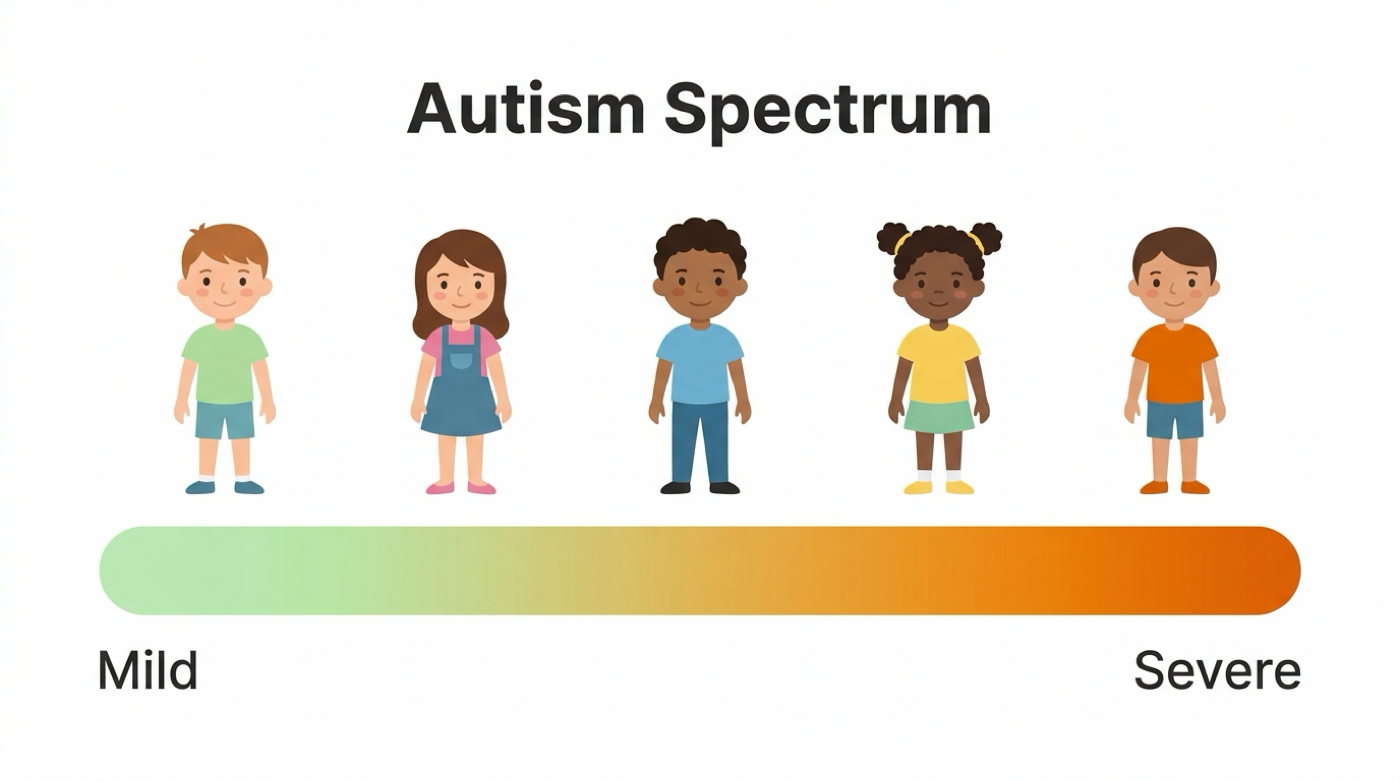
- Spectrum means "a range from mild to severe".
- At one end are people with only mild learning and social difficulties. At the other end are people with many difficulties and very unusual behaviour.
- That is why no two people with autism look alike or behave alike. Each person has their own strengths, limits and personality.
- Some do not speak at all; others speak grammatically correct, complex sentences.
- Some have only a slight delay in language but much more difficulty in making friends.
- Some have no sensory difficulties at all; for others, everyday sounds and lights feel like unbearable overload.
Qualitative Impairment
- In autism, skills are not absent; they are present, but they do not develop as expected for the age. This is called qualitative impairment.
- That is why, in each person with autism, each skill grows at its own pace.
Uneven Skill Development
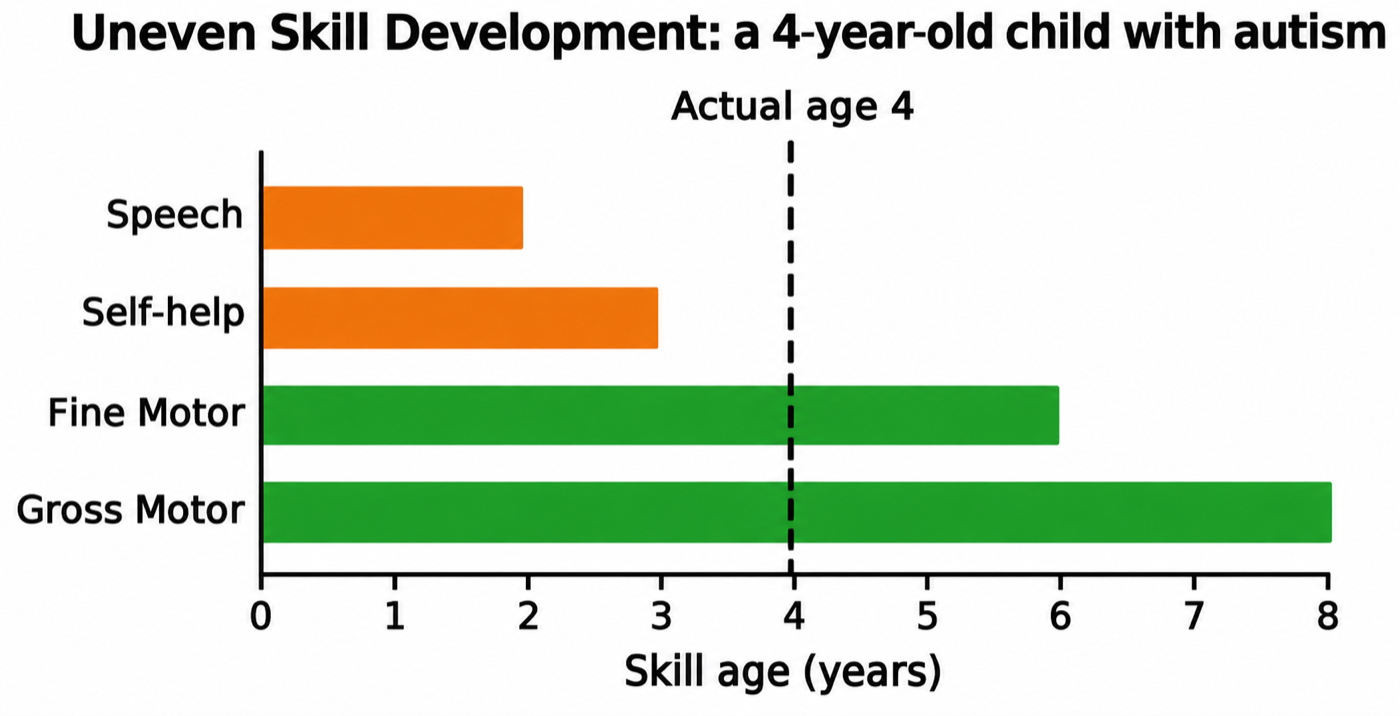
This is the most confusing feature of autism. In a typical 4-year-old, development in all areas is at about the 4-year level. But a 4-year-old with autism may look like this:
| Skill | The child's level |
|---|---|
| Speech | Like a 2-year-old |
| Self-help | Like a 3-year-old |
| Fine Motor | Like a 6-year-old |
| Gross Motor | Like an 8-year-old |
- For example: the child can add and subtract but cannot speak.
- The child knows letters, numbers and rhymes, but cannot express his needs, such as "I am hungry" or "I want water".
Exam focus: Triad = social relationships + communication + imagination/rigidity of thought. "Spectrum" = a range from mild to severe. In autism, skills are present but do not grow to match the age (qualitative impairment), and development is uneven. The body looks normal; we identify autism only through behaviour.
Previous papers questions asked in the exam on what you just read
These people can be differentiated by their behaviours even though their physical appearance is normal
- (1)Dwarfism
- (2)Autism
- (3)Cerebral palsy
- (4)Acid attacked victims
Answer & explanation
Correct answer: (2) Autism
The question asks which group looks physically normal but can be told apart from others only by their behaviour.
Autism is a neurodevelopmental condition. A child with Autism usually has a normal face and body. We identify the condition through behaviour: poor eye contact, not responding to their name, repetitive actions, insistence on sameness, difficulty mixing with others and delayed or unusual speech. So the answer is option (2) Autism.
The other options are visible conditions. Dwarfism (1) shows as very short height. Cerebral palsy (3) shows in posture, movement and gait. Acid attack victims (4) carry visible scars and disfigurement. In all three the physical appearance is not normal, so they do not fit the question.
Remember: Normal look + unusual behaviour = Autism.