ASD is a group of disabilities with many variations in symptoms and behaviours. Abilities, intelligence and behaviours vary a lot from person to person.
- Symptoms range from mild to very severe. Some children do not speak at all; others have limited or even well-developed language.
- Even those with good language talk only about a few topics; abstract concepts and pragmatic language are hard.
- Repetitive play, restricted interests and weak social skills are common.
- Unusual responses to loud sounds, lights, certain touches, foods and clothes are also common.
- The disorders in ASD are syndromes (a collection of symptoms), so each child has a different set of symptoms and a different level of impairment. Each child's level of development is different; each one becomes ready to learn each skill at a different age.
The PDD umbrella (Pervasive Developmental Disorders)
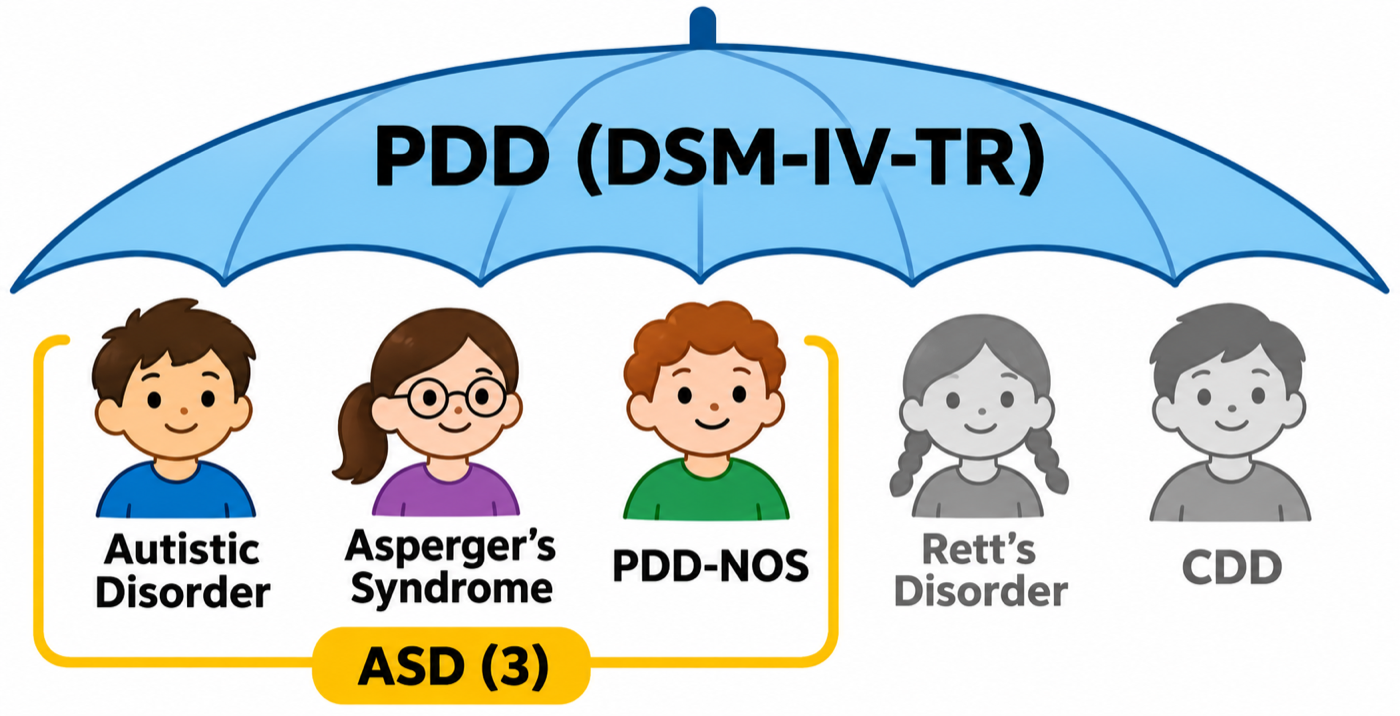
DSM-IV-TR (Diagnostic and Statistical Manual of Mental Disorders, 4th Edition - Text Revision, American Psychiatric Association) classified the disabilities and gave clear definitions for ASD. According to it, the ASDs are groups of disabilities under the heading Pervasive Developmental Disorders (PDD).
- PDD means: a severe and pervasive impairment in several areas of development, such as social interaction skills and communication skills, or the presence of stereotyped behaviours, interests and activities.
5 disorders under the PDD umbrella:
- Autistic Disorder (Classic Autism)
- Asperger's Syndrome / Disorder
- Pervasive Developmental Disorder - Not Otherwise Specified (PDD-NOS)
- Rett's Disorder
- Childhood Disintegrative Disorder (CDD)
The 3 disorders that come under ASD
Of these 5, 3 disorders were called "Autism Spectrum Disorders": Autistic Disorder, Asperger's Syndrome, PDD-NOS.
- These three share some common features; but each has its own special qualities, so they can be diagnosed separately (differential diagnosis).
- That is why the severity of impairment varies across different areas in the same person, and between different people.
| PDD (5 disorders) | Part of ASD (3)? |
|---|---|
| Autistic Disorder | Yes |
| Asperger's Syndrome | Yes |
| PDD-NOS | Yes |
| Rett's Disorder | No (only in PDD) |
| Childhood Disintegrative Disorder | No (only in PDD) |
Previous papers questions asked in the exam on what you just read
Disorders not comes under the Umbrella of FDD(ASD)
- (1)Autistic disorder
- (2)Asperger's disorder
- (3)Rett's disorder
- (4)Physical disorder
Answer & explanation
Correct answer: (4) Physical disorder
The question asks which disorder does not come under the Autism umbrella. "FDD" in the paper should be read as PDD, Pervasive Developmental Disorders.
Under DSM-IV, the PDD umbrella had five conditions: Autistic disorder, Asperger's disorder, Rett's disorder, Childhood Disintegrative Disorder and PDD-NOS (not otherwise specified). In 2013 DSM-5 merged most of them into a single diagnosis, Autism Spectrum Disorder (ASD). All of them are neurodevelopmental conditions affecting social interaction, communication and behaviour.
A physical disorder is not part of this group; it belongs to a different category such as locomotor disability. So the answer is option (4) Physical disorder. Options (1), (2) and (3) are all members of the PDD umbrella, so they cannot be the answer.
Remember: PDD family: Autistic, Asperger, Rett, CDD, PDD-NOS.
1. Autism / Autistic Disorder
- Significant difficulties in social interaction and in expressive and receptive language.
- There may be restricted, repetitive and stereotyped behaviours, interests and activities.
- Onset is clear before the age of 3 - delay or unusual functioning is seen in social interaction, language and symbolic play.
- It is also called Kanner's Autism / Classic Autism.
2. Asperger's Syndrome
- Significant difficulties in social interaction; there may be restricted, repetitive and stereotyped behaviours and interests.
- It causes clear impairment in social, occupational and other important areas of functioning.
- Key difference: unlike Autistic Disorder, these children have no clinically significant language delay. But they have deficits in the practical use of language and in social-communication skills.
- Usually no cognitive delay is seen in the first 3 years; intelligence is usually normal.
- They show intense interest in one object or topic and talk about it all the time. Because they talk like adults giving a lecture, they are called "little professors".
Previous papers questions asked in the exam on what you just read
Lack of socialization, communication and repetitive behaviours seen in
- (1)Down's Syndrome
- (2)Asperger's Syndrome
- (3)Klinefelter's Syndrome
- (4)Turner's Syndrome
Answer & explanation
Correct answer: (2) Asperger's Syndrome
The question asks in which condition we mostly see poor socialization, poor communication and repetitive behaviours.
These three are the core features of autism spectrum disorder, and Asperger's syndrome is a form of autism on that spectrum. Children with Asperger's usually have normal language and intelligence, but find it hard to make friends, read facial expressions and keep up a conversation. They often have intense interest in one topic, insist on routines and show repetitive behaviour. So the answer is option (2).
Down's syndrome (1) is caused by an extra chromosome 21; its main features are intellectual disability and typical facial features, and these children are usually sociable. Klinefelter's syndrome (3) is an extra X chromosome in males (XXY). Turner's syndrome (4) is a missing X chromosome in females (XO). These are chromosomal conditions whose main features are not this group of symptoms.
Remember: Social + communication difficulty + repetitive behaviour = autism spectrum (Asperger's).
3. PDD-NOS (Pervasive Developmental Disorder - Not Otherwise Specified)
- This category is used when the child does not fully meet the diagnostic criteria of the other disorders.
- But there is a severe and pervasive impairment in the development of social interaction or communication skills, or restricted, repetitive, stereotyped behaviours.
- Because some, though not all, of the features of autism are present, it is also called "atypical autism".
4. Rett's Disorder / Rett Syndrome
- Occurs almost only in girls.
- Regression begins between 5 and 18 months; symptoms appear between 1 and 4 years.
- Head growth slows down (head growth deceleration - between 5 and 48 months).
- Purposeful use of the hands is lost, and stereotyped movements such as hand-wringing and hand-washing appear.
- It is caused by a change (mutation) in a gene called MECP2; this gene is on the X chromosome. It was described in 1966 by the Austrian doctor Andreas Rett.
5. Childhood Disintegrative Disorder (CDD)
- The rarest form of ASD.
- It is also called Disintegrative Psychosis or Heller's Syndrome.
- Children develop normally for at least 2 years - they learn to walk, talk and other skills. After that (before 10 years, usually between 3 and 5 years) they lose the skills they learnt, and autism features appear.
- Bowel and bladder control, motor skills and language are also lost.
Comparison table of DSM-IV-TR disorders (Differential Diagnostic Features)
| Feature | Autistic Disorder | Asperger's Disorder | Rett's Disorder | CDD | PDD-NOS |
|---|---|---|---|---|---|
| Prevalence | 13 : 10,000 | 3 : 10,000 | 1 : 22,800 (live female births) | 0.2 : 10,000 (very rare) | 20.8 : 10,000 |
| Sex ratio (M:F) | About 4:1 | 5:1 to 9:1 | Almost only girls | 4:1 | M > F |
| Age of onset | Delay before 3 years; signs in the first year; regression in 20-25% | Often not identified until school age, when problems with peers appear | Regression at 5-18 months | Regression after 2 years and before 10 years (usually 3-5 years) | Deficits in the first few years after birth |
| Social | Little eye contact, no gestures or facial expressions, no age-appropriate friendships, do not share interests, do not point | Same as autism; interested in social relationships but behaviour is odd | Social skills lost at 1-4 years, then some improvement; eye contact is kept | Same as autism; social skills are lost | Social deficit is the main problem |
| Communication | Speech delayed or absent; echolalia; abstract concepts hard; no imaginative play | No speech / language delay; large vocabulary ("little professors"); odd voice and speed | Speech is lost; severe expressive and receptive language deficits | Loss of receptive and expressive language | Verbal / non-verbal deficits along with social deficit |
| Behaviour | Very restricted interests, insistence on routine, hand-flapping, fascination with parts of objects, toe-walking | Same as autism; intense interest in one topic, one-sided talking | Loss of purposeful use of the hands, hand-wringing; later ataxia, spasticity, scoliosis | Loss of bowel and bladder control and motor skills | Stereotyped behaviours may be present |
| Cognitive level | MR (ID) common - mild to severe; non-verbal skills better than verbal; some have special talents like calendar calculations | Occasionally mild MR, not common | Severe or profound MR | Severe MR | Not defined |
| Medical / genetic aspects | Epilepsy, EEG abnormalities; macrocephaly; unusual responses to the senses; highly heritable | Motor difficulties, poor coordination, clumsiness | Seizures, breathing and sleep problems; MECP2 gene mutation | Seizures, EEG abnormalities | Genetic link with autism |
| Prognosis | Continuous course; better outcome when language and cognitive ability are higher | Better prognosis than autism; improvement in adolescence | Progressive regression; some improvement in social interaction | Decline stops at a certain level; "limited recovery" in most | Better prognosis than autism |
Exam focus: In DSM-IV-TR, PDD = 5 disorders (Autistic, Asperger's, PDD-NOS, Rett's, CDD); of these, ASD = 3 (Autistic, Asperger's, PDD-NOS). Asperger's - no language delay, "little professors". Rett's - girls, hand-wringing, MECP2. CDD - normal development up to 2 years, then loss of skills, Heller's Syndrome, very rare. "Physical disorder" does not come under PDD.
Memory code: PDD 5 = "AAP + RC" - AAP (Autistic, Asperger's, PDD-NOS) = the 3 inside ASD; RC (Rett's, CDD) = the 2 outside. Rett's = "Wringing Girls" (hand-wringing, girls). CDD = fine until 2 years, then skills are lost (Heller's). Asperger's = "little professors" - speech is fine, social side is weak.