AP DSC Special Education Papersతెలుగు మీడియం

Topic 9 of 13 · Autism Spectrum Disorder: Nature, Types and Characteristics

Sensory-Motor and Attention-Organization Characteristics

These are related characteristics of autism.

Sensory Characteristics

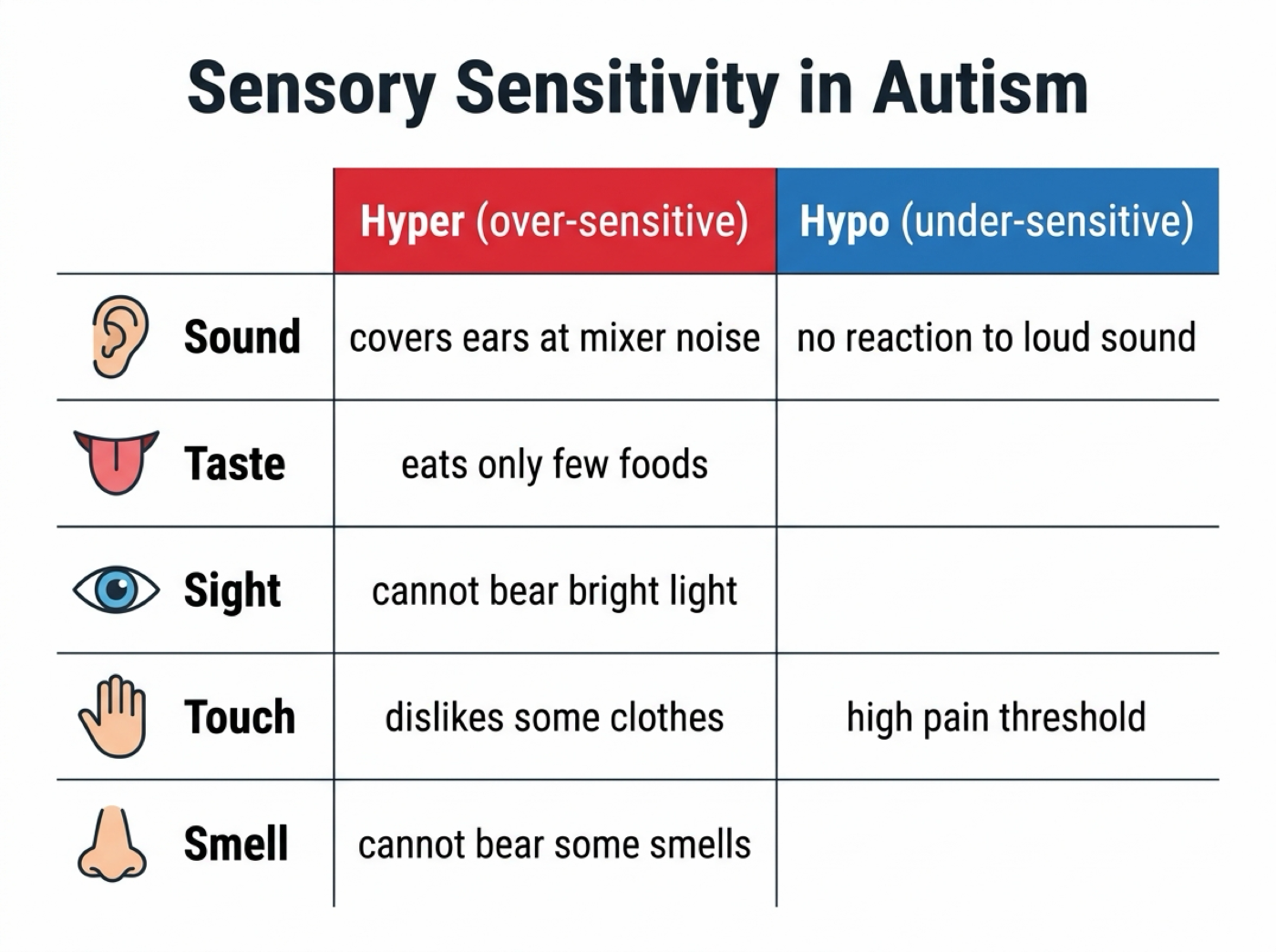
SenseExample
SoundsCovering the ears at the sound of a mixer or bell; or not reacting even to a loud sound
TastesEating only certain foods
Visual inputUnable to bear bright lights; over-fascination with spinning objects and flashing lights
TexturesDisliking the touch of certain clothes and objects
SmellSmelling objects; unable to bear certain smells
The senses: Hyper (over-sensitive) and Hypo (under-sensitive) - 5 senses

Motor Characteristics

Attention / Organization Characteristics

Poor ConcentrationPoor Organizational Skills
Often off taskLose papers and assignments
Easily distractibleBench / desk is cluttered
Overloads easilyNever empty their bag
DisorganizedCannot plan ahead and get the book, packet and other things needed for homework ready
Find it hard to keep attention for longDo not remember homework
Do not know how or where to start a taskPapers are dirty and written work is messy

Exam focus: In the senses, both hyper (over) and hypo (under) sensitivity occur - sound, taste, sight, touch, smell. High pain threshold. Weak fine motor → handwriting is hard; gross motor shows coordination and balance difficulties.

Memory code: Hyper = High (over-sensitive), Hypo = lOw (under-sensitive). The 5 senses in order: "Some Teachers See Tired Students" - Sound, Taste, Sight, Touch, Smell. Fine motor → Fingers (handwriting); Gross motor → Ground (playground, balance).

Topic 9 done

Mini exam: 5 questions

Pick an option for each question, then press "Show answers". Your score and the explanations appear at once.

Question 1 / 5

In class, as soon as the bell rings, a child with autism covers his ears and cries. Which feature does this show?

Answer and explanation

Correct answer: (1) Hypersensitivity to sounds

Covering the ears because sounds like a mixer or bell cannot be tolerated is an example of hypersensitivity (over-sensitivity) to sounds. Children with autism may show either over- or under-sensitivity to the senses.

With hyposensitivity they would not react even to a loud sound, so it is not that. High pain threshold relates to pain; a fine motor deficit relates to written work, not to sound.

Question 2 / 5

A student with autism does not cry even when he falls while playing and hurts his knee, and he also ignores heat and cold. What is this feature called?

Answer and explanation

Correct answer: (3) Insensitivity to pain / high pain threshold

Hardly reacting even when hurt, and indifference to heat and cold, are signs of the sensory feature called low response to pain / high pain threshold.

Toe-walking is a motor feature of walking on the toes. Poor organizational skills relate to handling papers, bag and desk. Over-sensitivity to sights relates to being unable to bear bright lights, not to pain.

Question 3 / 5

Under which type of features does 'toe-walking', seen in children with autism, come?

Answer and explanation

Correct answer: (2) Motor Characteristics

Toe-walking is an unusual movement, so it comes under Motor Characteristics. Weak fine motor skills, coordination and balance difficulties in gross motor skills, and poor body awareness in space are also in this group.

Sensory characteristics relate to sound, taste, sight, touch and smell. Poor concentration and poor organization are attention-organization features; they have no link with the way of walking.

Question 4 / 5

Which of the following is an example of 'Poor Organizational Skills' rather than 'Poor Concentration'?

Answer and explanation

Correct answer: (4) Never emptying the bag and having a cluttered desk

Never emptying the bag, a cluttered desk, losing papers and assignments, and not remembering homework are features of Poor Organizational Skills.

Being easily distractible, being off task, and not knowing how to start a task - these three are on the Poor Concentration side, so they are not the right answer.

Question 5 / 5

Consider the following statements about the motor skills of children with autism: (i) Fine motor skills are weak, and handwriting is messy and goes over the lines. (ii) There may be coordination and balance difficulties in gross motor skills. (iii) In some children with autism, gross motor skills are ahead of their age. Which of these are correct?

Answer and explanation

Correct answer: (4) All of (i), (ii) and (iii)

All three statements are correct. Because of weak fine motor skills, writing takes effort and handwriting is messy; gross motor skills may show coordination and balance problems. But since development is uneven, in some children gross motor skills are ahead of their age.

Saying only (i) and (ii) leaves out the key point of uneven development. The options 'only (ii) and (iii)' or 'only (i)' also leave out correct statements.