People with autism may show the following features in different combinations and at different levels of severity. Not everyone has all of them.
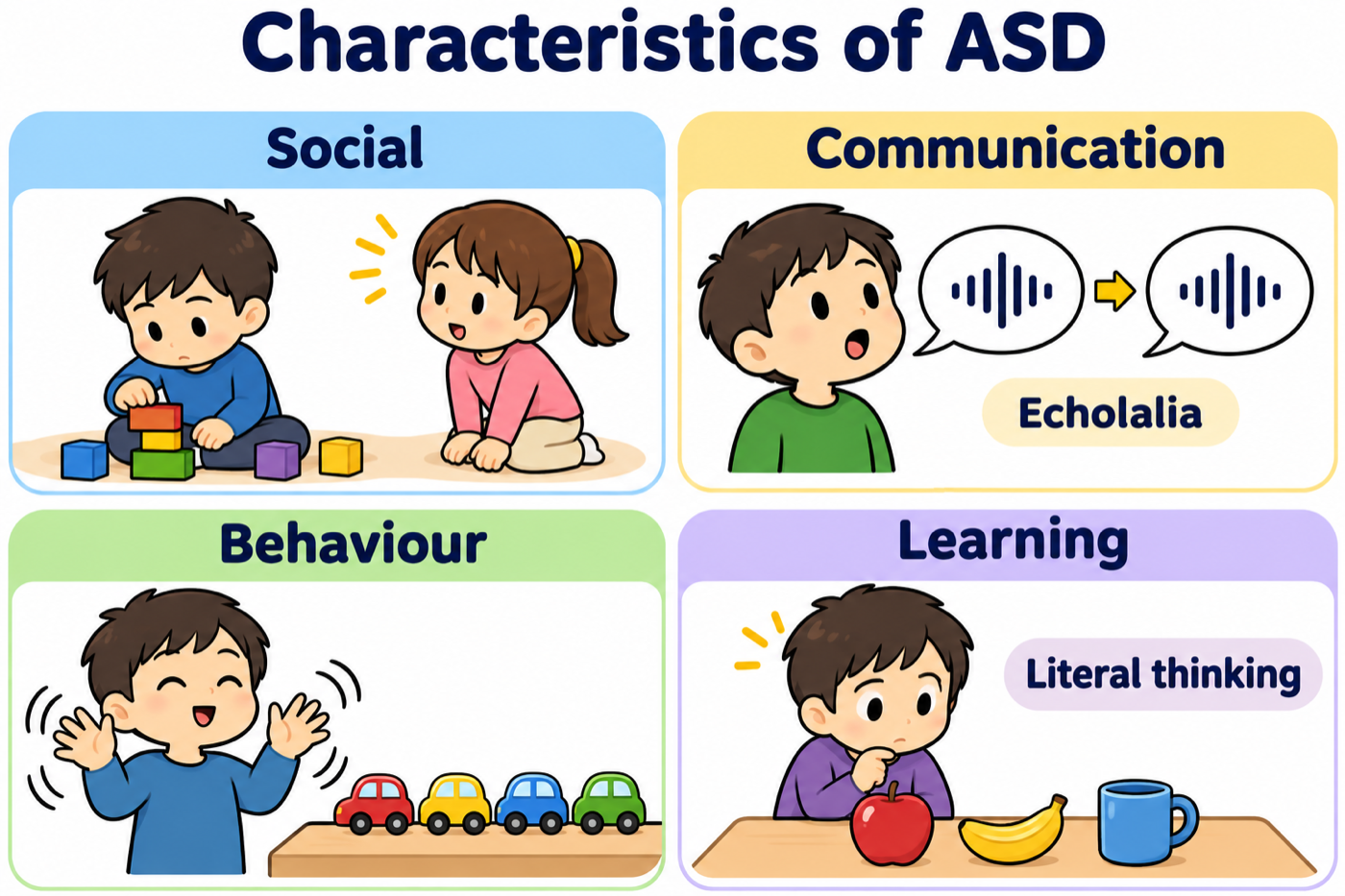
Social Characteristics
- Poor eye contact.
- Do not treat strangers differently from people they see daily; show no fear of strangers.
- A very narrow range of emotions; show emotions that do not fit the situation.
- Do not enjoy social games such as peek-a-boo and patty cake.
- Lack pretend / imaginative play skills.
- Seem unaware that others are around.
- Difficulty in emotional and social reciprocity; cannot mix with others.
- Very little or no interest in friendships; finding and keeping friends is hard.
- Starting and continuing play with other children and groups is hard. So they mostly engage in Solo Play / Solitary Play.
- Cannot understand social cues, gestures and facial expressions.
- Do not understand how others feel or how they show their mood.
- Have strange fears, or no fear at all of real danger.
- Play their favourite game again and again.
Previous papers questions asked in the exam on what you just read
One of the characteristic features of Autism is
- (1)Singing
- (2)Loss of eye contact
- (3)Dancing
- (4)Story telling
Answer & explanation
Correct answer: (2) Loss of eye contact
The question asks which of the given is a feature of autism.
Children with autism have difficulty in social communication. Poor or no eye contact, not responding to their name, playing alone, repetitive behaviour and delayed speech are its key features.
Loss of eye contact is one of the earliest signs of autism, so the answer is option (2).
Singing, dancing and storytelling are normal activities of any child and are not signs of autism. Storytelling in fact needs good communication skills, which are usually weak in autism. So options (1), (3) and (4) are wrong.
Remember: Early autism red flag: no eye contact.
Generally we observe this type of play in children with Autism
- (1)Parallel Play
- (2)Associative Play
- (3)Solo Play
- (4)Cooperative Play
Answer & explanation
Correct answer: (3) Solo Play
The question asks which type of play is typical of children with Autism.
Mildred Parten described stages of children's play: solitary (alone), parallel (side by side but separately), associative (together but without shared rules or goals) and cooperative (together towards a common goal). Children with Autism have weak social interaction. They tend to play alone, often repeating the same action with one object, without involving others. So the answer is option (3) Solo Play.
Parallel play (1) still involves playing near other children. Associative play (2) and cooperative play (4) need talking, sharing and taking turns with others, which are exactly the social skills that are difficult for children with Autism.
Remember: Autism and play: usually alone (solitary/solo play).
Communication Characteristics
- Find it hard to read and show feelings (e.g. little smiling, a blank face).
- Are unusually quiet.
- Do not respond when their name is called; act as if they did not hear or do not care. (That is why hearing impairment is often suspected first.)
- No babble or coo in infancy.
- Language delay.
- Stereotyped or idiosyncratic (their own peculiar) speech is common - echolalia may be immediate or delayed.
- Once spoke a few words but no longer speak (loss of speech).
- Find it hard to imitate and use gestures and suitable facial expressions.
- Find it hard to start a conversation with others; seem uninterested in conversation.
- Do not imitate or do functional play or pretend play.
- Do not point and do not wave bye-bye.
- Pitch, intonation, rhythm and stress are unusual.
- Grammar seems immature for the age.
- Find it hard to understand and use language suited to the situation (pragmatic language).
- May show what they want with gestures because they cannot say it in words.
Behaviour Characteristics
- Dislike being picked up and go stiff; may not like cuddling.
- Repetitive body movements such as hand / finger flapping and rocking back and forth.
- Spinning objects or themselves round and round.
- Over-react to some sounds; do not react at all to others.
- Stereotyped, repetitive or idiosyncratic use of language.
- Doing certain tasks again and again stubbornly (perseveration).
- Constant fascination with parts of objects (e.g. spinning only the wheel of a toy car).
- Resisting change in routine; a strong insistence on following the routine exactly.
- Lining up objects; inappropriate attachment to objects.
- No fear of real danger (e.g. not afraid of vehicles on the road).
- Exploring the surroundings in unusual ways such as licking, smelling and feeling with the hands.
- Avoiding looking at others; preferring to touch objects rather than people; preferring to be alone.
- Laughing or giggling without reason (inappropriate laughing or giggling), or crying.
- Severe tantrums and great distress for no clear reason.
- Hurting themselves when upset (self-injurious behaviour - head banging, biting).
- Seeming not to respond to pain (apparent insensitivity to pain).
- Unusual, long-lasting or repetitive play; uneven physical or verbal skills.
- Do not like giving or sharing objects with others.
Previous papers questions asked in the exam on what you just read
These children laugh unnecessarily
- (1)Orthopedically impairment
- (2)Hearing impairment
- (3)Autism
- (4)Visual Impairment
Answer & explanation
Correct answer: (3) Autism
The question asks which group of children laughs without any reason.
Children with autism spectrum disorder have difficulty in social interaction and communication. Common signs are poor eye contact, repetitive actions such as hand-flapping, insistence on sameness, and laughing or crying without any reason that fits the situation. They find it hard to show emotions that match the context.
So the answer is option (3), Autism.
Orthopedic impairment (1) affects movement, not emotional expression. Children with hearing impairment (2) may not hear speech, but they watch the situation and respond to it. Unnecessary laughter is not a typical sign of visual impairment (4) either.
Remember: Laughter without reason, poor eye contact, repetitive acts: autism.
The children who always expressing unusual or stereotypical behaviour are identified as
- (1)Intellectual Disability
- (2)Specific Learning disability
- (3)Autism Spectrum disorder
- (4)Multiple Sclerosis
Answer & explanation
Correct answer: (3) Autism Spectrum disorder
The question asks which condition is identified by constant unusual or stereotyped (repetitive) behaviour.
Autism Spectrum Disorder (ASD) has two core features: difficulty in social communication, and restricted interests with repetitive behaviour. Hand flapping, rocking, lining up objects and getting upset when the routine changes are typical stereotyped behaviours.
So children who always show such behaviour are identified as having Autism Spectrum Disorder, option (3).
Intellectual disability is mainly low intellectual functioning with poor adaptive behaviour. Specific learning disability is difficulty in reading, writing or maths. Multiple sclerosis is a disease of the nervous system. Stereotyped behaviour is not the defining sign of any of these.
Remember: Repetitive, stereotyped behaviour + poor social communication = autism.
Learning Characteristics
- Performance is uneven within one skill area and between different areas; there may be unusual talent in some areas (e.g. calendar date calculations).
- Resist change in the classroom / learning environment.
- Find it hard to wait and to use free, unstructured time.
- Cannot apply a skill learnt in one place to another place (poor generalization).
- Abstract and conceptual thinking is hard; they need clear, concrete experiences.
- Use and understand words literally. E.g. they take the idiom "all ears" to mean that a person is really made of ears. They cannot read facial expressions, body language and other social cues.
- Behave in an impulsive, compulsive or perseverative way; behaviour is inconsistent.
- Get distracted quickly by stimuli such as sounds and sights.
- Find organization, planning and making choices hard.
- Depend on learnt routines, cues and learnt patterns.
Exam focus: The best-known features of autism: no eye contact, echolalia, stereotypical behaviour, laughing without reason, solo play, resisting change in routine, no fear of danger, low response to pain. In learning - poor generalization, literal meaning, need for concrete experiences.
Memory code: Best-known features "Eye-Echo-Solo" - no Eye contact, Echolalia, Solo play. In learning "G-L-C": poor Generalization, Literal meaning, need for Concrete experiences.