Communication, language and speech
- Communication: a purposeful, two-way, complex process of sending a message from one end to the other through a channel. Sender (encoder) → message → channel → receiver (decoder).
- The way the message is sent is called expression, and receiving and understanding it is called comprehension. Communication happens only when both people share the same code. For example, if a message is sent with facial expressions and hand gestures, the other person must also understand them (this is the non-verbal mode).
- Language: a complex system of symbols used to share ideas. Language gives words to our thoughts, voice to our ideas and expression to our feelings. According to Noam Chomsky, language is a set of (finite or infinite) sentences, each finite in length and built from a finite set of elements.
- Language has three components: form, content and use.
- Speech: the oral form of language. Sounds and words are produced by the coordination of the facial muscles and the air flowing through the voice box (larynx).
- Ear language = spoken (oral) language, the medium of everyday conversation. Eye language = written language. A deaf child cannot pick up sound through the ear, so he is behind in ear language from the very start.
- Not every message is language: writing a letter, saying "go to the bank", listening to the radio and teaching a lesson in Indian Sign Language are language. Stopping at a red signal, waving goodbye, opening the door when the bell rings and telling a story through Bharatanatyam are communication, but not language.
- Linguistic communication takes place in three ways: auditory/oral (listening/speaking), visual/written (reading/writing) and visual/manual (sign language).
- We also communicate through gestures, facial expressions and body language. In conversation with people with hearing loss, face-to-face expressions and body language play a major role.
- For communication to go smoothly, the listener's hearing must be normal, the sound waves must reach the listener, and the auditory nervous system must carry the information to the brain.
Memory code: Language = "FCU" - Form, Content, Use. Communication chain "S-M-C-R" - Sender, Message, Channel, Receiver.
The broken link between hearing and speaking
A child with hearing loss has the system to process language and speech, but the raw material it needs (speech that can be heard) does not reach it in enough quantity. There are two ways to deal with this broken link:
| Way | Meaning |
|---|---|
| ACE (Appropriate, Continuous, Early) amplification | Amplification that is appropriate, continuous and given early, together with training - it restores the hearing-speaking link |
| ENR (Early, Natural, Rich) sign language | Giving sign language early, naturally and richly - it bypasses the hearing-speaking link |
Choosing between these two ways, and the methods in between, is a complex issue with many sides. A child with hearing loss does not learn to listen immediately; learning language becomes possible only after suitable amplification and speech-language training are given.
Memory code: "ACE repairs, ENR bypasses" - ACE = Appropriate, Continuous, Early amplification (mends the link); ENR = Early, Natural, Rich sign language (goes around the link).
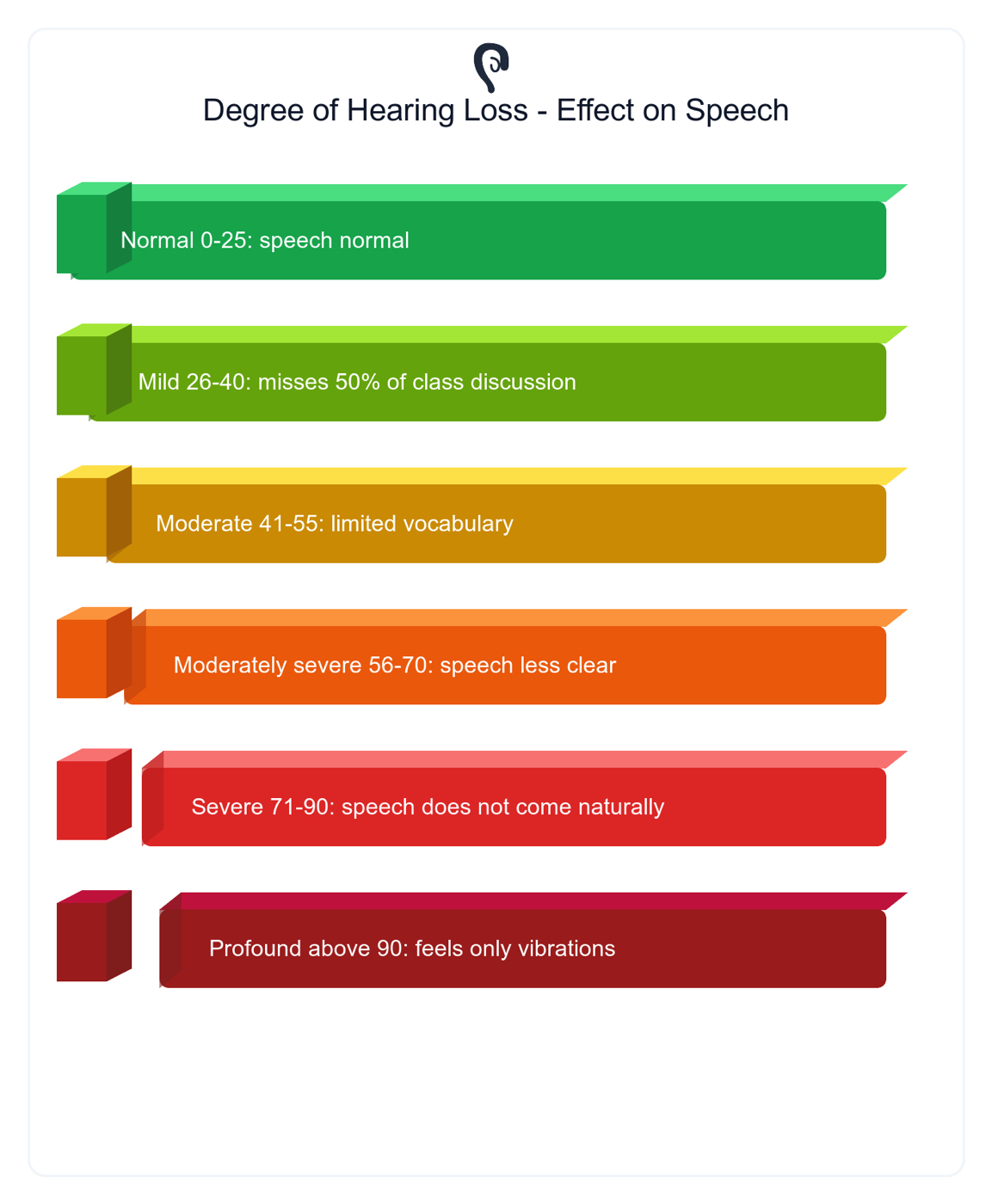
Effect of each degree of loss on language and communication
(The details of the classification of degrees are in the chapter "Hearing Impairment: Nature and Classification"; here we look only at the effect of each degree on language and speech.)
| Degree (dB HL) | Sounds that are missed | Effect on language and communication |
|---|---|---|
| Normal (0-25) | None | Speech and language normal; good listening comprehension skills |
| Mild (26-40) | 25%-40% of the speech signal; distant sounds, voiceless consonants, plurals, tenses | Misses about 50% of class discussion; cannot suppress background noise. Speech and language stay in the normal range, but there are occasional listening comprehension problems and some academic lag; soft sounds such as whispers are hard to detect |
| Moderate (41-55) | 50%-80% of the speech signal | Articulation deficit, limited vocabulary, learning difficulty. Rare words, fine differences of meaning and idioms are hard; speech is still intelligible. Reading and writing are delayed; special help with vocabulary, reading and writing is needed. Cannot hear conversation clearly; needs a hearing aid |
| Moderately severe (56-70) | Up to 100% of speech at normal conversational loudness (without a hearing aid); loud speech can still be heard | Delayed sentence structure (syntax), a voice without rise and fall (atonal), reduced speech intelligibility. Grammar, vocabulary, articulation and voice are affected; understands only when spoken to loudly; does not understand the first word. Has difficulty even with a hearing aid; needs special help with reading and writing. Cannot hear clearly even loud sounds such as a phone ringing |
| Severe (71-90) | All speech sounds; can hear only loud environmental sounds | Speech does not develop or deteriorates; learning deficits. Speech and language do not come naturally. Hears only sounds made loudly at 1 foot, close to the ear (a shout, a vacuum cleaner). The voice is high-pitched (shrill) and articulation is distorted |
| Profound (above 90) | All speech sounds; only vibrations are felt | Does not rely on hearing for communication. Language and speech come only through training; these children are educationally deaf. Communicate mostly through gestures; voice, rise and fall, and articulation are badly affected; need regular speech-language training from specialists |
- Speech discrimination (telling words apart when they are loud enough), in the better ear, roughly: mild loss about 100% (almost normal), moderate loss 50%-80%, moderately severe loss 40%-50%; in severe and profound loss there is no speech discrimination.
- By type, roughly: mild and moderate losses may be conductive or sensorineural; moderately severe, severe and profound losses are mostly sensorineural or mixed.
- Children with mild to severe loss usually keep building on the language they have learnt; research shows that children with profound loss can also learn to speak with training.
- For children born with a severe hearing loss, reading, writing and speaking are extremely difficult without the help of a hearing aid.
- If hearing loss is not identified, or is identified late (after the age of 6 months), language and speech are delayed. This delay affects social relationships, emotional development and studies.
Exam focus: A child with mild loss (26-40) misses about 50% of class discussion; voiceless consonants, plurals and tenses are not heard. A hearing aid is needed from moderate loss onwards. People with profound loss are "educationally deaf"; they feel only vibrations. Identification after 6 months counts as late identification.
Memory code: Degrees start at "26-41-56-71-91" - each step rises by 15 (the step from severe to profound rises by 20). For mild loss, "half the class missed" = 50%.