To decide what training, which communication method and which device a child needs, we must first find out the level of his language, communication and speech. This is called assessment. Assessment is not done once and forgotten; it must be repeated regularly to watch progress.
Language assessment: what to look at
- Receptive language: how much the child understands - words, instructions, questions.
- Expressive language: how much he can express - through speech, gestures or writing.
- The three components of language: form (sounds, word structure, word order/grammar), content (vocabulary, meanings) and use (using language to suit the situation, carrying on a conversation).
- How large is the vocabulary; does he use rare words, idioms, plurals and tenses correctly; how long and how well ordered are his sentences.
- Language assessment means estimating the child's language ability and, on that basis, improving his language skills. The child should be taught language and speech through daily events and the things happening around him, assessed on that basis and helped to develop.
Communication assessment: what to look at
- In which mode the child communicates - speech, gestures, sign language, writing, pointing, facial expressions.
- Does he start a conversation, does he take turns, does he ask again when he does not understand a message.
- Conversation: using speech or signs (or both) to share experiences, ideas and information informally.
- Gesture: a movement of a part of the body, especially the hand or head, to express an idea.
- Facial expression: conveying a feeling through the face in non-verbal communication.
- Sign: a large system made of hand shapes, positions and movements, with facial expressions added. A classifier is a special hand shape that stands for a person or an object.
Assessment methods
| Method | How it is done |
|---|---|
| Observation | Watching how the child communicates in natural situations - at home, at play, in class |
| Parent report / rating scale | Filling in a scale with information from parents. Example: the Receptive Expressive Emergent Language Scale (REELS) - developed by Bzoch and League (1971), it measures receptive and expressive language from birth to 3 years; it has also been translated into Indian languages |
| Language sample | Recording the child's speech/signs and analysing vocabulary and sentence structure |
| Checklist | Comparing with a list of age-wise language milestones |
| Diary | Writing down the child's language in a diary and watching progress |
Speech assessment
Features seen in the speech of children with hearing loss: articulation errors, a high-pitched (shrill) voice, a flat voice without rise and fall, inability to control how loud to speak, and unintelligible speech. Speech assessment looks at:
| Area | What is checked |
|---|---|
| Articulation | Are vowels and consonants pronounced correctly; which sounds are omitted, substituted or distorted |
| Voice | Pitch, loudness (loud/soft), voice quality |
| Fluency and rhythm | Flow of speech, stress, rise and fall (inflection) |
| Speech intelligibility | How far a stranger can understand his speech |
- How well speech sounds reach the child through the hearing aid / cochlear implant decides speech intelligibility. Speech therapy improves it.
- Some people with hearing loss are easy to understand; others may not be understood at first because they cannot control their loudness and voice.
Daniel Ling Six Sound Test
- This simple test, designed by Daniel Ling, has six sounds: /m/, /oo/, /ah/, /ee/, /sh/, /s/.
- They cover the whole range of speech sounds from low frequency (/m/, /oo/) to high frequency (/sh/, /s/).
- Each sound is said out of the child's sight (for example, from behind), and the teacher checks whether he heard it and which sound he recognised.
- It is a quick daily check that teachers and parents do to see whether the child's hearing aid / implant is working properly.
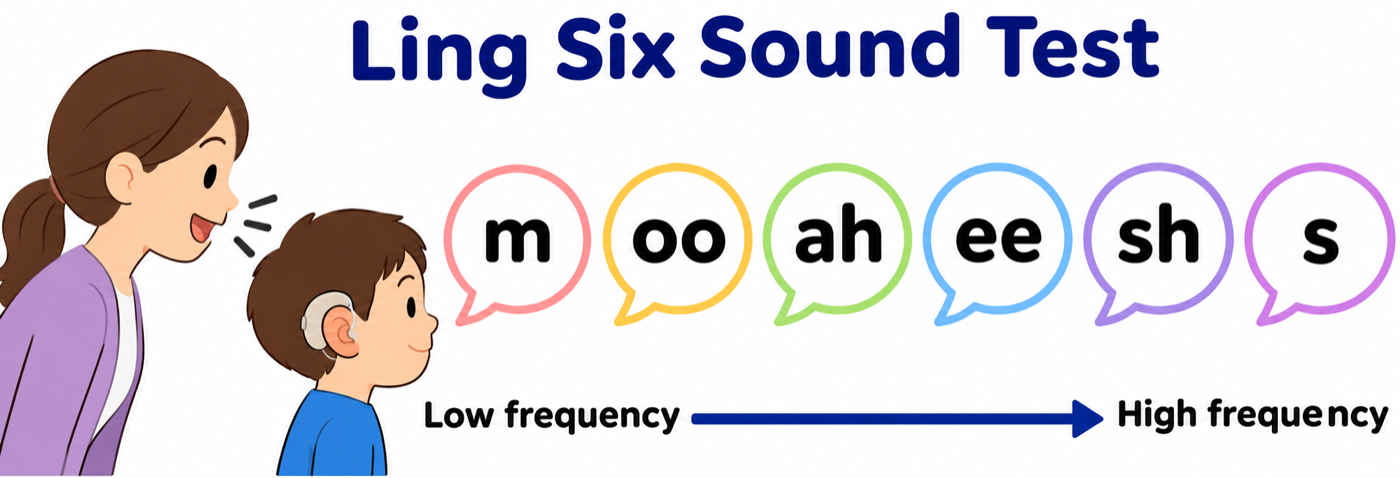
Exam focus: The Ling Six Sound Test is for detecting sounds (a daily check of how the hearing aid works). The six sounds: /m/, /oo/, /ah/, /ee/, /sh/, /s/. Language = form + content + use; both receptive and expressive language must be assessed. REELS = a language scale from birth to 3 years.
Previous papers questions asked in the exam on what you just read
Daniel Ling '6' Sound Test is used to
- (1)Identify the Sounds
- (2)Identify the Intelligence
- (3)Identify the Speech
- (4)Measure the Accuracy
Answer & explanation
Correct answer: (1) Identify the Sounds
The question asks the purpose of the Ling Six Sound Test developed by Daniel Ling.
The test uses six sounds: m, oo, ee, ah, sh and s. Together they cover the range of speech sounds from low to high frequency. The tester says each sound, usually from behind the child, and checks whether the child detects it and can identify which sound it was. Teachers use it as a quick daily check that a child's Hearing Aid or cochlear implant is working across the speech range. So the answer is option (1) Identify the Sounds.
The test does not measure intelligence (2). Its aim is not to judge the child's own speech (3) or to measure accuracy in general (4); it checks whether speech sounds are heard and recognised.
Remember: Ling 6: m, oo, ee, ah, sh, s.
Memory code: Speech assessment "A-V-F-I" - Articulation, Voice, Fluency, Intelligibility. Ling sounds "m-oo-ah-ee-sh-s" - read it as "Moo, ah-ee, shush!"; /m/ is the lowest and /s/ the highest frequency.