In today's society literacy (reading and writing) is a must: the internet, e-mail, work instructions, prescriptions, travel and newspapers all need it. It is also the key to success in studies. A student without literacy cannot take full part in class; he faces lifelong problems with school failure, employment, social adjustment and independent living.
Hearing loss and literacy
- Hearing loss has no direct link with literacy. But because of the basic gaps in language and communication, literacy suffers in many cases.
- Reading and writing are not just recognising a script; one must know the language behind that script. For example, we can read a German sentence written in the Roman script but cannot understand it; the same meaning in English we understand. So reading and writing are not possible without age-appropriate knowledge of language.
- Hearing loss affects language → language is not enough → literacy suffers.
- Though there are many similarities with the literacy development of hearing children, children with hearing loss lag far behind, especially in the early stages. Even in adolescence they have many-sided problems in reading, writing and language; these shape their attitude towards getting and using academic information.
- If they can get and use that information properly, they play a major role in society, study well, work and live independently.
Problems in literacy development
- In children with delayed language, the development of theory of mind is also significantly delayed; it depends on the chances they get for social interaction, listening comprehension, spoken conversation and play.
- Learning oral language remains a challenge, and this affects reading. According to one study, the reading outcomes of 96% of children with hearing loss are well below average; most reach only 4th to 6th grade reading proficiency.
- The 19th International Congress on Education of the Deaf (ICED) brought together 1,067 teachers, administrators and researchers from 46 countries. It noted that while academic outcomes improve where there are more hearing peers, social language use and making friends with hearing children remain problems in mainstream schools.
- Sensory-motor problems: children with sensorineural loss have more difficulty with vestibular processing (balance). This causes delays, or compensatory strategies, in gross motor skills such as balance, coordination and body-space awareness. Differences in balance, complex motor sequences, sensation and vestibular processing have been consistently recorded.
- 4 areas of concern compared with hearing peers (Kluwin, Stinson and Colarossi, 2002): (1) social skills, (2) interaction/participation, (3) social status/acceptance, (4) affective (emotional) functioning.
- They are more likely to have other diagnoses as well, such as apraxia and attention disorders. Auditory deprivation also affects motor and language skills that share the same brain areas.
- Literacy is the most important skill for getting academic information. It is also the basis for sharing ideas and learning through conversation, reading and writing.
- Students leaving school after the secondary level should come out with independent living skills, readiness for employment and the skill of "learning how to learn".
Early literacy: face-to-face language
- A student with hearing loss has two problems in early literacy. First, he cannot properly develop face-to-face language (spoken or signed conversation while looking at the face). Second, there is a gap between spoken language and written language; this problem grows bigger especially when the child's first language and the written language learnt at school are different. Those with a greater degree of loss have more problems.
- Mayer and Wells (1996) designed a framework: in the early stage, face-to-face language (taught through signs and facial expressions) must be developed first; reading and writing grow on that base.
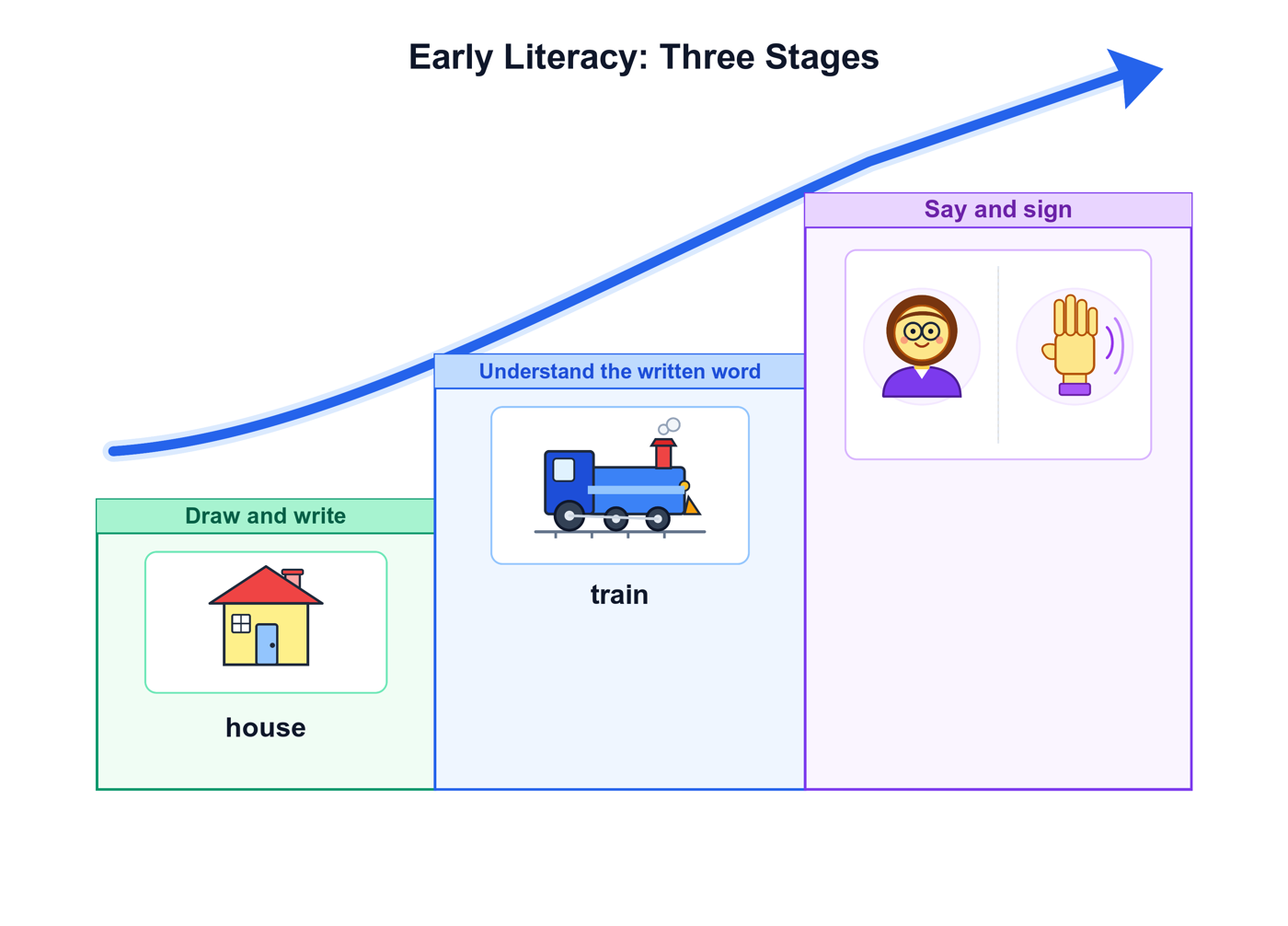
- The researcher Emilia Ferreiro, in 1990, realising that children with hearing loss have great difficulty in reading and writing, gave a three-stage framework based on the link between pictures and writing:
| Stage | What is done | Example |
|---|---|---|
| 1. Writing through pictures | Teaching, without the child noticing, how to hold a pen/pencil by drawing lines, circles and pictures; having the child draw a picture and write its name in letters | Drawing a house and writing "house" |
| 2. Understanding what is written | Teaching subject knowledge - what the written word refers to, why and where it is used | "Train" is a vehicle, and it is very long - teaching both "train" and "long" |
| 3. Saying and signing the written words | Teaching to say each word to suit the hearing ability and to show it with a sign; reading the teacher's lip movements and signs by looking at her face (face-to-face language); the most important stage for literacy | Saying "train" aloud and showing its sign while the child watches the teacher's lips and hands |
Measures to build literacy
- Literacy means independent reading (not reading aloud, but understanding) and independent writing (not copying or writing memorised sentences, but expressing one's own ideas).
- The student must be taken from guided/assisted literacy to independent literacy. Literacy is tied to experience and context; children learn quickly when taught through games and enjoyable activities.
- Useful classroom activities suggested by Briggle (2005): time to explore writing, drawing, books and the print in the surroundings; story time translated into signs; diary writing with their own (invented) spelling.
- According to Briggle (2005) and Williams (1994), while writing, children should get the chance to show these uses of language through sign/speech: interacting with peers and adults; giving information about what they wrote; naming their creations; monitoring the structure of their writing; asking for help; challenging others' literacy knowledge; evaluating literary works.
- The best method: giving written material graded to the child's level; it should take him forward one step at a time. Examples: textbooks of all boards, story/comic books, newspapers, magazines, notes written to teachers/parents/peers, films with subtitles, greeting cards, advertisements, manuals of phones, ovens and washing machines, mobile messages, rules of games, road maps, recipes, rail/bus/air tickets, information on packets, menu cards, joke books, encyclopaedias, hoardings, notice boards in parks and theatres, phone/electricity bills, receipts, registers, specially made albums, scrap books, experience books, a daily diary.
- Reading and writing are closely linked, but they are separate processes.
Reading activity: two steps
| Step | Method |
|---|---|
| Step 1 (new passage) | Sit with the student and read a suitable number of lines together silently, or have him read after you → discuss (asking, answering, describing, commenting, agreeing/disagreeing; in Total Communication) → explain new concepts with real objects and dramatisation → show similar short sentence examples → check with questions that no details were missed → link to prior knowledge → repeat for the next lines |
| Step 2 | The teacher first sets the context - tells what the lines are about, explains and discusses some concepts - and then the child reads |
In Step 1 the child reads first and the explanation comes after; in Step 2 the context comes first and the reading after. Both have strengths, so both should be used.
Dos and don'ts for better reading
- Reading material should not stop at the word level; it should be in sentence form. Key words can be underlined or highlighted in colour.
- Never make the child work on word lists without context.
- When reading is the goal, do not over-correct speech.
- Tolerate mistakes, especially when moving to a harder level.
- Reading does not mean understanding every letter; often an overall understanding is enough.
- Even at the pre-primary level, build the habit of turning the pages of picture books, looking at comics and reading magazines together - this is reading readiness.
- Link reading with school subjects - to reinforce what has been learnt and to prepare for what is to come.
Developing writing
- Give the child plenty of chances to write his own ideas.
- Link writing with reading, listening-speaking (or signing), context and experiences. What is taught without context and a practical background does not work in the long run.
- Feedback is essential. It should be clear, detailed, suggesting high expectations, appropriate, immediate, written, consistent, objective and forward-looking.
- Writing should be enjoyable and conversation-centred, not task-centred.
- Build the habit of self-correction. The teacher may not know whether the child's error is a slip or a gap in language knowledge; when the child corrects it himself, his inner language structure gets corrected. At first the teacher may mark the parts that need to be changed.
- Assessment of writing should be done separately and regularly (see the next topic).
- Involve parents in developing writing; since the home environment is rich in contexts, training parents is highly recommended.
Exam focus: Hearing loss affects literacy not directly but through the language gap. The reading of 96% of children is below average; most reach only the 4th-6th grade level. Ferreiro (1990) - three stages; Mayer-Wells (1996) - face-to-face language. Literacy = reading with understanding + writing one's own ideas. No word lists without context.
Memory code: Ferreiro's stages "P-M-S" - Picture writing, Meaning, Say and sign. Kluwin's 4 areas "SISA" - Social skills, Interaction, Status/acceptance, Affective functioning. Reading figures "96 - grade 4 to 6".