Meaning
- Early intervention means starting work as early as possible to meet the individual needs of a child with a disability.
- Aims: to enhance the development of the infant/young child, to reduce the chance of developmental delay, and to increase the family's ability to meet the child's needs.
- Here "intervention services" means any programme, service, help or information given to the families of children with hearing loss. These build the children's communication and language skills.
- If the loss is identified right after birth, the family and professionals can together start intervention at a young age.
- Under the US IDEA law, intervention programmes from birth to 3 years and school services from 3 to 21 years are provided free. The intervention programme appoints a service coordinator, who helps the family understand the system and makes sure the child gets the services he is entitled to.
Why early?
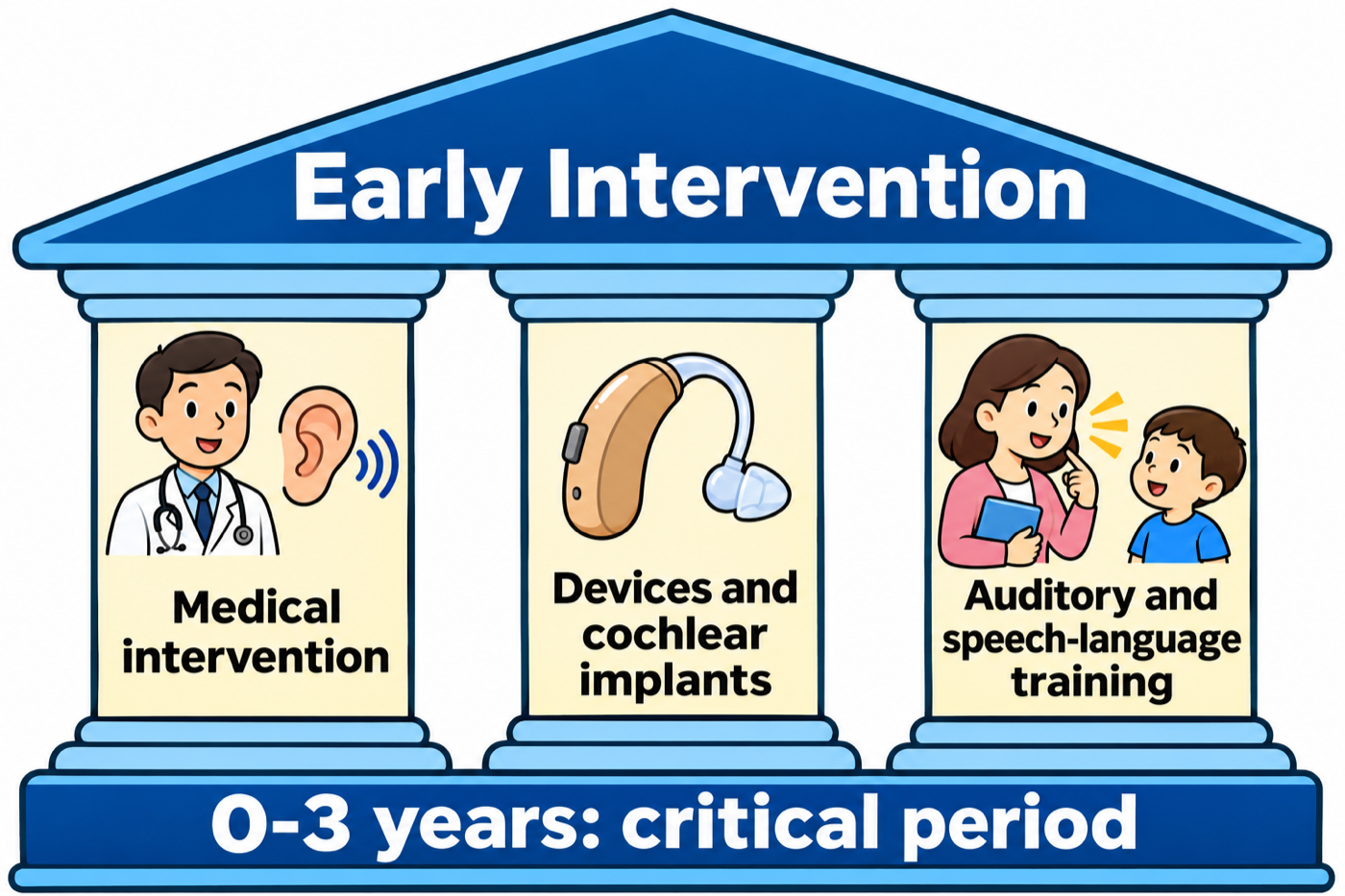
- 0-3 years is the critical period for language and speech development. If the loss is identified after 2-3 years, that critical period is lost.
- Hearing loss is an invisible problem. Even if it is present from birth, it cannot be spotted at once. Parents notice it only when the child reaches the age of speaking and problems show up in speech; by then more than a year has gone.
- Many studies show that if the loss is identified by 6 months of age and a suitable hearing aid is fitted with training, language and speech develop well. Intervention at a young age improves language development, success in studies and lifetime earnings.
- We must understand that hearing loss is not just the absence of sound; it also means absence of language. It affects the child's whole life development - social, emotional and academic.
Key points in infant intervention
- The infant with hearing loss should be taught sounds, language and communication skills systematically.
- The family should support the child so that he overcomes the loss and his communication ability grows.
- More attention should be paid to the child's loss and to the communication he needs.
- The child's language should be written down in a diary.
Service systems available to the family
- Government services: early intervention (up to the 3rd birthday), special education and related services for pre-primary and school-age children.
- Organisations specialising in hearing loss and deafness - information and support.
- Resource centres giving national and state resources and information on educational rights.
- Parent groups where parents can talk with other parents of such children.
Early intervention facilities in India
| Type | Details |
|---|---|
| 1. Medical intervention | Two conditions in school children that need medical care: removal of ear wax and inflammation of the middle ear (otitis media). Since ENT specialists are found only in hospitals, the doctor at the primary centre handles conductive problems. Anganwadi workers and field-level health workers are trained to deal with things like severe earache and objects stuck in the ear. Though the country has about 600 district hospitals, not all have ENT specialists and audiology facilities; a "medical kit" is being arranged for field workers |
| 2. Devices and cochlear implants | For children with pre-lingual loss (loss that came before language), fitting a suitable hearing aid is the key first step in intervention |
| 3. Auditory and speech-language training | Services are more in towns; rural caregivers can get demonstration therapy for home training. Centres run by parent groups give quality services. This is mainly the field of speech-language pathologists/audiologists, but special educators also take part |
Supply of hearing aids and the ADIP Scheme
- After import policies were liberalised, advanced hearing aids of all kinds (digital and analogue) are available in the Indian market. An older estimate says about 1.85 lakh aids are distributed/sold each year, of which about 1.25 lakh body-level aids are distributed under the ADIP Scheme.
- ADIP Scheme (Assistance to Disabled Persons for Purchase/Fitting of Aids and Appliances, Union Ministry of Social Justice and Empowerment): persons with disabilities get aids and appliances at subsidised prices or free. Under the old rules, up to Rs 8,000 per aid per ear; school-going children get aids for both ears (binaural), with new ones every 2 years. A solar charger with two AA rechargeable batteries is also given with the aid.
- ADIP income limit: under the old rules, fully free up to Rs 6,500 a month and partial subsidy from Rs 6,501 to 10,000. Under the revision in force from 1 April 2022, fully free up to Rs 22,500 a month and 50% help from Rs 22,501 to 30,000. Cochlear implants and follow-up therapy for children with pre-lingual loss are also given under this scheme.
- ESI and CGHS employees are reimbursed for the cost of aids; some states give free/subsidised aids.
- A cochlear implant is not a matter of choice; it is decided by candidacy and cost (Rs 5 lakh to 10 lakh). It is becoming more popular, especially for children who became deaf before acquiring language. Implants of well-known makers such as Cochlear, MED-EL and Advanced Bionics are available in the country. INS Ashwini Hospital in Mumbai has arranged free implants for its beneficiaries; some corporate bodies have funded private hospitals for the poor. Results are good where a team of specialists has worked (especially in children).
- The network of hearing aid dealers provides spare parts (cords for body aids, tubes for BTE aids) and repairs; major training institutions and some voluntary organisations also have repair facilities. The directory of services published by AYJNIHH, Mumbai, has these details.
- The ear mould is the last link between the hearing aid and the ear. Custom ear moulds are made at institutions in cities, some voluntary organisations and private professionals. District Disability Rehabilitation Centres (DDRC) have custom ear mould facilities. Soft moulds are available at some centres and from manufacturers.
Training and human resource development
- Auditory and speech-language training is very important for children who receive cochlear implants; the team approach of specialists has had a good effect on caregivers. Many special educators and caregivers have benefited from auditory verbal therapy workshops run by implant manufacturers.
- AIISH (All India Institute of Speech and Hearing), Mysuru, together with RCI, has started a certificate course for caregivers of children with developmental disabilities.
- For the needs of children from 0 to 5 years, AYJNIHH (Ali Yavar Jung National Institute for the Hearing Handicapped; now called AYJNISHD), Mumbai, together with Balavidyalaya, Chennai, runs one-month orientation programmes at 7 centres across the country.
- Low-cost materials such as picture story books, puzzles, audio/video and educational toys are now easy to get through the internet. Indian software and websites for auditory training and speech-language training are also available.
Exam focus: Early intervention = birth to 3 years; IDEA: 0-3 intervention, 3-21 school services. The critical period for language is 0-3 years; identifying the loss and fitting an aid by 6 months gives good results. Indian facilities are three: medical, devices-implants, auditory-speech training. ADIP Scheme = aids at subsidised prices. AYJNISHD - Mumbai. AIISH - Mysuru. DDRC has ear mould facilities.
Previous papers questions asked in the exam on what you just read
Under which Central Government Scheme, the person with disabilities get Aids & Appliances for subsidized prices.
- (1)ALIMCO
- (2)ALPHA
- (3)ADIP
- (4)NEP
Answer & explanation
Correct answer: (3) ADIP
The question asks which Central Government scheme gives aids and appliances to persons with disabilities at subsidised prices.
ADIP stands for Assistance to Disabled Persons for Purchase/Fitting of Aids and Appliances. It is a scheme of the Ministry of Social Justice and Empowerment (Department of Empowerment of Persons with Disabilities). Under it, eligible persons with disabilities get hearing aids, wheelchairs, tricycles, crutches, artificial limbs, Braille equipment and similar aids free or at a subsidy based on family income.
So the answer is option (3), ADIP.
Many students choose (1), ALIMCO. ALIMCO (Artificial Limbs Manufacturing Corporation of India) is a government company that makes these aids and is one of the agencies that carries out ADIP; it is not a scheme. ALPHA (2) is not a central scheme for persons with disabilities. NEP (4) is the National Education Policy, not a scheme for aids and appliances.
Remember: ADIP is the scheme; ALIMCO is the manufacturer.
Ali Yavar Jung National Institute of Speech and Hearing Disabilities (AYJNISHD) head quarters is located in
- (1)Secunderbad
- (2)Chennai
- (3)Mumbai
- (4)New Delhi
Answer & explanation
Correct answer: (3) Mumbai
The question asks in which city the headquarters of the national institute for speech and hearing disabilities is located.
The Government of India has set up a national institute for each major disability. The one for hearing and speech disabilities is the Ali Yavar Jung National Institute (AYJNISHD). Its headquarters is at Bandra, Mumbai, and it runs regional centres in other parts of the country.
So the answer is option (3), Mumbai.
Secunderabad (1) is the headquarters of the national institute for intellectual disabilities (NIEPID); it has only a regional centre of AYJNISHD, which is why many students pick (1). Chennai (2) has the national institute for multiple disabilities (NIEPMD). New Delhi (4) also has only a regional centre, not the headquarters.
Remember: Hearing – Mumbai, intellectual disability – Secunderabad, multiple disabilities – Chennai.
AYJNISHD, Mumbai is working for the persons with
- (1)Hearing Impairment
- (2)Visual Impairment
- (3)Intellectual Disability
- (4)Learning Disability
Answer & explanation
Correct answer: (1) Hearing Impairment
The question asks which disability group the AYJNISHD in Mumbai works for.
AYJNISHD stands for Ali Yavar Jung National Institute of Speech and Hearing Disabilities (Divyangjan). It is a national institute set up in Mumbai in 1983. It provides training, research and rehabilitation services for persons with hearing and speech disabilities. The words Speech and Hearing are in its name.
So the answer is option (1), Hearing Impairment.
The national institute for visual impairment (2) is NIEPVD at Dehradun. The national institute for intellectual disability (3) is NIEPID at Secunderabad. AYJNISHD is not a specialised institute for learning disability (4).
Remember: AYJNISHD Mumbai = speech and hearing; NIEPID Secunderabad; NIEPVD Dehradun.
Memory code: Indian facilities "MDT" - Medical, Devices, Training. Age code "6 - 3 - 21" - identify by 6 months, early intervention up to 3 years, school services up to 21 years. Institutes "Mumbai-Mysuru" - AYJNISHD in Mumbai, AIISH in Mysuru ("M and M").