A communication option (mode/method) is the route through which the child and family receive and express language. Choosing a mode that supports language development and lets the child talk easily with the family is a major issue throughout childhood. Each child responds differently to each method.
4 modes and 3 methods
| Modes of linguistic communication (4) | Details |
|---|---|
| Auditory/oral (listening/speaking) | The usual mode of hearing people; comes naturally and on its own in the early years (an acquired skill); for everyday conversation |
| Visual/written (reading/writing) | A secondary mode - a skill learnt formally; mastered in later years; for formal/academic needs |
| Visual/manual (sign language) | Used by people with hearing loss; not a bundle of gestures but a rule-governed language with its own grammar |
| Speech reading | A supporting role to the modes above; it cannot carry the message fully, so it does not work alone |
| Methods in deaf education (3) | Details |
|---|---|
| Oralism | The philosophy of developing spoken language through the auditory/oral mode. Modern oralists believe an effort must be made to break the communication barrier caused by deafness. In this method children learn conversation and speech through speech reading, watching lip movements |
| Total Communication | Using both signs and speech to develop the spoken language of deaf children. Garretson's (1976) definition: a philosophy that combines all suitable auditory, manual and oral modes for effective communication with and among deaf people |
| Educational Bilingualism | Arose as a reaction to both Oralism and Total Communication. It says that Oralism does not work for the profoundly deaf, and that the Total Communication claim that combining signs with speech will bring speech is also wrong. The first language of all deaf children should be the sign language of the local deaf community |
- Linguistic communication is also classified as human-animal communication and linguistic-non-linguistic communication.
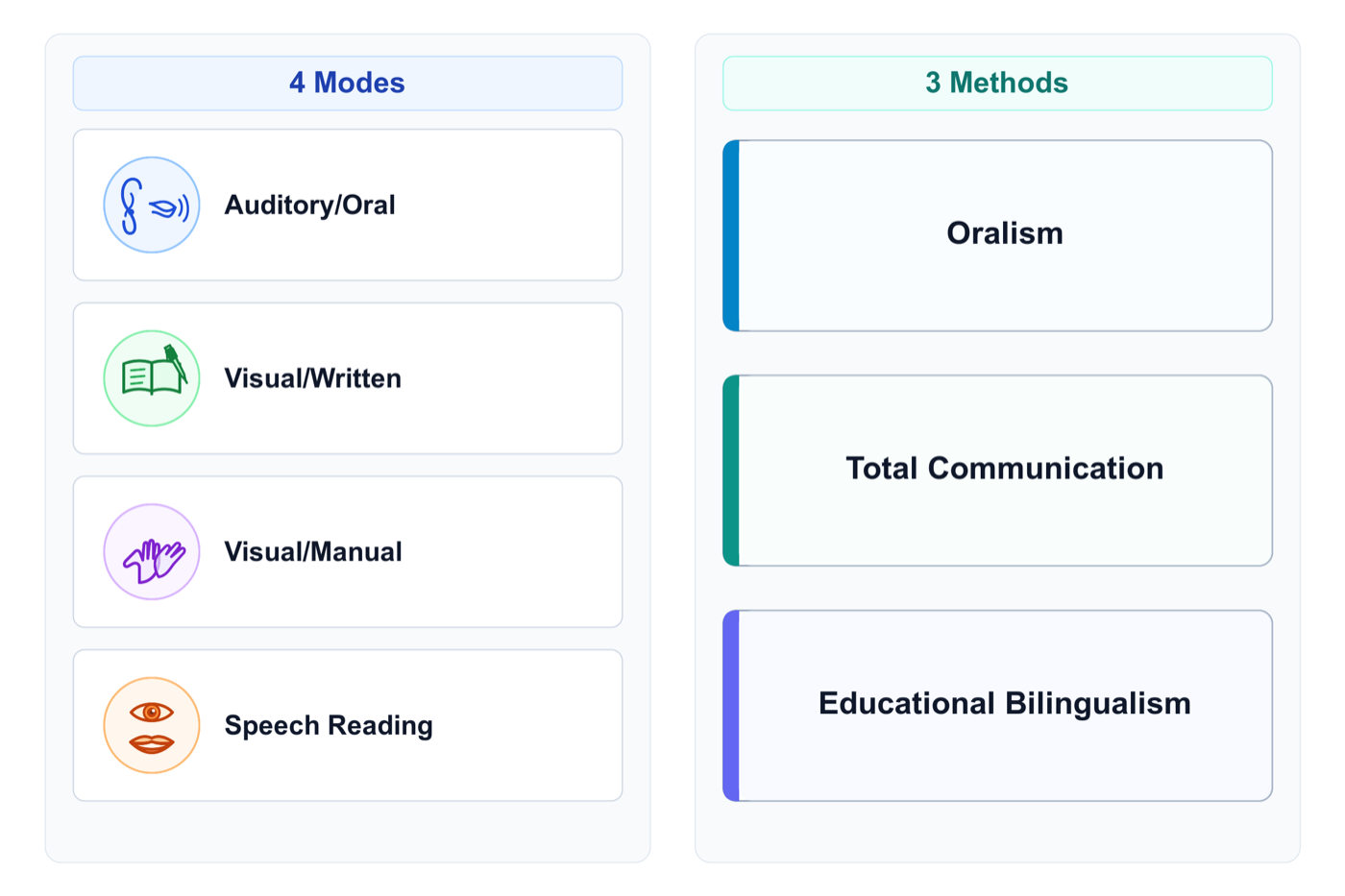
Memory code: 4 modes "LRSS" - Listening-speaking, Reading-writing, Sign language, Speech reading. 3 methods "O-T-B" - Oralism, Total Communication, Bilingualism.
Communication options available to children
| Option | Key feature | Amplification |
|---|---|---|
| Auditory-Verbal | Teaches spoken language by making the fullest use of residual hearing; during language learning and therapy, hearing is the single main input; visual cues, speech reading and signs are strictly controlled; auditory training only | Essential and early; so that the whole speech frequency range is audible; hearing aids, FM and implants must be used constantly |
| Auditory-Oral | Spoken language using both residual hearing and speech reading; both auditory and speech reading training | Essential and early |
| Cued Speech | Makes spoken language visible through special hand shapes and positions plus lip movements (cues) | Not essential for spoken language; can be given if the family wishes |
| Manually Coded English (MCE) | Represents spoken English through a sign system and finger spelling; used together with Total and Simultaneous Communication | Not needed; if the family wishes |
| Total Communication (TC) | Many methods (manual, oral, auditory) at the same time; uses MCE; encourages signing, speech reading and hearing | Should be given early |
| Simultaneous Communication | Sign system, finger spelling and speech together; does not depend on hearing | Not a core part of the approach; audiology care is given when needed |
| Bilingual-Bicultural (Bi-Bi) | ASL (sign language) first, spoken language second; experiences of both the deaf and the hearing communities | Not needed for the visual language; may be used for alerts, awareness of environmental sounds and speech development |
- Role of the family (Auditory-Verbal, Auditory-Oral): be a model of spoken language, give plenty of chances at home, take professional support in that approach, manage audiology care and closely monitor how the devices work; the main aim is to join the mainstream school and the hearing community.
- In Cued Speech, MCE and TC the family must become fluent in that system; in Bi-Bi the family must learn ASL and arrange constant contact with both the deaf and the hearing communities.
Previous papers questions asked in the exam on what you just read
Total communication method is being used in teaching for children with
- (1)Thalasemia
- (2)Visual impairment
- (3)Hearing impairment
- (4)Cerebral Palsy
Answer & explanation
Correct answer: (3) Hearing impairment
The question asks for which children the total communication method is used.
There are three main approaches to communicating with children who have hearing impairment. The oral method uses speech and lip reading. The manual method uses sign language and finger spelling. Total communication combines both: speech, lip reading, signs, finger spelling, gestures, writing and the child's remaining hearing through a hearing aid are all used together, so the child can use whichever channel works best.
So the answer is option (3) Hearing impairment.
Thalassemia (1) is a blood disorder, not a communication problem. Children with visual impairment (2) need Braille, audio material and orientation and mobility training. Some children with cerebral palsy (4) use AAC devices, but 'total communication' is a term specific to the education of children with hearing impairment.
Remember: Total communication = oral + manual: speech, lip reading, signs and writing together.
AVT: Auditory Verbal Therapy
- In AVT, the child with hearing loss learns to speak through listening alone. The focus is on making the fullest use of residual hearing.
- Key principles: early identification of the loss and prompt audiology care; constant use of the best hearing technology (aid/implant); parents are the main helpers in developing the child's listening and speaking, and the therapist guides and trains them; making listening part of daily life; the child listening to his own speech and correcting it; regular assessment; schooling in a regular school with hearing peers.
- How many certified AV therapists, auditory-oral therapists and sign language interpreters are available also affects the choice.
Factors that affect the choice of communication option (facilitating factors)
| Factor | What to consider |
|---|---|
| 1. Language used at home | A spoken language; two spoken languages; a visual language (ASL); a visual + spoken combination |
| 2. Family involvement | Chances to learn language at home, degree of participation in intervention, family members, consistent use of the chosen system, socio-economic status, working hours |
| 3. Age at identification and start of intervention | Whether the loss was identified and intervention started early (before 6-11 months of age) or later |
| 4. Literacy | Development of speech perception and phonological awareness |
| 5. Community resources | Certified AV therapists, sign interpreters, the deaf community, intervention programmes using those approaches |
| 6. Hearing status | Degree of loss, stability, recurring middle ear effusion (OME) |
| 7. Hearing aids and implants | Constant use of the aid/FM, implant candidacy, financial limits, expected benefit from the device |
| 8. Speech intelligibility | Speech sounds reaching the child through the aid/implant, speech therapy |
| 9. Additional disabilities | Vision, motor, cognitive, attention/behaviour |
| 10. Later educational options | Regular school with support services, special class, special school, residential school |
Sign languages and finger spelling
- Sign languages are independent languages. Like spoken languages they have a complex structure; each sign language has its own grammar. Examples: ASL (American Sign Language), ISL (Indian Sign Language), BSL (British Sign Language). Sign Supported English (SSE) is not a separate language: it uses signs in English word order along with speech. Finger spelling is a hand alphabet used within sign languages.
- American Sign Language (ASL): taught with a sign for each word, especially with grammatical features; abstract ideas too are made clear through facial expressions, body movements and various gestures. ASL is a very natural and effective sign language; through it deaf children can read the world.
- BSL: the sign language of deaf people in Britain; using it made teaching the deaf easier.
- Manual English: developed from ASL; taught on the basis of English words and grammar, according to the student's communication and language level.
- Finger spelling: representing the sounds or letters of a language with hand shapes - like writing letters in the air with hand shapes instead of on paper. Every letter and every number has its own hand sign. BSL and ISL spell with both hands; ASL spells with one hand. In the two-handed system the 26 letters are written in the air in 26 different positions with the fingers; touching the fingertips of the left hand with a finger of the right hand shows the vowels.
- The term Total Communication was introduced in 1967 by Roy Holcomb. It is not a method but a philosophy / approach. Oral skills, signs, finger spelling, cueing, auditory training, reading, writing and any other mode of communication can be used - to build the child's thinking, language development, language knowledge and fluency. Its main aim is to make the student communicate in some way.
- The deaf do not need the Braille script (that is for the visually impaired); the Taylor Frame too is a maths device for the visually impaired. The deaf need sign language, body language and facial expressions.
Previous papers questions asked in the exam on what you just read
Sign language is used for children with
- (1)Visual Impairment
- (2)Specific Learning Disabilities
- (3)Hearing Impairment
- (4)Speech Impairment
Answer & explanation
Correct answer: (3) Hearing Impairment
The question asks for which children sign language is used.
Sign language is a visual language that expresses ideas through hand shapes, hand movements and facial expressions. It needs no hearing, only sight. That is why it is the main means of communication for children with severe hearing impairment. In India, Indian Sign Language (ISL) is used.
So the answer is option (3), hearing impairment.
Children with visual impairment (1) cannot see signs; they need Braille and audio aids. Children with specific learning disabilities (2) hear and speak normally. Children with speech impairment (4) may sometimes use gestures, but their main support is speech therapy. Many students pick (4), but sign language is chiefly the language of people with hearing impairment.
Remember: Sign language is seen, not heard → hearing impairment.
This may not be required for children with Hearing Impairment
- (1)Body language
- (2)Sign language
- (3)Facial Expressions
- (4)Taylor frame.
Answer & explanation
Correct answer: (4) Taylor frame.
The question asks which item is NOT needed by children with hearing impairment.
Children with hearing impairment communicate through their eyes. Body language, sign language and facial expressions are all visual signals, and they are very important for these children to understand meaning. The Taylor frame, however, is a mathematics device for children with visual impairment: metal types are placed in its star-shaped holes in different directions, and the child reads the numbers by touch.
So the answer is option (4), Taylor frame.
Body language (1), sign language (2) and facial expressions (3) are all needed by children with hearing impairment, so they are not the answer to a NOT question.
Remember: Taylor frame, abacus and Braille are for visual impairment; signs and expressions are for hearing impairment.
This is not necessary for persons with deaf
- (1)Braille Script
- (2)Sign language
- (3)Hindi language
- (4)Telugu language
Answer & explanation
Correct answer: (1) Braille Script
The question asks which of these is NOT needed by deaf persons. It is a negative question.
Braille, devised by Louis Braille, is a script of raised dots (a six-dot cell) read by touch, meant for persons with visual impairment. Deaf persons can see, so they read ordinary print and do not need Braille. So the answer is option (1) Braille Script.
Sign language, option (2), is a main means of communication for deaf persons. Languages such as Hindi, option (3), and Telugu, option (4), are still needed for reading, writing, lip reading and living with the hearing community. So these options are wrong.
Remember: Braille is for those who cannot see; sign language is for those who cannot hear.
Exam focus: Total Communication - Roy Holcomb (1967) - not a method but a philosophy; Garretson's (1976) definition. In AVT hearing is the only main channel; in Auditory-Oral, hearing + speech reading. Cued Speech = hand shapes + lip movements. In Bilingualism the first language is sign language. Sign language is a language with its own grammar.
Memory code: "AVT = ear only, AO = ear + lips, Cued = hand + lips, TC = everything". Total Communication "Total = Holcomb 67" - "whole" sounds like Holcomb; Garretson's definition is 76 (67 reversed).