Hearing loss / hearing impairment:
- Loss of any degree in the ability to perceive sound is hearing loss. That is, a partial or total inability to hear.
- It can be in one ear (unilateral) or in both ears (bilateral).
- Hearing loss is reduced sensitivity to sounds that are normally heard. Its degree is classified by how much louder than the usual level a sound must be made before the person can detect it.
- Its root is a defect in or damage to any part of the hearing mechanism - the outer, middle or inner ear. Depending on the nature and degree of the defect, the person becomes deaf or hard of hearing.
- Normal hearing sensitivity = being able to hear even the faintest sound or a whisper without difficulty, with no history of disease or infection. Its range is -10 to 25 dB HL.
Previous papers questions asked in the exam on what you just read
Bilateral hearing loss means
- (1)Hearing loss in right ear
- (2)Hearing loss in left ear
- (3)Hearing loss in both ears
- (4)Hearing in both ears
Answer & explanation
Correct answer: (3) Hearing loss in both ears
The question asks the meaning of bilateral hearing loss.
"Bi" means two and "lateral" means side, so bilateral means on both sides. Bilateral hearing loss is hearing loss in both ears. Loss in only one ear, right or left, is called unilateral hearing loss. So the answer is option (3) Hearing loss in both ears.
Options (1) and (2) describe one ear only, which is unilateral loss. Option (4), hearing with both ears, is normal binaural hearing and not a loss at all. Do not pick (4) just because it says "both ears".
Remember: Bilateral = both ears; unilateral = one ear.
Terminology: they are not the same
Even hearing professionals often use these terms in place of one another. But each term has a different meaning. Hearing impairment, hearing disability and hearing handicap are not synonyms.
| Term | Meaning |
|---|---|
| Hearing loss | Used when referring to a loss of a particular degree; measured with an audiometer and stated in dB |
| Hearing impairment | A general term for any physical problem of hearing, whatever its cause or degree; a change that has fallen below the normal range in structure or function. Everything from mild loss to total deafness comes under it |
| Deaf | A very severe loss; very little or no usable hearing |
| Hard of hearing | Has enough remaining hearing (residual hearing); can perceive speech with the help of a device such as a hearing aid or an FM system; mainly uses the ear to learn language |
| Deafened | People who became deaf at an older age; they face different challenges from those born deaf or deafened in early childhood |
| Deafness | A hearing disability that does not allow language information to be received successfully through the ear, with or without a hearing aid; the level at which speech is not understood even when sound is amplified |
| Hearing handicap | The effect of hearing impairment on a person's daily life; the disadvantage it causes in carrying out tasks |
- The term "people with hearing impairment" applies to everyone from mild to severe. But many deaf and hard of hearing people prefer the terms "deaf" and "hard of hearing"; they feel the word "impairment" suggests something is lacking, as if the person were incomplete.
- In profound deafness, even the loudest sounds an audiometer produces may not be heard. In total deafness, nothing at all is heard, however much the sound is amplified or however it is produced.
- Because deaf and hard of hearing people cannot hear their own voice, others may find their speech hard to understand.
- They may use hearing aids and cochlear implants; or they may use lip reading, sign language, interpreters and captioning.
- Audiometer = a machine that measures hearing by producing pure tones across a range of frequencies.
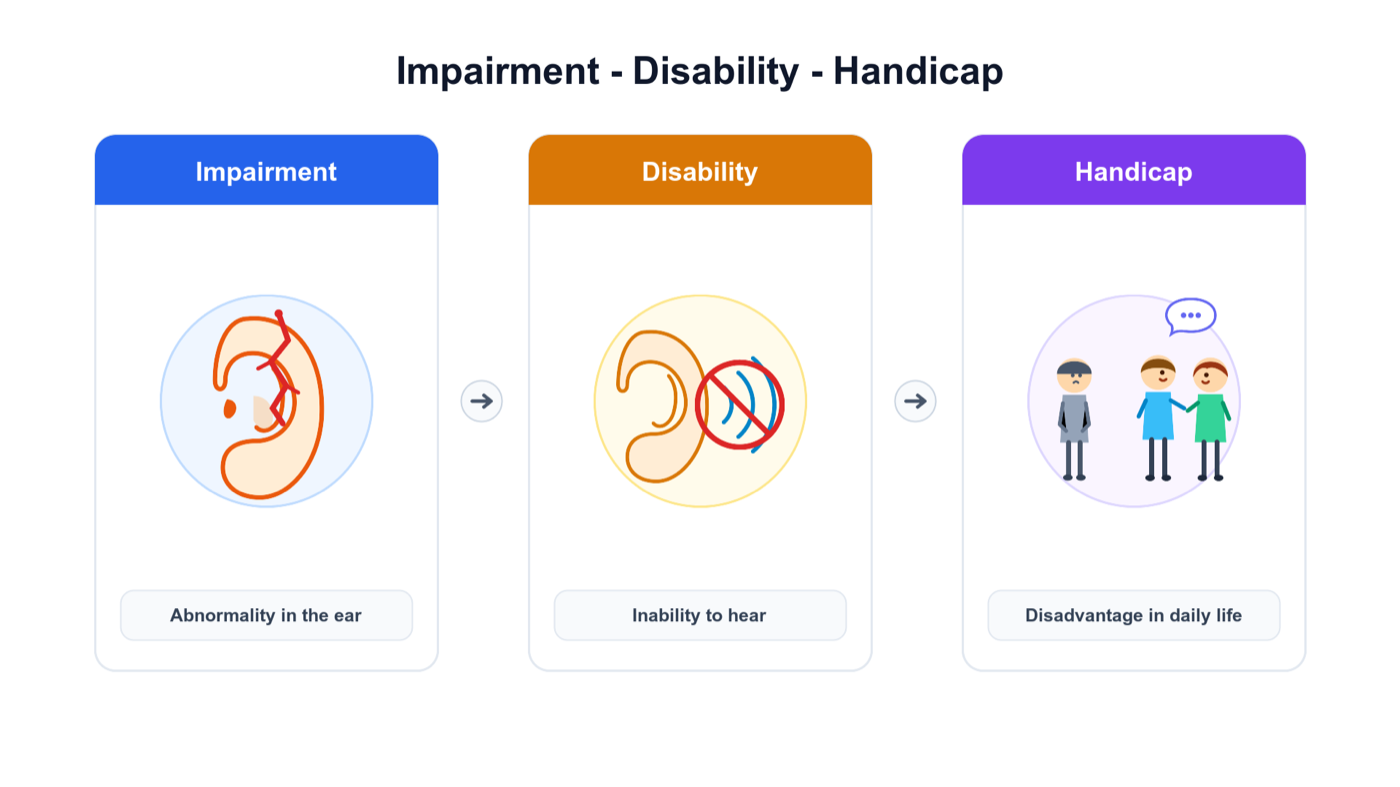
Impairment - Disability - Handicap
- Impairment: an abnormality in a body part or in its function.
- Disability: an inability in the function of the impaired part, and in the person's overall functioning because of it.
- Handicap: the disadvantage the person faces in his surroundings as a result of the impairment and disability. It shows up as the person adjusts to the environment.
- That is, impairment → disability → handicap. Handicap arises from both impairment and disability.
Older definitions: the 1986 notification and the PWD Act 1995
- The 1986 notification of the central Ministry of Welfare fixed the degrees of hearing impairment (table in the next topic).
- Under the Ministry of Social Justice and Empowerment and the PWD Act 1995: a hearing loss of 60 dB HL or more in the better ear in the conversational range of frequencies = hearing impairment / hearing handicap.
Previous papers questions asked in the exam on what you just read
As per Persons with Disabilities Act-1995, _____ or more hearing loss can be defined as “Hearing Impairment”
- (1)30 dBHL
- (2)40 dBHL
- (3)50 dBHL
- (4)60 dBHL
Answer & explanation
Correct answer: (4) 60 dBHL
The question asks for the decibel limit in the definition of hearing impairment under the PwD Act 1995.
The PwD Act 1995 defines hearing impairment as a loss of 60 decibels or more in the better ear in the conversational range of frequencies. dBHL means decibel hearing level, the unit read on an audiometer.
So the answer is option (4), 60 dBHL.
30 (1), 40 (2) and 50 (3) dBHL are not the limit used in this Act. Do not mix it up with the RPwD Act 2016, which defines "deaf" as 70 dB loss in both ears and "hard of hearing" as 60 to 70 dB loss in both ears. Always check which Act the question names.
Remember: PwD 1995: 60 dB in the better ear.
Definitions in the RPwD Act 2016
In the list of 21 disabilities in the RPwD Act 2016, hearing impairment comes under the heading "physical disability". The Act defines it in two types:
| Type | Definition in the RPwD Act 2016 |
|---|---|
| Deaf | Persons having 70 dB hearing loss in speech frequencies in both ears |
| Hard of hearing | Persons having 60 dB to 70 dB hearing loss in speech frequencies in both ears |
- So under the RPwD Act, deaf and hard of hearing are two separate types; both come under "hearing impairment".
- As with the other disabilities in the Act, 40% or more is a "benchmark disability".
- To calculate the disability percentage, the average of the hearing thresholds found with a pure tone audiometer at 500, 1000 and 2000 Hz is taken.
- The old PWD Act 1995 said "60 dB in the better ear"; the RPwD Act 2016 says "in both ears" and separates deaf from hard of hearing.
Previous papers questions asked in the exam on what you just read
Deaf means, person having this level of hearing loss in both ears.
- (1)60 dB
- (2)70 dB
- (3)80 dB
- (4)90 dB
Answer & explanation
Correct answer: (2) 70 dB
The question asks how much hearing loss in both ears makes a person "deaf".
Under the RPwD Act 2016, "deaf" means a person with 70 dB hearing loss in speech frequencies in both ears. "Hard of hearing" means a person with 60 dB to 70 dB hearing loss in speech frequencies in both ears. So the answer is option (2) 70 dB.
60 dB is where hard of hearing begins, not deafness, so (1) is wrong. Persons with 80 dB or 90 dB loss are also deaf, but the limit set in the Act's definition is 70 dB, so (3) and (4) are not the answer.
Remember: RPwD: deaf = 70 dB; hard of hearing = 60–70 dB (both ears).
According to RPWD Act – 2016, 70 dB hearing loss or more in the better ear are defined as
- (1)Deaf
- (2)Hard of hearing
- (3)Mild hearing loss
- (4)Marginal hearing loss
Answer & explanation
Correct answer: (1) Deaf
The question asks how the RPwD Act 2016 names a hearing loss of 70 dB or more.
The Schedule of the RPwD Act 2016 has two categories of hearing impairment. 'Deaf' means a 70 dB hearing loss in speech frequencies in both ears. 'Hard of hearing' means a 60 dB to 70 dB hearing loss in speech frequencies in both ears. If even the better ear has a 70 dB loss, both ears have that level of loss.
So a loss of 70 dB or more is defined as deaf, option (1).
Hard of hearing is the 60–70 dB band, below the deaf level. Mild and marginal hearing loss are smaller losses and are not disabilities under the Act. So options (2), (3) and (4) are wrong.
Remember: RPwD 2016: 70 dB = deaf; 60–70 dB = hard of hearing.
According to the RPWD Act 2016, hearing impairment is mentioned as (a) deaf (b) hard of hearing. The one is
- (1)a & b same
- (2)b only
- (3)a only
- (4)a & b different types
Answer & explanation
Correct answer: (4) a & b different types
The RPwD Act 2016 describes hearing impairment as (a) deaf and (b) hard of hearing. The question asks how the two are related.
Under the Act, (a) deaf means a hearing loss of 70 dB in speech frequencies in both ears, and (b) hard of hearing means a hearing loss of 60 dB to 70 dB in speech frequencies in both ears. So they are two different types under one disability, differing in severity.
So the answer is option (4), a & b different types.
Option (1) is wrong because the Act defines them separately. Options (2) and (3) are wrong because the Act names both types, not just one.
Remember: Deaf 70 dB; hard of hearing 60–70 dB: two different types.
Exam focus: Normal hearing = -10 to 25 dB HL. Hearing impairment, disability and handicap are not synonyms. PWD 1995 - 60 dB or more in the better ear. RPwD 2016 - deaf = 70 dB in both ears; hard of hearing = 60-70 dB in both ears (two separate types). Deafened = became deaf as an adult. Bilateral = loss in both ears.
Memory code: RPwD = "60-70 Hard, 70 Deaf, Both ears"; the old Act "95 - 60 - Better ear" (1995 - 60 dB - better ear). The order "I-D-H" - "I Did Hear": Impairment → Disability → Handicap.