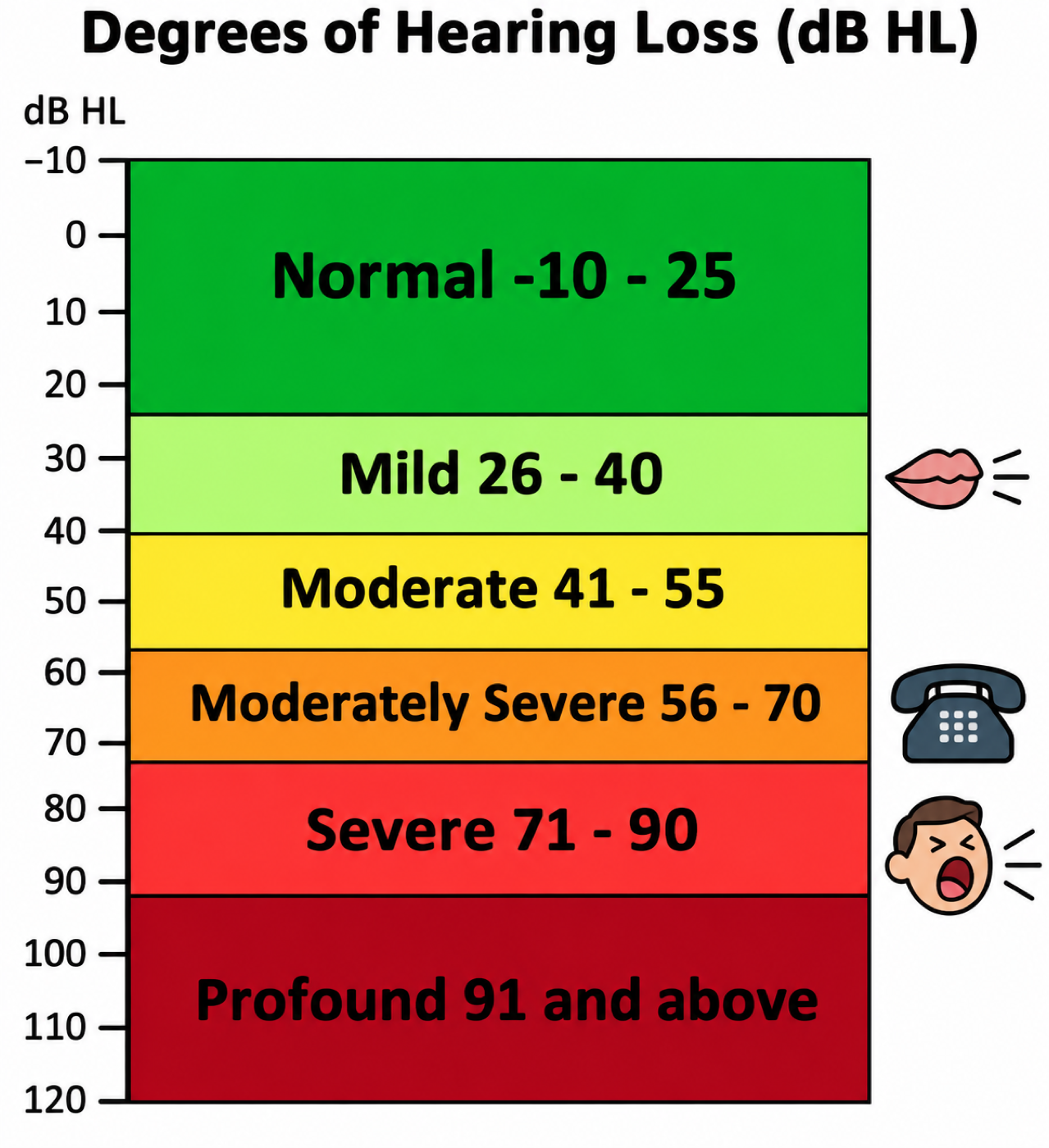
The main thing to look at in a hearing loss is its degree (severity). Hearing sensitivity is measured in dB HL (Hearing Level). We can usually hear sounds at intensities of 0 to 25 dB, at frequencies between 250 and 8000 Hz. By the degree of loss, it is classified like this:
| Degree | dB HL | What they cannot hear / what happens |
|---|---|---|
| Normal hearing | -10 to 25 | Can hear even the faintest sound and a whisper |
| Mild | 26 to 40 | Hard to detect soft sounds like whispers; speech from a distance is difficult; a hearing aid is useful to amplify sound |
| Moderate | 41 to 55 | Others' speech in conversation is not heard clearly; a hearing aid is needed |
| Moderately severe | 56 to 70 | Even loud sounds such as a telephone ringing are not heard clearly |
| Severe | 71 to 90 | Only very loud sounds such as shouting or a vacuum cleaner are heard |
| Profound | 91 and above | Can perceive almost no sound; depends on lip reading and sign language for speech |
Previous papers questions asked in the exam on what you just read
The Persons who are able to hear 26 – 40dB sounds are called
- (1)Mild hearing loss
- (2)Moderate hearing loss
- (3)Severe hearing loss
- (4)Profound hearing loss
Answer & explanation
Correct answer: (1) Mild hearing loss
The question asks which category of hearing loss covers a hearing level of 26 – 40 dB (decibels).
Hearing loss is measured in dB. The commonly used classification is: 0 – 25 dB normal hearing, 26 – 40 dB mild loss, 41 – 55 dB moderate loss, 56 – 70 dB moderately severe loss, 71 – 90 dB severe loss and above 90 dB profound loss.
26 – 40 dB falls in the mild range, so the answer is option (1), Mild hearing loss. Such children miss soft speech and speech from a distance, and benefit from sitting in the front row.
Moderate loss is 41 – 55 dB, severe is 71 – 90 dB and profound is above 90 dB, so options (2), (3) and (4) are wrong.
Remember: 26-40 Mild, 41-55 Moderate, 71-90 Severe, above 90 Profound.
As per classification of hearing loss, which is the moderate hearing loss
- (1)0 – 15 dB
- (2)16 – 25 dB
- (3)26 – 40 dB
- (4)41 – 55 dB
Answer & explanation
Correct answer: (4) 41 – 55 dB
The question asks for the decibel (dB) range of moderate hearing loss.
In Goodman's classification: up to 15 dB is normal hearing, 16-25 dB slight, 26-40 dB mild, 41-55 dB moderate, 56-70 dB moderately severe, 71-90 dB severe and above 90 dB profound. A child with moderate loss understands conversation only at close range and benefits well from a hearing aid. So the answer is option (4) 41 – 55 dB.
0-15 dB, option (1), is normal hearing; 16-25 dB, option (2), is slight loss; and 26-40 dB, option (3), is mild loss. Many students choose (3), but that is the mild range, not moderate.
Remember: Cut-offs: 15, 25, 40, 55, 70, 90 dB.
The 1986 Government of India classification (with percentages)
The central Ministry of Welfare notification of 06-09-1986 gave the degree and percentage of hearing impairment (in the better ear) like this:
| Category | Type of impairment | dB in the better ear | Percentage of impairment |
|---|---|---|---|
| I | Mild hearing impairment | 26 to 40 | Less than 40% |
| II | Moderate hearing impairment | 41 to 55 | 40% to 50% |
| III | Severe hearing impairment | 56 to 70 | 50% to 75% |
| IV (c) | Profound hearing loss | 71 to 90 | 75% to 100% |
| IV (b) | Near total deafness | 91 and above | 100% |
| IV (a) | Total deafness | No hearing at all | 100% |
- The 1986 categories use different names for the same dB ranges (for example, 56-70 is "moderately severe" in the general table but "severe" here; 71-90 is "severe" there but "profound" here). Do not mix the two tables.
- The ability to tell speech sounds apart (speech discrimination) is almost fully present in a mild loss; it falls as the degree rises; in total deafness it is absent.
Exam focus: Normal -10 to 25; mild 26-40; moderate 41-55; moderately severe 56-70; severe 71-90; profound 91 and above (dB HL). Mild = whispers are difficult; moderate = conversation is difficult, an aid is needed; severe = only shouting is heard; profound = almost nothing is heard. 0 dB = the faintest sound a normal ear can hear.
Memory code: The boundary numbers "25 - 40 - 55 - 70 - 90" - after 25, add 15 at each step to get 40, 55, 70; then add 20 to get 90. The order of degrees "N-Mi-Mo-MS-S-P": Normal, Mild, Moderate, Moderately severe, Severe, Profound.