Hearing loss is classified from different angles. In medicine it is classified by the degree of loss, and in audiology by the site of the defect in the ear. Overall, the bases are: age of onset, time of language acquisition, site of the defect, nature, degree, cause, one ear/both ears, and whether it can be reversed.
By the site of the defect
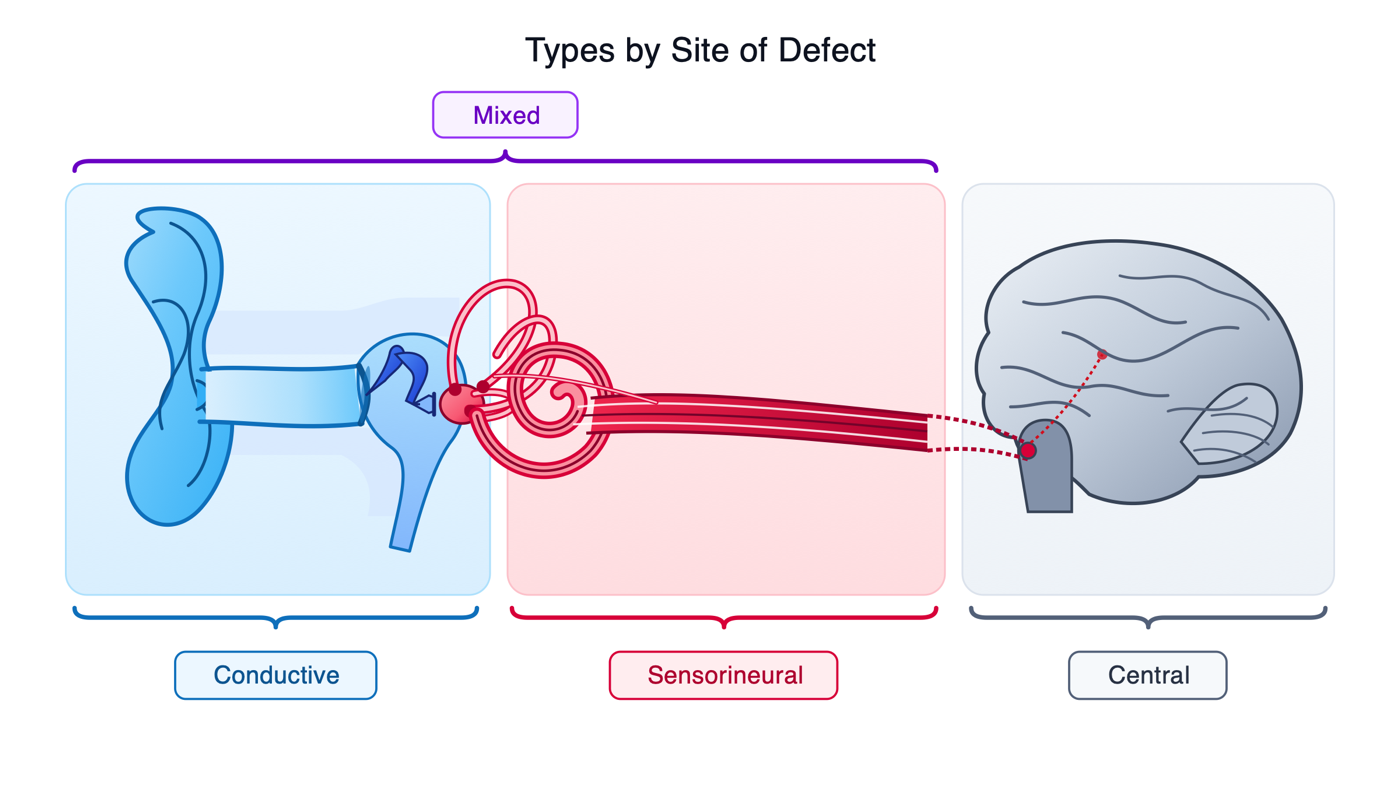
Hearing has two parts: carrying sound inwards (conduction) and processing sound neurally. Depending on where the problem is:
| Type | Where the problem is | Main features |
|---|---|---|
| Conductive hearing loss | Outer ear / middle ear | Sound does not reach the inner ear properly; the inner ear is normal; mainly the loudness (volume) of sound is reduced; often temporary; often cured with medicines and surgery; air conduction is reduced, bone conduction stays normal |
| Sensorineural hearing loss | Inner ear (cochlea, hair cells) / the auditory nerve from the inner ear to the brain | Sound reaches the inner ear but is not perceived normally; some frequencies are affected more than others; can range from mild to profound; usually permanent; needs good hearing aids or a cochlear implant |
| Mixed hearing loss | Conductive + sensorineural at the same time | Both the outer/middle ear and the inner ear are damaged |
| Central / neural hearing loss | The auditory nerve and the hearing areas of the brain | Even though the ear works properly, the brain cannot interpret the sound signals as language; more difficulty than the actual hearing loss suggests; more likely to be a permanent loss |
- Conductive loss is the most common type in children, mainly because of middle ear infection (otitis media). It may be present from birth or come later because of some event.
- Sensorineural loss is also called perceptive hearing loss.
- Sudden hearing loss is almost always sensorineural.
- Because of a problem at the level of the brain, it becomes hard to turn the signals from the auditory nerve into language even though the ear works properly; the disturbance this causes is greater than the actual hearing loss.
Previous papers questions asked in the exam on what you just read
Hearing loss is due to problems in the inner ear is called
- (1)Sensory neural hearing loss
- (2)Conductive hearing loss
- (3)Functional hearing loss
- (4)Optical hearing loss
Answer & explanation
Correct answer: (1) Sensory neural hearing loss
The question asks what we call hearing loss caused by a problem in the inner ear.
The ear has three parts: outer, middle and inner ear. In the inner ear, the cochlea changes sound vibrations into nerve signals, which travel along the auditory nerve to the brain. Hearing loss caused by damage to the cochlea or the auditory nerve is called sensorineural hearing loss. It is usually permanent and is managed with hearing aids or a cochlear implant. So the answer is option (1).
Conductive hearing loss (2) is caused by problems in the outer or middle ear, such as wax, a perforated eardrum or fluid, and can often be treated medically. Functional hearing loss (3) is hearing difficulty without any physical damage, often due to psychological reasons. ‘Optical’ (4) relates to the eye and is not a type of hearing loss.
Remember: Outer/middle ear = conductive; inner ear/nerve = sensorineural.
Mixed hearing loss is a mixture of
- (1)Conductive & Sensorineural
- (2)Congenital & Conductive
- (3)Congenital & Conjugative
- (4)Super Sensoral
Answer & explanation
Correct answer: (1) Conductive & Sensorineural
The question asks which two types of hearing loss combine to form mixed hearing loss.
Hearing loss is classified by the part of the ear that is affected. If the outer or middle ear blocks sound from reaching the inner ear, it is conductive hearing loss. If the cochlea in the inner ear or the auditory nerve is damaged, it is sensorineural hearing loss. When both are present in the same ear, it is mixed hearing loss.
So the answer is option (1) Conductive & Sensorineural.
'Congenital' means present from birth; it tells us when the loss began, not where in the ear it is, so options (2) and (3) are wrong. 'Conjugative' and 'Super Sensoral' (4) are not types of hearing loss at all.
Remember: Mixed = Conductive + Sensorineural.
Hearing problem due to problem in external ear, middle ear and inner ear is called
- (1)Moderate hearing loss
- (2)Sensory neural hearing loss
- (3)Conductive hearing loss
- (4)Mixed hearing loss
Answer & explanation
Correct answer: (4) Mixed hearing loss
The question asks the name of a hearing loss caused by problems in the outer, middle and inner ear together.
By site of the problem there are three types. Conductive loss comes from the outer or middle ear, where sound is not carried inward properly. Sensorineural loss comes from the inner ear (cochlea) or the auditory nerve. When both kinds are present together, it is mixed hearing loss.
Here the outer and middle ear (conductive part) and the inner ear (sensorineural part) are both affected, so it is mixed hearing loss, option (4).
'Moderate' tells how severe a loss is, not where it is. Sensorineural loss is only the inner ear or nerve, and conductive loss is only the outer or middle ear. So options (1), (2) and (3) are wrong.
Remember: Outer/middle = conductive; inner = sensorineural; both = mixed.
By age of onset
| Type | Meaning |
|---|---|
| Congenital | A loss present before or at birth; may be hereditary, or may arise during pregnancy / at delivery |
| Adventitious / acquired | The person is born with normal hearing; the loss comes after speech has been learnt, because of infection, disease or damage to the hearing mechanism; can occur at any time in life |
By the time of language acquisition
| Type | Meaning |
|---|---|
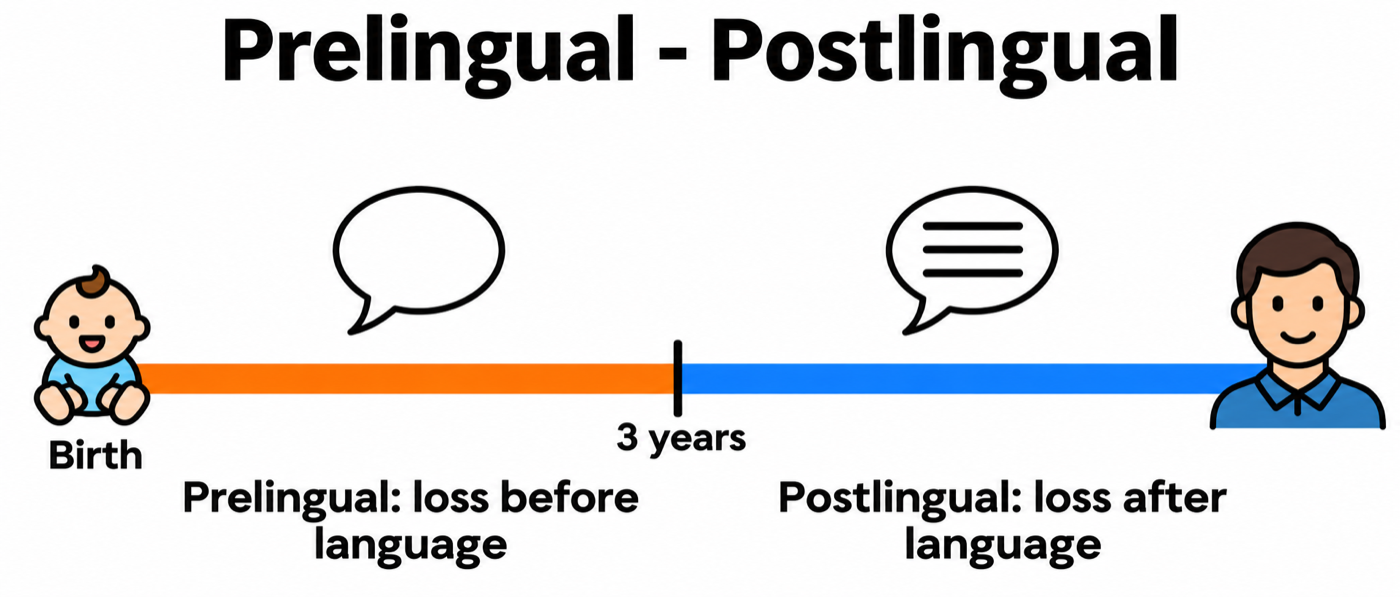
| Prelingual | A loss that comes before language develops / is learnt; a loss arising in the first 3 years of life is called prelingual (Schein, 1987) |
| Postlingual | A loss that comes after language has developed substantially - in later childhood or as an adult (Vernon and Andrews, 1990); may come suddenly or progress gradually |
- Postlingually deaf people find it harder to adjust to deafness than prelingually deaf people.
- But in language, postlingual children have an advantage - basic language has already been acquired. However, without care, even the speech and language skills they have may be lost.
- For people born deaf, lip reading is much harder than for those who became deaf after learning speech.
- A child with normal hearing starts speaking at about one year; before that he learns many pre-verbal skills, such as vocal imitation, and receptive language. A child with hearing loss cannot learn these and falls behind children of his age.
- In children born with hearing loss, language develops differently from typical children: the typical child "acquires" language; the child with hearing loss has to be "taught" language. They process language visually. Abstract concepts are hard; comprehension is low because of limited vocabulary.
- In a congenital mild / moderate loss, the child can reach his goals with proper guidance, therapy and devices; in a severe / profound loss this is very hard.
Previous papers questions asked in the exam on what you just read
Hearing loss caused before the acquisition of complete language is called
- (1)Post – Lingual deafness
- (2)Pre – Lingual deafness
- (3)Accidental deafness
- (4)Irreversible hearing loss
Answer & explanation
Correct answer: (2) Pre – Lingual deafness
The question asks the name for hearing loss that occurs before a child has learnt language.
Hearing loss is classified by the time of onset. If it occurs before language is acquired (usually before about 2 to 3 years of age), it is pre-lingual deafness. If it occurs after language has developed, it is post-lingual deafness. Since the question says "before the acquisition of complete language", the answer is option (2) Pre-Lingual deafness.
Post-lingual deafness (1) is the opposite; such persons already have language, so their speech is usually better. Accidental deafness (3) describes a cause, not the time of onset. Irreversible hearing loss (4) describes whether it can be cured. Pre-lingual deafness has the greatest effect on speech and language, which is why early identification matters so much.
Remember: Pre = before, Post = after, lingual = language.
By nature
| Type | Meaning |
|---|---|
| Progressive / gradual | Hearing sensitivity falls slowly over time; due to infection, a hereditary disorder or ageing; can be conductive, mixed or sensorineural |
| Sudden | A partial / total loss in one or both ears, overnight or within a few days; almost always sensorineural. Defined as a loss of at least 30 dB over 3 contiguous frequencies within 3 days. It is an emergency: many people recover partly or fully, especially with early treatment. Often no cause is found; a viral infection is one suspected cause |
By cause
| Type | Meaning |
|---|---|
| Exogenous | All causes except heredity: prenatal, at delivery, postnatal causes, infections, noise, ageing |
| Endogenous | Heredity is the only cause; passed on as a dominant or recessive trait |
| Idiopathic | A loss whose cause or disease process is not known |
Other classifications
- One ear / both ears: unilateral - in one ear; bilateral - in both ears.
- Can it be corrected?
- Reversible: can be reduced with medicines, surgery or precautions. Example: ear wax, discharge of pus from the ear.
- Irreversible: cannot be reduced with medicines or surgery. Example: a permanent defect in the middle ear / inner ear.
- Functional deafness: the ear and hearing are actually normal, but the person appears "not to hear", either because of a psychological feeling that he cannot hear or because he deliberately pretends to be deaf. There is no physical cause; objective tests such as BERA and OAE reveal the truth.
Previous papers questions asked in the exam on what you just read
Persons having psychological feeling as deafness though they are having normal hearing is called
- (1)Conductive Hearing loss
- (2)Sensory-Neural Hearing loss
- (3)Central Auditory disorder
- (4)Functional Deafness
Answer & explanation
Correct answer: (4) Functional Deafness
The question asks what we call it when a person has normal hearing but feels or behaves as if deaf for psychological reasons.
This is functional deafness, also called psychogenic or non-organic hearing loss. There is no damage to the ear or the hearing nerve; tests show normal hearing structures. It can follow severe stress, fear, shock or anxiety. So the answer is option (4) Functional Deafness.
Conductive hearing loss (1) is caused by a problem in the outer or middle ear, such as wax or a perforated eardrum. Sensorineural hearing loss (2) is due to damage to the inner ear (cochlea) or the hearing nerve. Central auditory disorder (3) is a problem in how the brain processes sound. All three are real physical conditions, not the psychological state described in the question.
Remember: Ear is fine, the problem is psychological = functional deafness.
‘Functional Deafness’ means
- (1)Hearing loss caused due to accidents
- (2)Absence of outer ear
- (3)Pretending as Deaf
- (4)Hearing loss caused by birth
Answer & explanation
Correct answer: (3) Pretending as Deaf
The question asks what 'functional deafness' means.
Hearing loss is of two kinds. In organic hearing loss there is a real physical problem in the ear or the auditory nerve. In functional hearing loss the ear is structurally normal and there is no physical cause, yet the person behaves as if they cannot hear. The reason may be psychological, or the person may be deliberately pretending to be deaf (malingering). In exams it is asked as 'pretending to be deaf'. So the answer is option (3).
Hearing loss from accidents (1) is acquired hearing loss. Absence of the outer ear (2) is a structural defect called anotia. Hearing loss from birth (4) is congenital hearing loss. All three have a real physical cause, so none of them is functional deafness.
Remember: Functional = ear is normal, no physical cause.
Exam focus: Conductive = outer/middle ear, often curable; sensorineural = inner ear/auditory nerve, permanent; mixed = conductive + sensorineural (outer, middle and inner ear). Prelingual = before language, first 3 years. Sudden loss = almost always sensorineural; an emergency, early treatment helps recovery. Endogenous = heredity only; exogenous = everything except heredity; idiopathic = cause unknown. Functional deafness = behaving as / pretending to be deaf although hearing is normal.
Memory code: "COM-SIN-MIX": Conductive = Outer + Middle ear; Sensorineural = INner ear; MIXed = both. "Endo = inside the family" - endogenous = heredity; "Exo = outside" - exogenous. Pre = before 3.