If hearing loss is suspected, first see a doctor; the doctor may refer you to two specialists:
- Otolaryngologist (ENT doctor): a doctor for diseases of the ear, nose and throat; investigates the cause of the loss.
- Audiologist: a specialist who identifies and measures hearing loss; does a hearing test to find the type and degree; selects the device that will improve hearing.
Aural rehabilitation: professional efforts to help a person with hearing loss - services and procedures that reduce or make up for the loss; above all, making adequate receptive and expressive communication easier (ASHA 1984; WHO 2000).
Amplification: key facts
- The most important tool for a person with hearing loss to overcome the barrier is a hearing aid or an educational amplification unit.
- No amplification system can restore hearing. But it makes usable the residual hearing that would otherwise be out of reach; goals can be achieved that would not be possible without it.
- A hearing aid does not correct hearing the way spectacles correct vision. Most people with hearing loss have a sensorineural loss, in which speech clarity is damaged. A hearing aid does not make speech clear; it only makes sound louder.
- There is a basic difference between adults with hearing loss and children born with it: adults already have speech and language skills, so they use devices on that base; children must learn language through the device.
- The hearing aid should be worn all day, except while sleeping and bathing.
- These children need a hearing aid, an ear mould and an IEP; they do not need a cane (that is for the visually impaired).
Previous papers questions asked in the exam on what you just read
When should a child uses hearing aid in a day
- (1)Total day
- (2)Only in School
- (3)At home only
- (4)Except during sleep and bath time
Answer & explanation
Correct answer: (4) Except during sleep and bath time
The question asks how long in a day a child should wear a hearing aid.
To learn language and speech, the child must hear sounds and speech around them all the time. Talk at home and in play is as important as lessons at school. So the hearing aid should be worn during all waking hours. It must be removed while bathing because water damages it, and during sleep because listening is not needed and wearing it can hurt the ear and the device.
So the answer is option (4) Except during sleep and bath time.
Total day (1) would include sleep and bath time, which is wrong. Only in school (2) or only at home (3) cuts off listening experience for the rest of the day and slows auditory training and language growth.
Remember: Hearing aid: all waking hours, off for sleep and bath.
Children with Hearing Impairment doesn’t require
- (1)IEP
- (2)Hearing Aid
- (3)Ear Mould
- (4)Cane
Answer & explanation
Correct answer: (4) Cane
We must find which item children with hearing impairment do not need.
A hearing aid amplifies sound. An ear mould is a soft piece made to the shape of the child's ear; it holds the hearing aid firmly in place, stops sound from leaking out and prevents whistling (feedback). An Individualised Education Programme (IEP) is needed for every child with special needs.
A cane is a mobility aid used by persons with visual impairment to detect obstacles and walk independently. Children with hearing impairment usually have normal vision, so they do not need it. The answer is option (4) Cane.
IEP (1), Hearing Aid (2) and Ear Mould (3) are all directly needed for the education and hearing of these children, so none of them is the answer.
Remember: Cane is for visual impairment; hearing aid and ear mould are for hearing impairment.
The instrument used for hearing loss problems
- (1)Teaching Aid
- (2)Hearing Aid
- (3)Tape recorder
- (4)Spectacles
Answer & explanation
Correct answer: (2) Hearing Aid
The question asks which device is used by persons with hearing loss.
A hearing aid is a small electronic device worn on or in the ear. Its microphone picks up sound, the amplifier makes it louder and the receiver sends the louder sound into the ear. Common types are body-level, behind-the-ear (BTE) and in-the-ear (ITE) aids. It helps the person use their residual hearing.
So the answer is option (2), Hearing Aid.
A teaching aid (1) helps a teacher explain a lesson; it does not improve hearing. A tape recorder (3) records and plays sound but does not correct a person's hearing loss. Spectacles (4) are for vision problems, not hearing.
Remember: Ears: hearing aid; eyes: spectacles.
Hearing aid: 4 basic parts
| Part | Function |
|---|---|
| Microphone | Picks up sound and sends it to the amplifier |
| Amplifier | Makes the sound louder |
| Receiver | Sends the amplified sound into the ear canal |
| Battery | Powers the aid |
Types of hearing aids
| Type | What it is like | For whom |
|---|---|---|
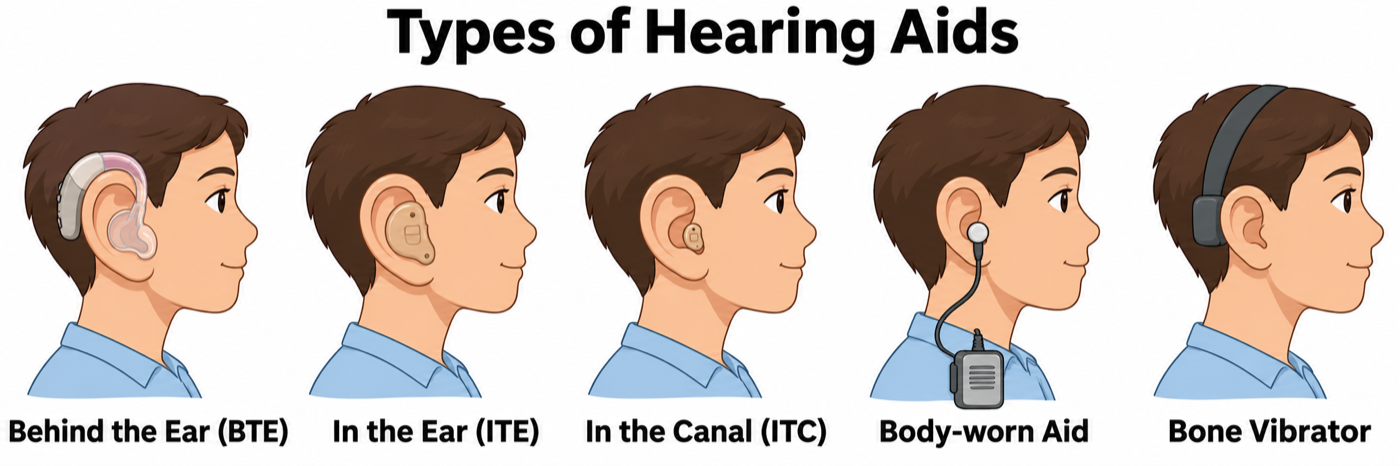
| Behind the Ear (BTE) | All parts are in a plastic case that sits behind the ear; joined by a clear plastic tube to an ear mould that fits inside the ear | Most used by children; for any degree of loss; easy to use with telephones and assistive listening devices |
| In the Ear (ITE) | Smaller than BTE; all parts in a case made to fit the ear | Not always a good choice for children, since it must be changed as the child grows |
| In the Canal (ITC) | Even smaller than ITE; sits partly in the ear canal, with its face showing in the outer ear (the even smaller CIC - Completely in the Canal - sits fully inside the canal) | Mainly for mild to moderate loss; not recommended for children because of its size and the child's growth |
| Body-worn aid | A rectangular box (microphone, amplifier, battery) in a pocket or waist pouch; a cord to a button receiver, which goes into the ear mould | Mostly people with severe to profound loss |
| Bone vibrator aid | The vibrator is placed on the mastoid bone behind the ear, held by a headband | Mainly people with conductive loss; those with a closed ear canal/small ear (who cannot wear ordinary aids) |
Other devices
- Bone Anchored Hearing Aid (BAHA): useful for those who cannot use ordinary devices and for those with deafness on one side. A small titanium screw (implant) is fixed by surgery in the skull bone behind the ear, and the sound processor attaches to it through an abutment; sounds reach the inner ear through the bone.
- CROS (Contralateral Routing of Sound): a device fitted with or without a wire; sound picked up by the microphone at one ear is sent to the other side. For some patients, BAHA is often preferred over CROS.
- Implantable middle ear device: for people with mild to severe sensorineural loss (and some with conductive or mixed loss) who cannot use ordinary hearing aids; mostly used in adults. Piezoelectric or electromagnetic transducers give vibration energy that moves the chain of middle ear bones; it has external and internal parts. These are very costly; low-cost devices are also being made.
Cochlear implant
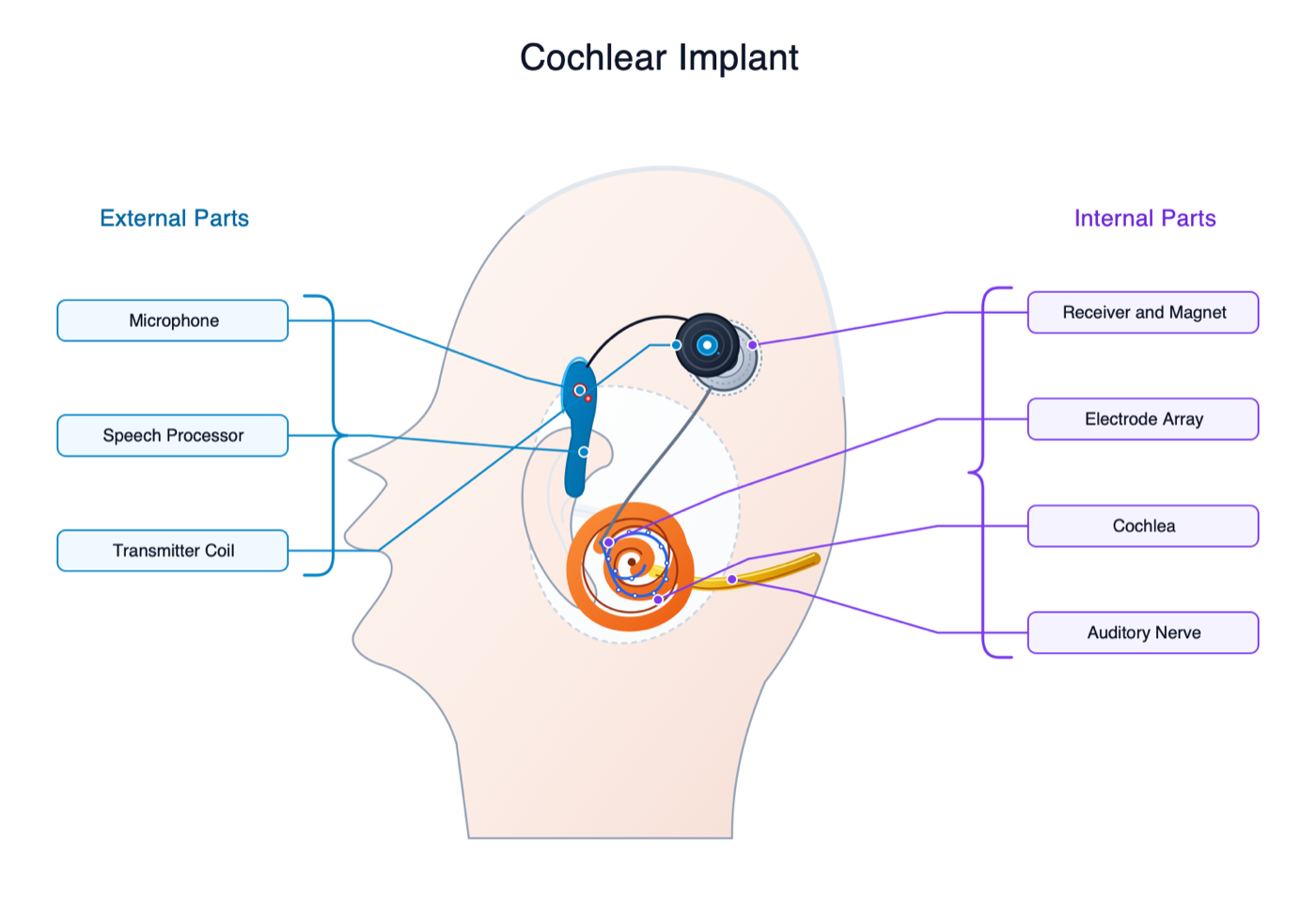
- It is not a hearing aid; it is a device placed inside the body that stimulates the auditory nerve directly with the help of electrodes inside the cochlea. It is a relatively new device.
- In normal hearing, sound energy from the outer ear is changed into nerve signals in the cochlea and reaches the brain through the auditory nerve. If the cochlea is badly damaged, this change does not happen; the implant bypasses the damaged part and stimulates the nerve directly.
- Internal parts (by surgery): the electrode array (into the cochlea), the receiver, and the magnet (in the bone behind the ear).
- External parts: the transmitter coil and microphone (both behind the ear) and the speech processor (in a pocket or waist pouch; in newer ones, behind the ear itself).
- How it works: the microphone picks up sound and changes it into electrical signals → the speech processor (speech coding) turns the signals into a suitable electrical pattern → the signal is passed from the processor to the internal parts → the electrodes stimulate the nerve fibres.
- Candidacy: people with severe to profound loss in both ears who get little or no benefit from hearing aids. Medical, psychological and educational status are also considered. Children can be implanted from about 9-12 months of age; the earlier the implant, the better the results.
- Before surgery, a CT scan and MRI of the ear structure and other hearing tests are done. Wide studies have been done on biocompatibility (materials the body accepts) and surgical safety. A hospital stay of 2-3 days after the operation is enough.
- Like any surgery it has some risks: infection, meningitis (so vaccination is given before surgery), injury to the facial nerve, dizziness and device failure. After the operation, long-term auditory training (often for years) is a must.
Group amplification devices (for the classroom)
Besides personal aids, these devices help with listening in class and in groups:
| Device | How it works | Strength | Limitation |
|---|---|---|---|
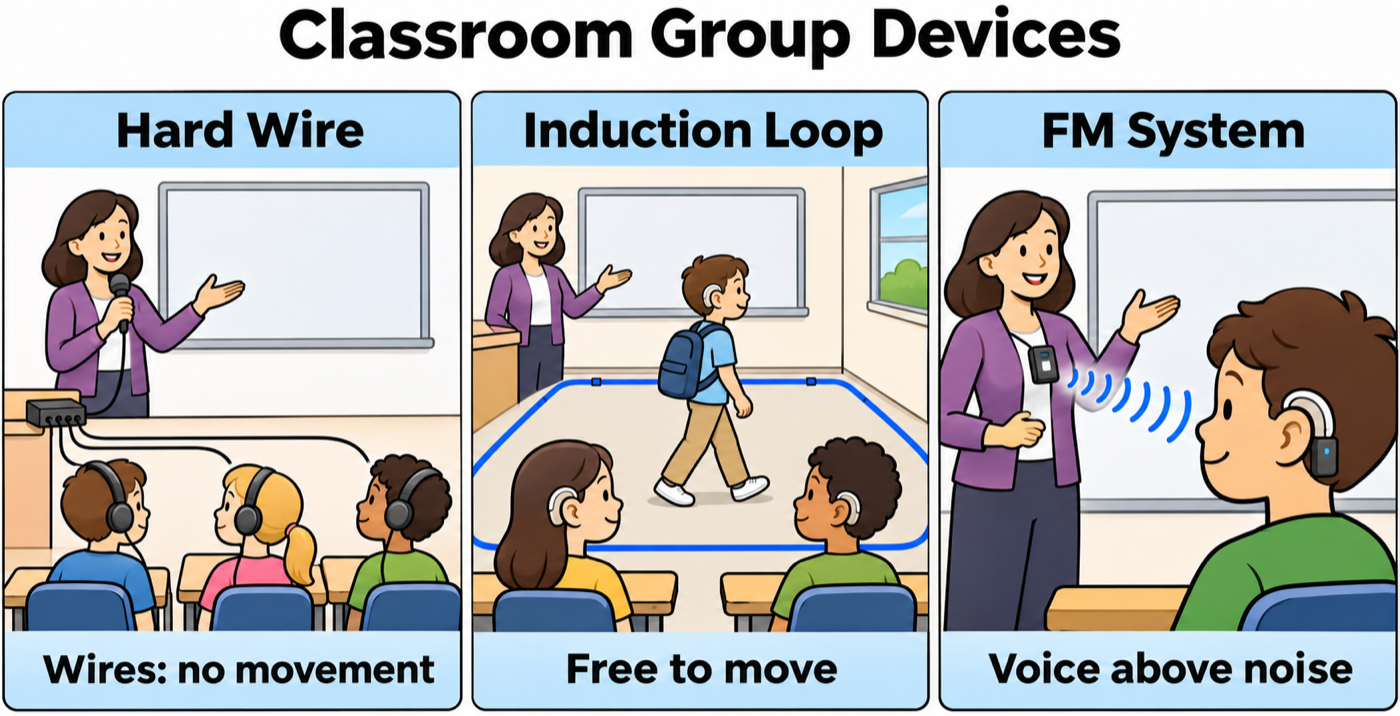
| Hard wire system | The teacher's microphone, the amplifier and each student's headphones are connected by wires | The very first group amplification system; high signal quality | Because of the wires, the teacher and students cannot move |
| Induction loop | A loop of wire around the classroom creates a magnetic field; the telecoil (T switch) in the student's aid picks it up | The teacher and student can move freely | The signal changes with the position in the room and the direction of the head (not uniform) |
| FM system (auditory trainers) | Two parts: a transmitter (with microphone) worn by the speaker and a receiver worn by the listener; the receiver passes the signal to the ear through the child's aid earpiece | Lifts the speaker's voice above the background noise (raises the signal-to-noise ratio); mainly in schools, also in other listening situations | The teacher must wear the microphone and switch it on and off at the right time; it can pick up interference and costs more (newer digital remote-microphone (DM) systems are replacing analogue FM) |
Previous papers questions asked in the exam on what you just read
Match classroom amplification devices with suitable statements. i) Hard Wire System – a) Permit mobility of teacher & student. ii) Induction Loop System – b) Excellent quality of Signal. c) First group amplification System developed. d) Inconsistency of the signal.
- (1)i-b, d ii-a, c
- (2)i-c, b ii-a, d
- (3)i-a, b ii-c, d
- (4)i-c, d ii-a, b
Answer & explanation
Correct answer: (2) i-c, b ii-a, d
We have to give two features to each of two group amplification systems used in classrooms for children with hearing impairment.
Hard wire system: the teacher's microphone, the amplifier and each child's headphones are connected by wires. It was the first group amplification system developed (c). Because the sound travels directly through wires, the signal quality is excellent (b). Its drawback is that the wires do not let the teacher or children move about.
Induction loop system: a loop of wire is laid around the room and creates a magnetic field, which is picked up by the telecoil (T-switch) of the child's hearing aid. Nobody is tied to wires, so teacher and student can move freely (a). But the signal strength changes with the child's position in the room and the direction of the head, so the signal is inconsistent (d). So i-c, b and ii-a, d, which is option (2).
Options (1) and (4) give 'inconsistent signal' to the hard wire system, which is a loop feature. Option (3) gives 'mobility' to the hard wire system, which is not possible with wires.
Remember: Hard wire: first, best quality, no mobility. Loop: mobility, uneven signal.
Exam focus: Children mostly use BTE; body aid for severe-profound loss; bone vibrator aid for conductive loss; ITC for mild-moderate. A hearing aid only makes sound louder; it does not make it clear. Wear it all day except while sleeping and bathing. A cochlear implant stimulates the auditory nerve directly; candidacy = severe-profound loss in both ears and no benefit from aids. FM = raises the signal-to-noise ratio. Hard wire = the first system, high quality; loop = movement, uneven signal.
Memory code: Parts of the aid "MARB" - Microphone → Amplifier → Receiver, with Battery power. Aid types "BTE for the Baby, Body for the severe, Bone for the conductive". "Wire = first, Loop = free to walk" - hard wire came first; with a loop you can move.