There are three rehabilitation methods that help people with hearing loss communicate: (1) human support - lip reading, sign language, communication support workers; (2) technical support - listening devices; (3) auditory training.
Deafness is called the "invisible disability" - it is not seen, not noticed and not discussed. These people face barriers in three places:
- In education: teachers, not knowing that the child did not hear the instructions properly, wrongly label these children "lazy" or "dull"; they get low marks.
- At work: it is hard to get a job; team meetings and answering the phone are difficult.
- Socially: others forget that hearing aids and implants are only aids; reminding them again and again causes fatigue, frustration and embarrassment; in the end they stay away from social events.
Lip reading vs speech reading
| Lip reading | Speech reading | |
|---|---|---|
| What is watched | Only the lips of the speaker | The lips along with the jaw, tongue, the whole facial expression and mouth movements |
| Nature | Understanding a spoken message through the visual medium | Like an art; this term is more widely accepted in the USA and Britain; the process is more accurate |
- Lip reading goes along with sign language; it is not a substitute for it but a support.
- People with natural ability, practice and confidence can become fairly skilled at lip reading. It can be learnt and used in everyday situations.
- Even ordinary hearing people look at the speaker's face when hearing is difficult. Other visual signals in the surroundings also help deaf children understand a message.
- Lip reading and listening strategies are a must for deaf students. Teachers should give due importance to speech reading, listening strategies and auditory training.
- Children with hearing loss understand by watching the teacher's lip movements. The mirror is a teaching tool often used in speech training - the child compares his lip movements with the teacher's. A candle flame is used to teach the sound "f" (the flame moves with the breath).
Previous papers questions asked in the exam on what you just read
These children can understand by observing teacher's lip movements in classroom.
- (1)Hearing Impairment
- (2)Low - vision
- (3)Visual Impairment
- (4)Autism
Answer & explanation
Correct answer: (1) Hearing Impairment
The question asks which children understand speech by watching the teacher's lip movements.
This skill is called lip reading or speech reading. Children with hearing impairment cannot hear speech clearly, so they watch the speaker's lips and facial expressions to understand. That is why the teacher should face them, keep light on the face, speak at a normal pace and not talk while facing the board.
So the answer is option (1), Hearing Impairment.
Children with low vision (2) or visual impairment (3) cannot see lip movements clearly; they learn through hearing and touch. Children with Autism (4) usually avoid looking at faces and eye contact, so lip reading is not their way of understanding.
Remember: Lip reading / speech reading → hearing impairment.
‘Mirror’ is used as a teaching learning aid for these children very often.
- (1)Intellectual Disability
- (2)Hemophilia
- (3)Parkinson's Disease
- (4)Hearing Impairment
Answer & explanation
Correct answer: (4) Hearing Impairment
The question asks for which children a mirror is used very often as a teaching aid.
In speech training for children with hearing impairment, the teacher and child sit in front of a mirror. The child watches how the teacher's lips, tongue and jaw move to produce a sound, and then watches their own mouth in the mirror while trying to copy it. A child who cannot hear their own voice well gets visual feedback from the mirror instead.
So the answer is option (4), Hearing Impairment.
A mirror may sometimes be used in self-care training for children with intellectual disability (1), but it is not their main aid. Hemophilia (2) is a blood disorder and Parkinson's disease (3) is a nervous system disease seen mostly in older adults; a mirror is not a teaching aid for them.
Remember: Mirror → speech training → hearing impairment.
Candle flame is used in speech therapy to train this sound
- (1)‘P’ Sound
- (2)‘B’ Sound
- (3)‘F’ Sound
- (4)‘M’ Sound
Answer & explanation
Correct answer: (3) ‘F’ Sound
The question asks which sound is trained in speech therapy with the help of a lit candle.
A child with hearing impairment cannot hear the sound, so the teacher makes the airflow visible. For 'F' the upper teeth touch the lower lip and air flows out steadily through the narrow gap (a fricative). A candle held in front of the mouth bends and stays bent with this continuous air stream, so the child can see whether the sound is being produced correctly.
As per the official key, the answer is option (3) 'F' Sound.
'P' (1) also releases a puff of air, and a paper strip or flame is sometimes used for it too, but the steady flow that a flame shows best is that of 'F'. For 'B' (2) the air puff is weak and the vocal cords vibrate; it is taught by feeling the throat. 'M' (4) is a nasal sound: the air comes out through the nose, so the flame in front of the mouth does not move.
Remember: F = steady air, flame bends; M = nasal, flame stays still.
Facts about speech reading
- Not all people with hearing loss are good lip readers. Lip reading skill has nothing to do with intelligence.
- Not everyone knows sign language; not everyone uses interpreters. Some prefer lip reading, others sign language.
- It is impossible for a child to lip-read a word he has never seen. If there is time, write the word down and show how it looks on the lips.
- A deaf person cannot lip-read and at the same time read or take notes. Give time to look at the handout, and speak only after his attention has come back to you.
- Students with hearing loss, like other students, differ from one another in communication skills.
- Possible barriers: no interpreters or people who know sign language; reduced awareness of auditory cues in conversation.
Human support workers
| Support worker | Role |
|---|---|
| Lip speaker | For those who do not use sign language and find it hard to read the teacher's lips. Repeats the speaker's words without voice; shows clearly the shape of words, the natural flow of speech, rhythm and stress; uses facial expressions, natural gestures and (if asked) finger spelling. Used by people who rely mainly on lip reading and have a good command of language |
| Interpreter | For those who prefer sign language (e.g. BSL) or Sign Supported English. Turns the teacher's speech into signs and voices the student's signs. An interpreter with subject knowledge is better |
| Communication support worker | Does interpreting, lip speaking, note-taking and voicing for the student, but has not yet reached the level of an interpreter (usually a Level 1/2 certificate in BSL) |
Tips while teaching and speaking
- Get the student's attention before speaking; face him while you speak.
- Speak clearly and naturally; slowing down a little helps. But do not speak artificially slowly, over-move your lips or shout - these spoil the natural rhythm of speech. Speaking fast or mumbling leaves no chance for speech reading.
- Do not put your hand or objects in front of your mouth.
- There should be enough light on your face. Do not stand with your back to windows or other light - light from behind makes it hard to read the lips and facial expressions.
- Use natural gestures and facial expressions as clues to meaning.
- Short sentences are easier to understand than long sentences with many clauses.
- If he does not understand, say it again; if he still does not understand, do not repeat the same words but use different words in a different order. Use pen and paper if needed; the goal is communication, not the method.
- If there is an interpreter, speak directly to the student, not to the interpreter; ask for interpreting in social conversations too.
- Use visual material such as handouts, key words, diagrams and written instructions. Write important new words on the board.
- Signal when the topic changes; check understanding and encourage questions; repeat questions that come from the class.
- In discussions, make a rule that people raise a hand before speaking - the deaf student then knows the speaker is changing. Only one person should speak at a time.
- If a video/DVD is used, the student cannot follow the soundtrack; give subtitles or a written transcript.
Previous papers questions asked in the exam on what you just read
The strategy to be followed by a teacher in an inclusive class room with children with hearing impairment.
- (1)Teach by walking around the class room.
- (2)By placing the students with hearing impairment at middle of the classroom.
- (3)Writing new words before going to discuss.
- (4)Teacher's facial expression should not modify.
Answer & explanation
Correct answer: (3) Writing new words before going to discuss.
The question asks which strategy a teacher should follow in an inclusive classroom that has children with hearing impairment.
Children with hearing impairment depend mostly on vision: speech reading, facial expressions and what is written on the board. If a new word is written on the board, the child can see it even if it was not heard clearly, and can follow the discussion. So new words should be written before they are discussed. The answer is option (3).
Walking around while teaching (1) hides the teacher's face and lips from the child. These children should sit in the front rows where they can see the teacher's face clearly (preferential seating), not in the middle (2). Natural, clear facial expressions help understanding, so keeping the face unchanged (4) is also wrong.
Remember: Hearing impairment: front seat, face visible, new words on the board.
Specific consideration of a teacher not to be followed while teaching English in an inclusive classroom
- (1)Use clear speech
- (2)Face the students when speaking
- (3)Make sure the group’s attention before the session
- (4)Not aware of learner’s language abilities
Answer & explanation
Correct answer: (4) Not aware of learner’s language abilities
The question asks which point a teacher should NOT follow while teaching English in an inclusive classroom. Notice the word ‘not’.
An inclusive classroom has children with different needs, such as hearing impairment or learning disabilities. The teacher must know each learner’s language abilities in order to plan and adapt teaching. Being unaware of them is poor practice. So option (4) ‘Not aware of learner’s language abilities’ is the one not to be followed.
Option (1) using clear speech, option (2) facing the students while speaking (children with hearing impairment need to see the teacher’s lips and face), and option (3) getting the group’s attention before starting are all good practices that a teacher should follow.
Remember: In a ‘not’ question, look for the bad practice.
Strategies to improve conversation (Field and Haggard, 1989)
Students with hearing loss have great difficulty in conversation; others do not understand them properly, and they get irritated. Besides ordinary and electronic methods, Field and Haggard (1989) divided conversation strategies into three kinds:
| Strategy | Examples |
|---|---|
| Social strategies | Asking others to speak slowly / loudly / clearly; asking them to look attentively first and to keep facing you while speaking; asking them not to shout; in a group, having a friend tell the topic and purpose beforehand; friends nearby explaining when something is not understood; showing understanding with gestures like a smile or a nod; telling others about the hearing problem and confirming |
| Physical strategies | Making sure light falls on the speaker's face; keeping the face unblocked; avoiding side noises; sitting near the sound box in cinema halls and parks; laying a thick carpet in the classroom to absorb sound (less echo and footstep noise); turning up the radio and TV a little; sitting on the side from which more sound comes |
| Observation strategies | Watching gestures and facial expressions; getting things said in whole, meaningful sentences; the speaker speaking according to the student's level of knowledge; speaking patiently, slowly and clearly |
More suggestions for conversation and the oral method
- To raise the language level of the deaf, talk with them as much as possible; talk whenever you work together.
- Make sure the hearing device is always used.
- Listen attentively when they speak and encourage them; encouraging them to speak on stage increases their wish and enthusiasm to speak well.
- Explain what you say with signs and aids.
- Do not speak with your back to the children, turned sideways, walking up and down, or while writing on the board.
- Encourage the children to learn together with one another.
- Speech can be corrected through suitable speech therapy, speech training and speech practice together. Teach them useful gestures and facial expressions, and create chances for them to learn new things.
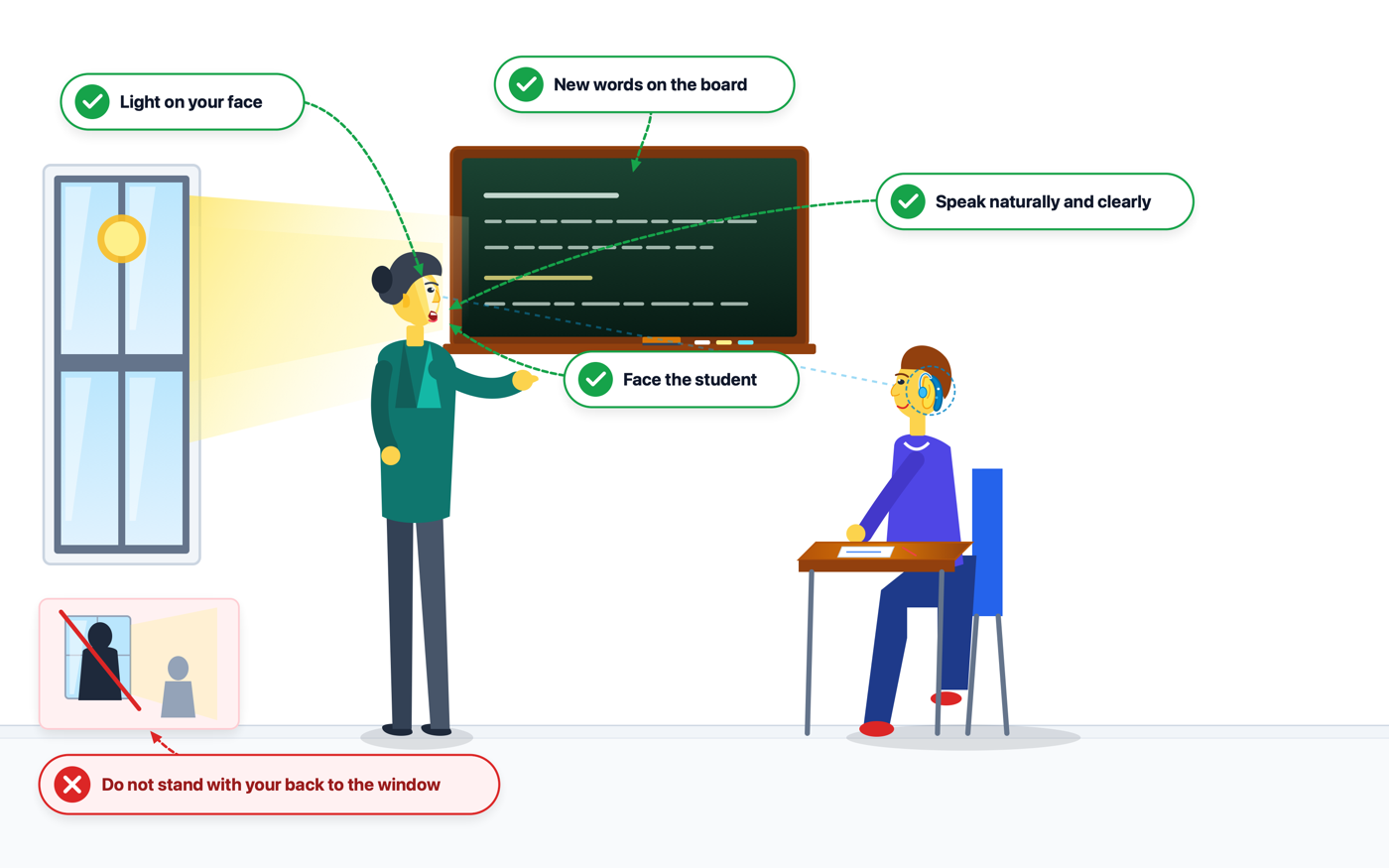
Exam focus: Lip reading = lips only; speech reading = lips + jaw + tongue + whole face. Lip reading has nothing to do with intelligence; a word never seen cannot be lip-read. Lip speaker = one who speaks without voice. Do not stand with your back to the window; write new words on the board before the discussion; even with an interpreter, speak to the student. Mirror - for speech training; candle - for the sound "f".
Memory code: Field-Haggard strategies "SPO" - Social, Physical, Observation ("SPOt the speaker"). Rehabilitation methods "HTA" - Human support, Technical support, Auditory training.