The hearing mechanism is most vital for the development of speech and language. Many kinds of sounds surround us; through experience we learn to pick out the important ones and respond. Hearing is the main sensory route for awareness of our surroundings.
Meaning and importance
- Auditory training is the process of building a child's listening ability so that he uses his residual hearing to hear and understand sounds and gradually gains speech and language skills.
- It has two main purposes: (a) perceiving various environmental sounds - to respond to sudden changes around him and protect his safety and well-being; (b) perceiving speech signals - to learn the rules of language, build speech skills and share ideas through oral communication.
- Auditory training is the first training to be given to make better use of residual hearing.
Previous papers questions asked in the exam on what you just read
This training should be given prior to improve residual hearing ability in Children with Hearing Impairment
- (1)Mobility training
- (2)Speech training
- (3)Auditory training
- (4)speech reading
Answer & explanation
Correct answer: (3) Auditory training
The question asks which training should come first to make the best use of the residual (remaining) hearing of children with hearing impairment.
Most children with hearing impairment still have some hearing left. To use it with a Hearing Aid, they need auditory training: learning to detect sound, discriminate between sounds, identify them and finally comprehend speech. This trains the brain to make sense of what the ear receives. So the answer is option (3) Auditory training.
Mobility training (1) belongs to Orientation and Mobility for the visually impaired. Speech training (2) teaches the child to produce sounds; it does not improve hearing and works better after auditory training. Speech reading (4) uses the eyes to read lip movements, not the residual hearing.
Remember: Residual hearing is developed through auditory training.
When to start?
As early as possible. It should start as soon as the routine audiometric assessment is complete. While the child wears hearing aids in both ears, the teacher/speech therapist gives speech stimuli.
Prerequisites
- A suitable hearing aid must be fitted.
- Suitable reinforcement must be given; the child and family members must cooperate.
- The child's response to various sounds and loudness levels must be watched carefully.
- The sounds the child can hear must be listed in a graded order, from easy to difficult.
- Activities and materials must be prepared in advance; they are usually available at home.
- It is better not to give training when the child is sleepy or busy with something else.
Conditioning
Conditioning is an important stage in auditory training. Visual and tactile cues are given to show the child where a sound comes from and how. One can begin with sounds such as rubbing the fingers or rattling marbles. Then, level by level:
- Introduce sounds one at a time and record the level at which the child responds.
- Vary the loudness of the sound and the distance between the sound and the child, and record the lowest loudness and the greatest distance he can detect.
- Have him tell how many times he heard the sound.
- Teach him to tell whether a sound is short or long - for example, a/aa, i/ee.
- Teach him to tell from which direction a sound comes (localisation).
- Teach him to hear numbers and words in the correct order and repeat them.
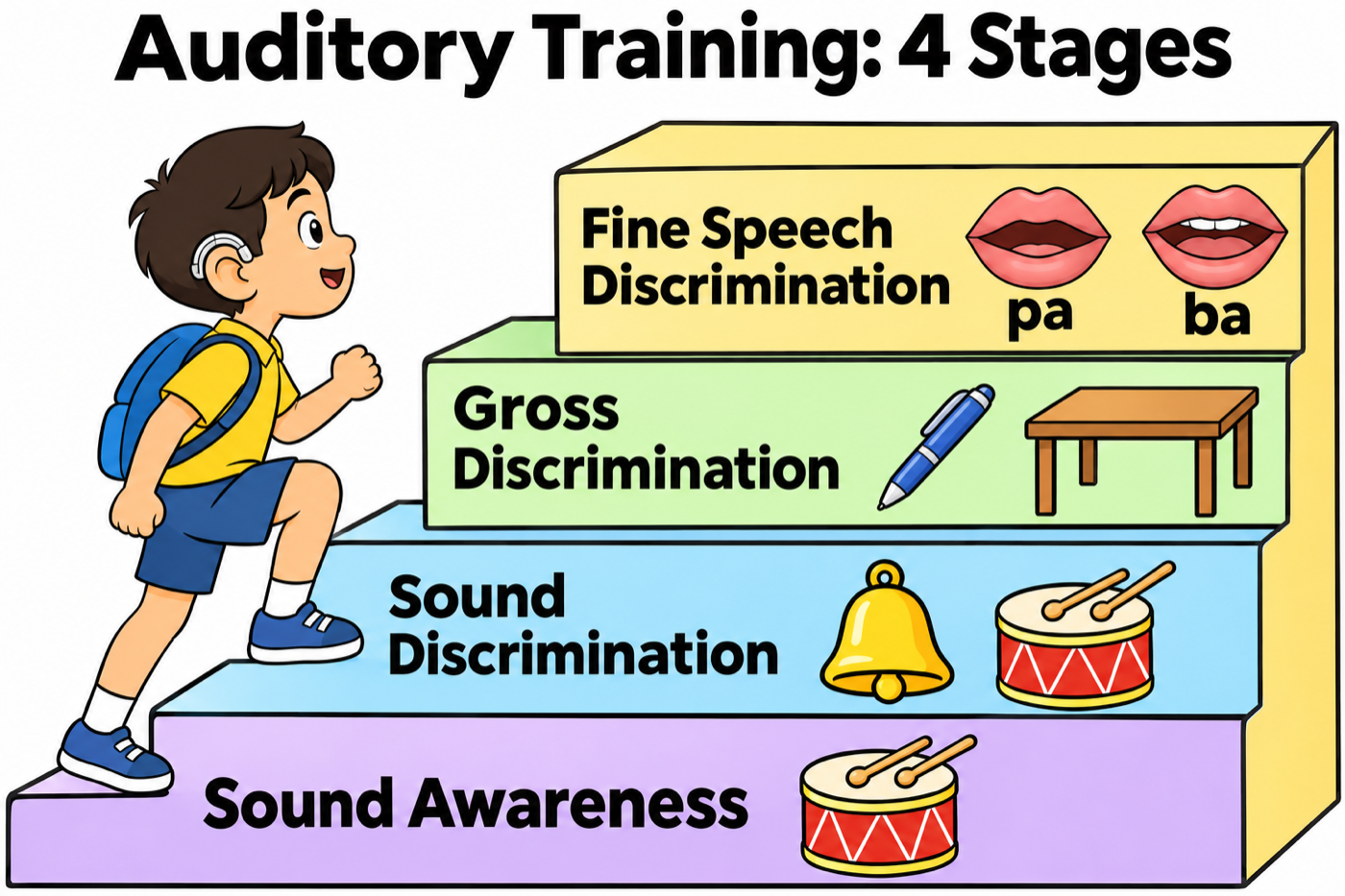
Auditory training: 4 stages
| Stage | What happens | Example |
|---|---|---|
| 1. Sound awareness training | Introducing sounds one at a time; the child should respond that a sound is present and where it comes from; adding a slightly louder sound each day to build attention. It also helps to estimate what kind of sounds, at what loudness and from what distance he can hear | Turning the head at a drum or bell |
| 2. Sound discrimination training | Using sound-makers such as bells, drums, horns and whistles to respond to the presence of a sound and to tell the difference between two or more sounds. Steps: playing two sounds again and again → responding consistently to both → auditory, visual and tactile cues during conditioning → care in giving the stimulus → encouragement at every step, 80-90% correct responses → gradually more sounds | Bell vs drum |
| 3. Gross discrimination of speech sounds | Once he can detect the presence of sound, telling the broad differences between very different sounds and between phrases close to daily experience | pa/ga, sa/la, pen/table |
| 4. Fine discrimination of speech sounds | The last stage. Telling the fine differences between similar vowels and consonants; putting together the growing vocabulary to understand connected speech quickly and accurately | pa/ba, ka/ga, pin/bin, tip/dip, ball/mall |
Previous papers questions asked in the exam on what you just read
According to Carhart Approach (1974), First and second stages of auditory training are
- (1)Awareness and development
- (2)Description and development
- (3)Awareness and discrimination
- (4)Awareness and comprehension
Answer & explanation
Correct answer: (3) Awareness and discrimination
The question asks for the first two stages of auditory training in Raymond Carhart's approach.
Auditory training teaches a child with hearing impairment to make full use of residual hearing. It always moves from easy to difficult: first noticing that a sound is present, then telling sounds apart, and finally understanding speech.
As per the official key, the answer is option (2) Description and development. We could not find a source that confirms these stage names, so the key's answer is given as it is. In option (4), comprehension is the last stage of auditory training, not the second.
Note: textbooks usually list Carhart's stages as awareness of sound, then gross discrimination, then finer discrimination. On that basis option (3) Awareness and discrimination looks correct.
The training to identify the difference between different vowels in hearing impaired children
- (1)Development of fine discrimination of speech
- (2)Development of discriminations among simple speech
- (3)Development of gross sound discrimination sounds
- (4)Development of awareness of sound
Answer & explanation
Correct answer: (2) Development of discriminations among simple speech
The question asks which stage of auditory training covers telling apart different vowels in hearing impaired children.
Auditory training follows a sequence: first awareness of sound (is there a sound or not?), then gross sound discrimination (telling apart very different non-speech sounds such as a drum and a bell), then discrimination among simple speech sounds, and last fine discrimination of speech (sounds and words that are very close to each other). Vowels such as /a/, /i/ and /u/ that are clearly different from each other are simple speech sounds, so distinguishing them belongs to the simple speech discrimination stage. So the answer is option (2).
Awareness of sound, option (4), and gross discrimination of non-speech sounds, option (3), come before speech sounds are used at all. Fine discrimination of speech, option (1), is the last stage, for very similar sounds such as two close consonants, not for clearly different vowels.
Remember: Awareness → gross sounds → simple speech → fine speech.
Other sequences of listening skills
- In the Carhart approach (Raymond Carhart) too, training moves in the order: awareness of sound, gross discrimination, discrimination between simple speech patterns, and fine discrimination in speech.
- Erber's (1982) hierarchy of auditory skills: (1) detection - is there a sound or not; (2) discrimination - are two sounds the same or different; (3) identification - naming or pointing to the sound; (4) comprehension - grasping the meaning of what is heard (the highest level).
Materials for auditory training
Drum, tabla, kanjira, whistle, rattle, bell, horn, telephone, a dog's bark, a cat's mew, a cow's moo, a cock's crow, birdsong, a moving train, a motor, a fire engine, a cycle bell, a calling bell, knocking on a door, laughing, crying, running, dancing, eating, clapping, a pressure cooker whistle, calling a name, mother's and father's voices, an aeroplane, TV, radio, computer - all kinds of natural and artificial sounds.
Exam focus: Auditory training = using residual hearing; starts as early as possible, after the audiometric assessment. 4 stages: awareness → sound discrimination → gross discrimination → fine discrimination. Telling apart similar vowels/consonants (pa/ba, pin/bin) = fine discrimination (the last stage). In discrimination training the target is 80-90% correct responses. Erber: detection → discrimination → identification → comprehension.
Memory code: Stages of auditory training "A-D-G-F" - Awareness, Discrimination, Gross, Fine ("big difference first, small difference last"). Erber "DDIC" - Detection, Discrimination, Identification, Comprehension.